Companies are ‘tokenmaxing’ in a big way, but not all these tokens are being deployed for useful purposes.
A chart circulated by ZeroHedge, citing data from Entelligence AI and UBS, breaks down where every dollar spent on AI tokens actually goes — and the numbers are striking. Of every $1 spent on AI tokens, $0.44 goes toward fixing bugs that the AI itself introduced. Another $0.27 is spent rewriting or reworking AI-generated code. A further $0.11 disappears into review friction, context switching, and merge overhead. That leaves just $0.18 — 18 cents on the dollar — as value that actually reaches end users in the form of shipped product.
The chart is titled “Breakdown of every US$1 spent on AI tokens” and the data is as of May 2026.
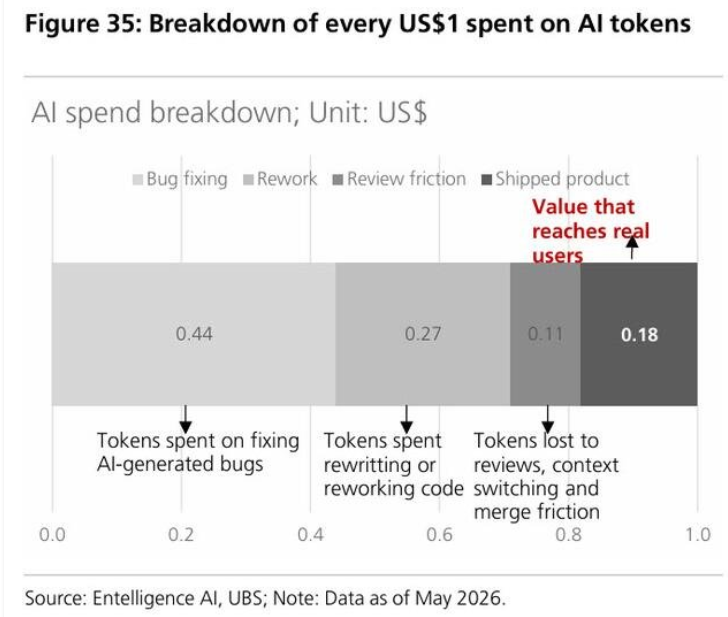
At face value, this looks like a damning indictment of AI-assisted development. Companies are spending aggressively on AI tooling, running up substantial token bills, and walking away with only a fraction of that spend translating into working software. The rest is being consumed by a cleanup cycle that the AI itself is generating.
This finding sits uncomfortably alongside the productivity narrative that has dominated the AI conversation in enterprise circles. Broadcom CEO Hock Tan recently claimed that a senior engineer with AI can now do in one week what ten engineers could do in three months. That figure gets cited a lot. What gets cited less often is the maintenance cost of the code being produced at that pace.
The bug-fixing number — 44% — doesn’t exist in isolation. Academic research has been circling this problem for a while. A study from Tilburg University found that while AI coding tools like GitHub Copilot do increase output, the productivity gains are concentrated among less experienced developers. The rework burden falls disproportionately on senior engineers, who were found to review 6.5% more code after Copilot’s introduction while their own original code productivity dropped by 19%. More volume, more review, less time for the work that actually moves things forward.
The issue with AI-generated code isn’t just that it sometimes has bugs — it’s the nature of those bugs. Logical errors that allow code to run while producing incorrect outputs, inconsistent patterns that make the codebase harder to maintain, and a tendency toward quick fixes rather than extensible design. A patch that passes today’s test suite can become expensive debt when the codebase needs to evolve. Most AI coding benchmarks evaluate correctness in a snapshot — they don’t measure what happens three iterations later when the original shortcut compounds.
There’s also the question of what the 27% rework figure actually represents. Rewriting or reworking AI-generated code isn’t just editing — it often means understanding code that a developer didn’t write and can’t immediately reason about, then rebuilding it in a way that’s actually maintainable. That’s a different kind of cognitive load than writing from scratch, and it’s one that scales poorly with team size and codebase complexity.
The 11% lost to review friction and context switching might be the most underappreciated line in the chart. Vibe coding has accelerated the volume of code being generated and submitted — that acceleration doesn’t just benefit shipping timelines, it also multiplies the review queue. More pull requests, more context switches, more handoffs. Every merge carries overhead, and when the volume of code going through that pipeline doubles or triples, the friction accumulates fast.
None of this is an argument that companies should slow down their AI adoption. The productivity gains are real enough that pulling back isn’t a serious option for any team trying to compete. But the 18-cent figure is worth sitting with. If the honest return on AI token spend is $0.18 of shipped value per dollar, then the question isn’t whether to use AI for development — it’s how to get that number up. Better prompting practices, tighter code review pipelines, and more deliberate use of AI for well-scoped tasks rather than open-ended generation are all part of that answer.
The companies that figure out how to close that gap will have a real edge. Right now, most of the industry is focused on how fast AI can write code. The more interesting question is how much of what it writes actually works.