Seven months ago, Jensen Huang threw down a gauntlet. Google and Amazon could talk all they wanted about the cost advantages of their custom AI chips, but neither, he said, would test them against NVIDIA on an open, independent benchmark.
“Dylan’s InferenceMAX is sitting out there for everybody to use, and not one… TPU won’t come, Trainium won’t come,” Huang said on the Dwarkesh Podcast in April. “I encourage them to use InferenceMAX and demonstrate their incredible inference cost.”
They’ve now taken him up on it.
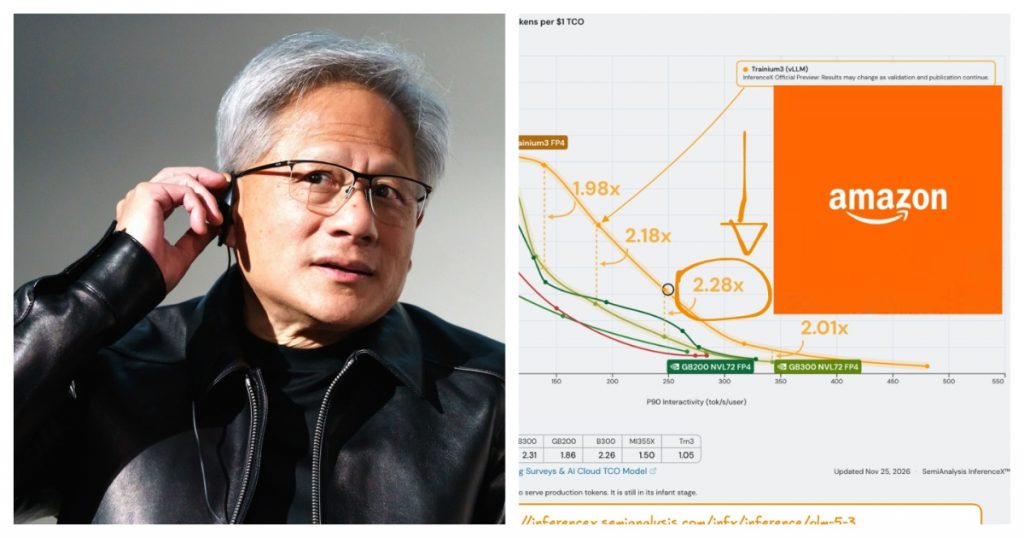
SemiAnalysis, the research firm founded by Dylan Patel, has announced that both Google’s TPU and Amazon’s Trainium are now on InferenceX and its agentic counterpart AgentX, the benchmarking platform that grew out of InferenceMAX. According to the firm, Trainium and TPU deliver anywhere from 1.2x to 2.5x the performance per dollar of NVIDIA’s GPUs.
Trainium3 Posts A 2.28x Lead Over GB300
The headline result is Amazon’s. In its first-ever AgentX submission, a Trainium3 UltraServer delivered up to 2.28x better performance per dollar than NVIDIA’s GB300 NVL72 and B300 and AMD’s MI355X. SemiAnalysis credited the result to Amazon’s wide expert-parallelism (EP) approach for serving external customers.
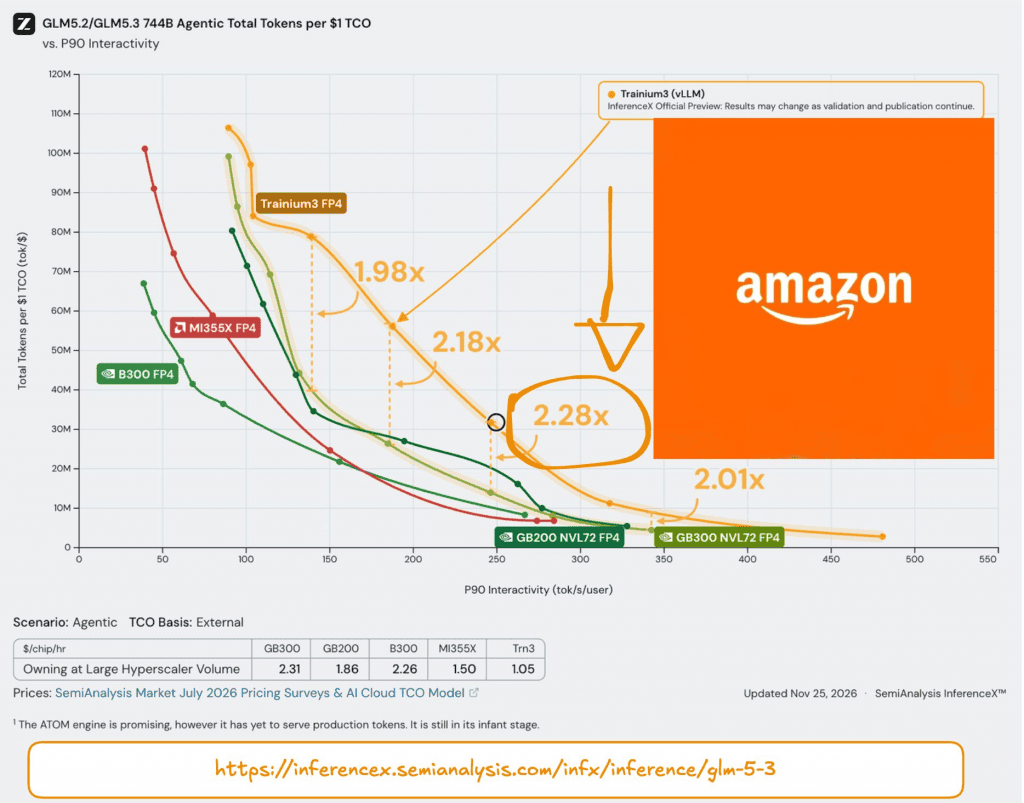
The test ran Z.ai’s 744-billion-parameter GLM-5.2/GLM-5.3 model on vLLM in FP4 precision, plotting total tokens generated per dollar of total cost of ownership (TCO) against P90 interactivity — roughly, how fast the slowest 10% of users see tokens arrive. Trainium3 led across the curve: about 1.98x better at around 140 tokens per second per user, 2.18x at around 190, a peak of 2.28x at around 250, and 2.01x at around 350. Its curve also stretches past 450 tokens per second per user, further than any NVIDIA or AMD system tested.
Cost is a big part of the story. SemiAnalysis’s estimates for the hourly cost of owning each chip at hyperscaler volume:
| Chip | Cost per chip per hour |
|---|---|
| NVIDIA GB300 | $2.31 |
| NVIDIA B300 | $2.26 |
| NVIDIA GB200 | $1.86 |
| AMD MI355X | $1.50 |
| AWS Trainium3 | $1.05 |
At less than half the hourly cost of NVIDIA’s flagship, Trainium3 doesn’t need to match it chip-for-chip on raw speed to win on economics. SemiAnalysis has labelled the Trainium3 numbers an “official preview” that may change as validation continues.
Google Got There First
Google’s TPU had already been making waves on the platform. A few weeks ago, TPUv7 beat NVIDIA’s GB300 NVL72 on performance per dollar across most of the curve in its first AgentX submission. Before that, SemiAnalysis reported that Ironwood achieved up to 50% better performance per dollar than Blackwell Ultra, and optimised megakernels pushed TPU v7 56% ahead of GB200 on Moonshot’s Kimi K3. Google has also been open-sourcing parts of its TPU inference stack to make the chips easier to use outside its own walls.
Why An Agentic Benchmark Matters
AgentX is built around how AI is increasingly used: not one-off chatbot questions, but agents running long, multi-step tasks. SemiAnalysis says it captures four features of these workloads:
- Multi-turn sessions: tens or hundreds of user–assistant exchanges, versus a handful in a chatbot conversation.
- Long context: system prompts, tool definitions and many turns make context pile up quickly.
- High prefix reuse: each turn’s output is appended to the next turn’s input, rewarding efficient caching.
- Sub-agent bursts: sessions spin up short-lived sub-agents with fresh context, creating bursty demands on the KV cache.
These are the workloads behind coding agents and autonomous assistants, which now account for a growing share of tokens served. A chip that is cheap on short prompts but struggles as contexts balloon would look very different here than on a simple throughput test. According to SemiAnalysis, Trainium3 has shown it can handle these agentic workloads successfully.
Anthropic Is The Proof Point
SemiAnalysis said the results would come as no surprise to existing Trainium3 customers like Anthropic, which has deployed Trainium at massive scale for Claude’s production inference and other workloads.
Anthropic has been one of the industry’s most aggressive multi-chip buyers. Alongside Trainium, it has committed to up to a million Google TPUs and added AMD as a fourth supplier. Amazon’s Trainium-filled Project Rainier campus in Indiana, built largely for Anthropic, is now the world’s second-biggest datacenter by compute. And OpenAI has committed to around two gigawatts of Trainium capacity as part of its expanded AWS deal.
Every Major Chip, On One Leaderboard
SemiAnalysis says AgentX is the first industry-standard LLM inference benchmark to feature Trainium, TPU, NVIDIA and AMD GPUs, and OpenAI’s custom Jalapeño ASIC, with Huawei’s chips and Alibaba’s PPU coming soon. It says the benchmark is backed by nearly every major compute buyer, including Microsoft Azure, Amazon, Google, Oracle and Meta, by open-source projects such as vLLM, LMCache, SGLang, PyTorch and Hugging Face, and by labs including OpenAI, MiniMax, Z.ai, Qwen and Moonshot.
That breadth makes the results hard to wave away. NVIDIA’s dominance has long rested partly on the argument that custom chips only look good on vendors’ own slides. Huang’s April challenge was a version of that: if TPU and Trainium were really cheaper, prove it in public.
What It Means For NVIDIA
None of this means NVIDIA is about to be displaced. Its GPUs still dominate training, CUDA remains a powerful lock-in, and performance-per-dollar figures depend heavily on cost assumptions. The $1.05-per-hour Trainium3 figure is SemiAnalysis’s estimate of what a hyperscaler pays to own the chip at volume; outside customers renting one may pay quite differently.
But the direction is clear. On the very benchmark Huang pointed to, the two custom-silicon programmes he dismissed are showing up and winning on cost. Patel recently argued that Google and AMD could eat into NVIDIA’s market share during Huang’s absence, saying SemiAnalysis’s nightly TPU benchmarks show them to be “just as good as Nvidia.” Now back in charge, Huang faces a challenge of his own: Google and Amazon took his advice, published their inference costs, and came out ahead.