A year is a long time in AI, and OpenAI is showing it at a top coding contest.
At the AtCoder World Tour Finals Heuristic 2026, the same event where OpenAI narrowly lost to a human coder last summer, the company’s model has run away with first place by a margin that isn’t close.
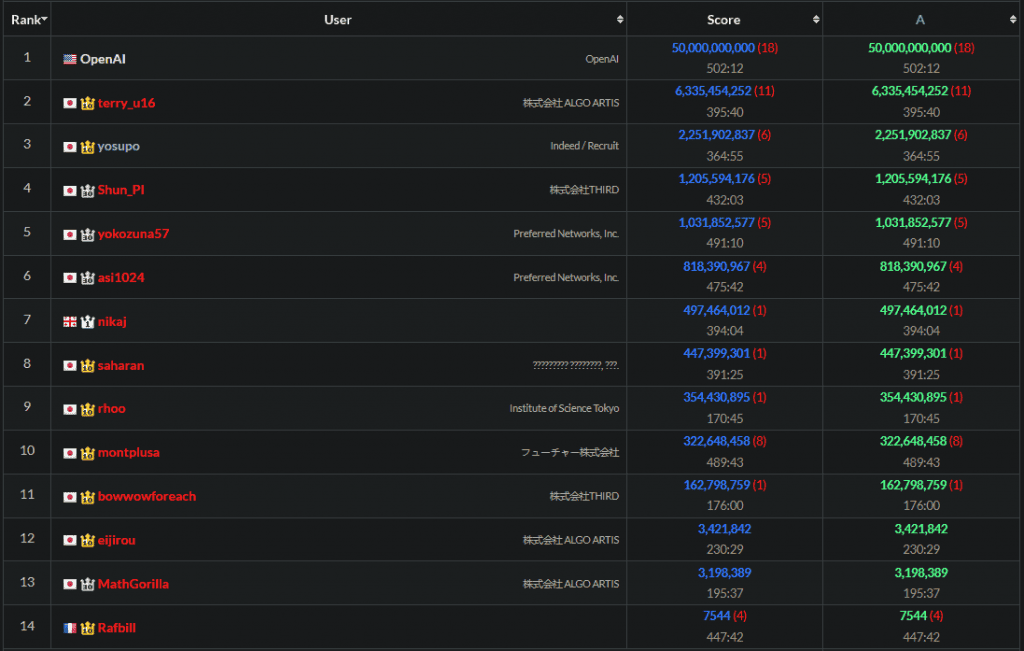
The final standings tell the story on their own. OpenAI currently has a score of roughly 50 billion points. At second-place, a Japanese competitor going by terry_u16 representing ALGO ARTIS, ended up with around 6.3 billion. Every other name on the leaderboard, including well-known competitive programmers like yosupo and Shun_PI, was even further back. It’s not a photo finish this time. It’s a rout.
The clearest account of how the contest actually unfolded came from Psyho, the human coder who beat OpenAI’s model in 2025 by less than an hour of work and later described himself as “completely exhausted” after pulling it off. This year, Psyho wasn’t competing in the heuristic finals himself, but he live-posted his read on the contest on X throughout, and his running commentary is worth walking through.
Before the contest even started, Psyho published a long breakdown of why he thought OpenAI’s win wasn’t guaranteed, despite the model having taken second place in 2025 and OpenAI having also delivered a gold-medal showing at the International Mathematical Olympiad and cleared every problem at the ICPC. His argument centered on a specific weakness: heuristic optimization problems reward continual learning and iterative refinement over raw speed, and he pointed out that AI agents tend to get “stuck in local minima” and are “surprisingly bad at code optimization.” His pre-contest estimate gave humans something like a 20-25% chance of winning.
He also raised a pointed question about motive. Why would OpenAI even enter again in 2026, after already having a strong 2025 showing across IMO, ICPC, and AtCoder? His answer was that a repeat runner-up finish would be “a huge narrative violation,” so he assumed the company would show up with a considerably stronger setup this time, backed by heavy parallelization and effectively unlimited inference.
That prediction held up. Three and a half hours into the two-day contest, Psyho noted that OpenAI already had a commanding lead and that the problem itself looked complex enough that humans would need real time to develop competitive solutions. Then came a wrinkle: at one point OpenAI’s system briefly submitted a solution that timed out across all test cases, dropping it to last place. Psyho was quick to remind followers that only the final submission counts, and the stumble turned out to be temporary.
By the 7.5-hour mark, OpenAI no longer held the top score on every one of the 50 test cases, something Psyho said he hadn’t expected to see that early. He described the model as still making constant submissions and clearly exploring multiple approaches in parallel, while terry_u16 built the strongest lead among the human field. An hour later, Psyho posted that the mood had swung back toward “feeling hopeless,” after OpenAI made its first big jump in a while.
Psyho also used the moment to reflect on what it’s like to compete against a visible AI benchmark on the leaderboard in real time. He argued that watching a far superior score sitting at the top can actually work against human competitors, tempting them to abandon a reasonably good solution in search of some best possible approach that may not even exist, only to run out of time to implement anything at all. His advice, echoing his own competitive instinct from years of these contests, was that it’s usually better to commit to something promising early and spend the remaining hours squeezing performance out of it.
None of that hedging mattered much once the final scores were tallied. OpenAI’s roughly 50 billion score wasn’t just ahead of the field, it was nearly eight times larger than the next best result. For a company that spent last year’s contest being edged out in the final stretch, and that has spent the months since claiming a gold-medal performance at the International Olympiad in Informatics, this year’s AtCoder finals look less like a coin flip and more like a statement.
Whether that gap says more about how far OpenAI’s models have come in twelve months, or about how much easier it is to dominate a contest when you can throw effectively unlimited compute at it, is likely to be debated for a while. Either way, the humans who show up to these events next year will be doing so with a much clearer picture of what they’re up against.