New data from SimilarWeb puts a number on something the developer community has been watching since early 2025: the rise of agentic coding tools has triggered a significant jump in app releases. iOS and Android app launches are up roughly 50% year-over-year, with the inflection point tracking almost exactly to when tools capable of building and shipping full applications with minimal human intervention became widely available.
The chart tells the story clearly. From mid-2022 through early 2025, global app release growth was in decline — falling to around -35% year-over-year at its worst in early 2024. Beginning around March 2025, the trend reversed sharply and has stayed elevated since, with growth peaking near 55% YoY in early 2026.
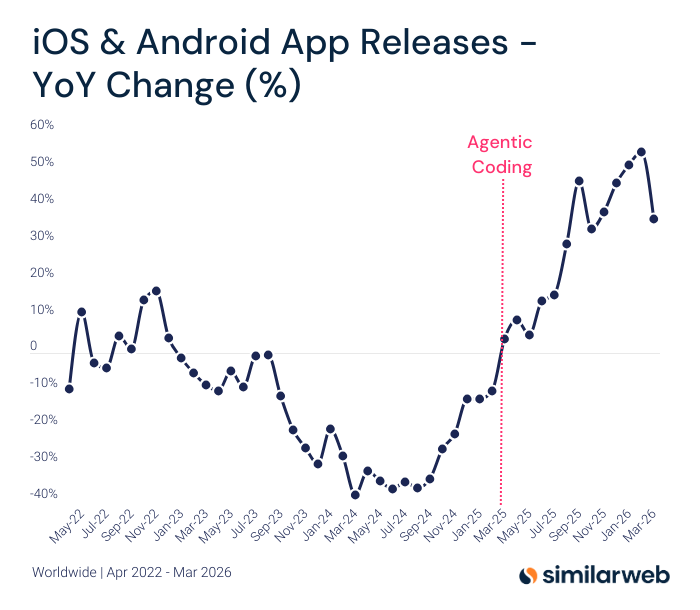
What changed around that period was the maturation of agentic coding — tools that don’t just autocomplete code but take high-level instructions, handle implementation, debug errors, and produce working software with far less developer involvement than before. The barrier to shipping an app dropped substantially.
The supply side of the app economy has responded accordingly.
What hasn’t followed is user adoption. SimilarWeb’s download distribution data for Android apps released since February 2025 reveals a stark pattern: 75.2% of newly launched apps have failed to accumulate even 1,000 cumulative downloads. Only 2.7% crossed the 100,000-download threshold. The middle of the distribution — 1K to 100K downloads — accounts for just over 22% of releases.
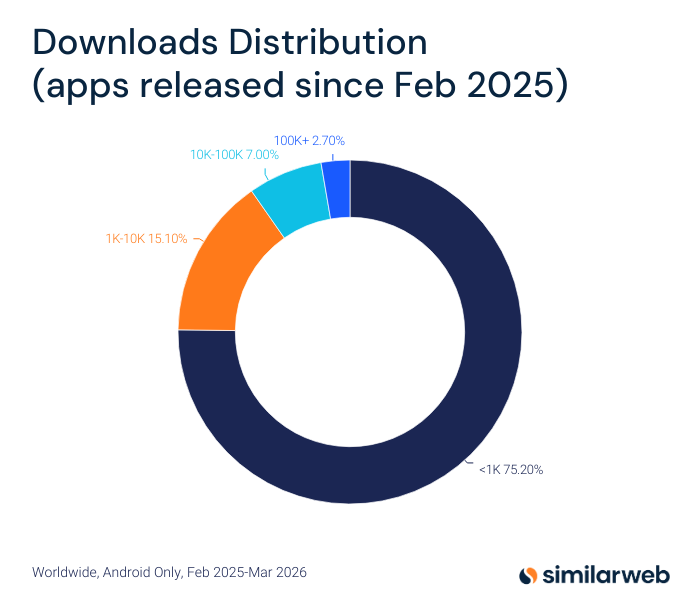
This isn’t a new dynamic in app stores, where most releases have always struggled for visibility. What’s new is the sheer volume of low-traction apps entering the market simultaneously. When AI tools make it faster to build and ship, the number of products competing for the same finite pool of user attention grows — without anything changing on the demand side.
George Hotz made a related point recently when he argued that AI coding agents were ushering in “a golden era for buckets and buckets of slop.” His concern was about code quality; the SimilarWeb data suggests user reception is another dimension of the same problem. More apps are being built and shipped, but building and shipping has never been the hard part — getting people to actually use something and keep using it is.
The 50% increase in app releases is a real measure of how much agentic coding tools have changed the economics of software creation. What the download distribution data shows is that discoverability, product-market fit, and user retention remain just as difficult as they were before AI entered the picture — possibly more so, given how much noisier the app stores are becoming.
For founders and developers using these tools to move faster, the SimilarWeb numbers are a reminder that speed to launch and traction are separate problems.