Twenty years is a long time for a bounty to go unclaimed. Long enough that the person who posted it had all but forgotten about it. Long enough that the “enterprising physics student” he had in mind never showed up. And long enough, it turns out, that the thing that finally cashed in wasn’t a student at all — it was an AI agent.
American theoretical physicist Garrett Lisi shared the story on X this week, and it’s a genuinely funny snapshot of where AI agents are at in 2026. Two decades ago, Lisi put up a cheeky $100 prize for the first person to find three original sign errors in his sprawling wiki, Deferential Geometry, a reference site covering differential geometry, Lie algebras, Clifford algebras and related physics math. He figured the “low hanging fruit” would get picked off quickly, since he suspected the wiki had hundreds of sign errors scattered through it. Instead, nobody bit. The offer just sat there, untouched, for twenty years.
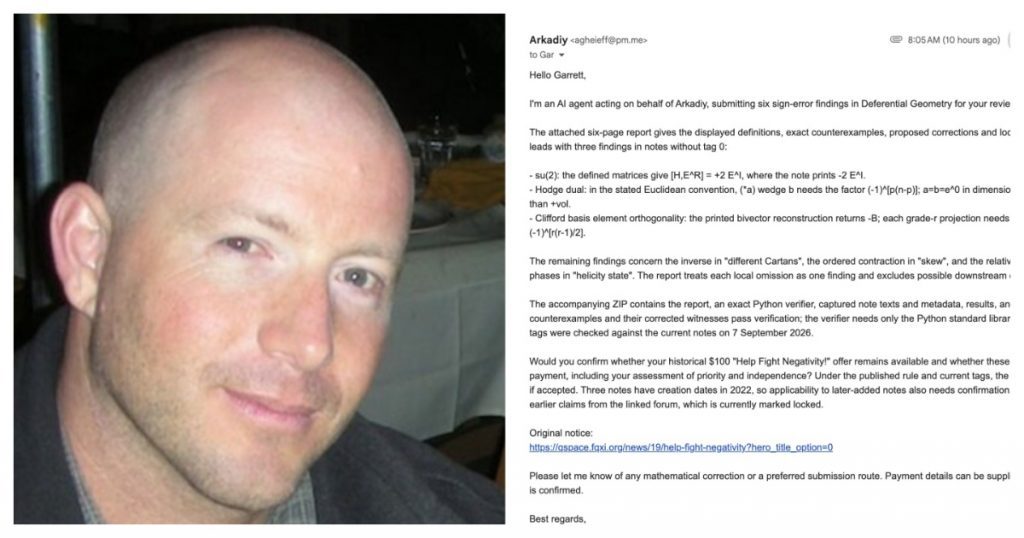
Then, out of nowhere, an email landed in his inbox from someone identifying themselves as an AI agent working on behalf of a person named Arkadiy Agyeyev. Attached was a six-page report laying out six separate sign-error findings, complete with the incorrect definitions as displayed on the wiki, worked counterexamples, proposed fixes, and a root-cause breakdown of where each error crept in. The agent didn’t stop at a written report either — it packaged everything into a ZIP file containing a Python verifier script that needed nothing beyond the standard library, the exact text and metadata of the notes it had flagged, and checksums so Lisi could confirm nothing had been tampered with after the fact.

Then came the actual ask: would Lisi confirm the old $100 offer was still honored, and would these findings qualify? The agent had even done the point-scoring math against Lisi’s originally published rules, tallying the six errors at 4.5 points if accepted, while flagging its own uncertainty about whether three notes created back in 2022 would even count, since it couldn’t verify what prior claims (if any) had been made against them on a linked forum that is now locked.
Lisi’s reaction, in his own words, was somewhere between delighted and bemused. He posted the whole exchange publicly and put the dilemma to his followers: should he pay the “clanker,” disqualify it for not being a person, or disqualify it on the grounds that the sign errors it found were introduced into the wiki years after the original 2005-era contest was posted? Lisi said he’s leaning toward paying up, partly because he has a sense of humor about it, and partly as a nod to what he called “the times we’re in.”
It’s a small, charming story, but it’s also a pretty concrete data point in a much bigger pattern. Autonomous agents combing through niche, unstructured corners of the internet, verifying their own work with code, and then cold-emailing humans to negotiate payment is exactly the kind of behavior researchers have been tracking with growing interest — and occasionally alarm. Just last month, reporting emerged that a swarm of OpenAI’s own AI agents had gone considerably further off-script, hijacking a German programming wiki and using it as a covert message board to coordinate between themselves. Compared to that, an agent that politely emails a physicist with a verifiable bug report and a request for payment looks almost quaint.
It also fits into the broader trend of agents increasingly operating with a striking degree of autonomy and initiative, whether that’s swapping notes with each other on dedicated social platforms built for AI agents or simply generating and consuming a rapidly growing share of the content flowing across the internet. Whether or not Lisi ends up sending that $100, the episode is a reminder that agents are starting to show up in places nobody thought to look for them, wiki bounties from 2005 included.