Just as many companies are laying off thousands of employees citing AI productivity gains, demand for office spaces seems to be simultaneously falling.
According to data from JPMAM’s Guide to Alts shared by a16z, office vacancy rates in the US have climbed to 14.2% in Q1 2026 — the highest they’ve been since the Global Financial Crisis. For context, the long-run average sits at 12.2%. The gap between where we are and where things have historically settled tells you something about how structurally different this period is.
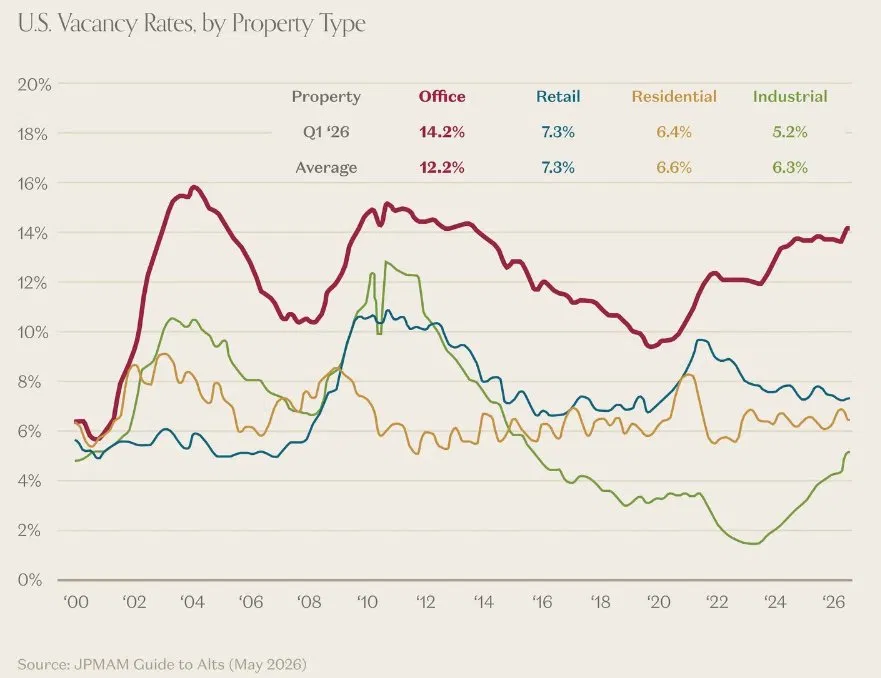
What makes this moment unusual is that the vacancy rate started climbing again after appearing to plateau over the previous couple of years. The causes aren’t mysterious. Remote and hybrid work arrangements have reached a kind of equilibrium — they’re not spreading further, but they’re also not retreating. The pandemic reset workplace norms at a higher baseline of flexibility, and most companies have accepted that as permanent. On top of that, overall employee headcount isn’t growing meaningfully across the economy. S&P 500 companies shed roughly 400,000 workers in 2025, ending eight consecutive years of headcount growth — the first such decline since 2016. Fewer employees means fewer desks, fewer floors, fewer leases.
The AI-driven restructuring narrative looms large here too. Cloudflare cut over 1,100 employees despite record revenue. Upwork laid off 25% of its workforce citing leaner AI-powered teams. Block eliminated 40% of its staff, with Jack Dorsey directly naming AI as the rationale. These aren’t isolated events — they reflect a broader corporate philosophy that smaller, flatter organizations can do the same work with less headcount. Fewer people means less office space needed, full stop.
The result is a market that’s broken into a clear split between winners and losers. Newer, well-located office buildings with modern amenities are doing reasonably well — vacancy in Class A space has actually started to decline. Older stock is a different story entirely. Tenants who are renewing leases are increasingly using the opportunity to upgrade, not simply roll over. That accelerates the hollowing out of second-tier properties that were already struggling. Some of that space is getting converted or demolished, but conversion economics are challenging, and the pace of removal is slow relative to the scale of the problem.
The other property types tracked by JPMAM paint a sharper contrast. Industrial vacancy sits at 5.2% against a long-run average of 6.3% — below average, driven by e-commerce infrastructure and supply chain reshoring. Residential vacancy is at 6.4%, also below its historical norm. Retail, which was written off by many analysts years ago, is tracking at exactly its long-run average of 7.3%. Office is the outlier — the one category where the structural headwinds from changing work patterns are most visible in the data.
What’s notable is that even a meaningful return-to-office push across large employers hasn’t moved the needle much. Many companies now mandate three or four days in the office, and attendance has risen from its pandemic lows — but the footprint decisions, lease expirations, and downsizing that happened between 2020 and 2024 are locked in for years. Commercial leases don’t reset quickly. The market is absorbing the consequences of decisions that were made when the future of office work felt maximally uncertain, and those consequences will keep rippling through for some time.
For older properties in secondary locations, the math gets harder each quarter. And with corporate headcount unlikely to surge in an environment where companies are actively competing to demonstrate how much they can do with AI and smaller teams, a meaningful demand recovery for the broader office market remains distant.