AI hasn’t quite disrupted search — Google’s search numbers seem to only be growing three years after AI went mainstream — but it could’ve impacted one of the most popular websites in the world.
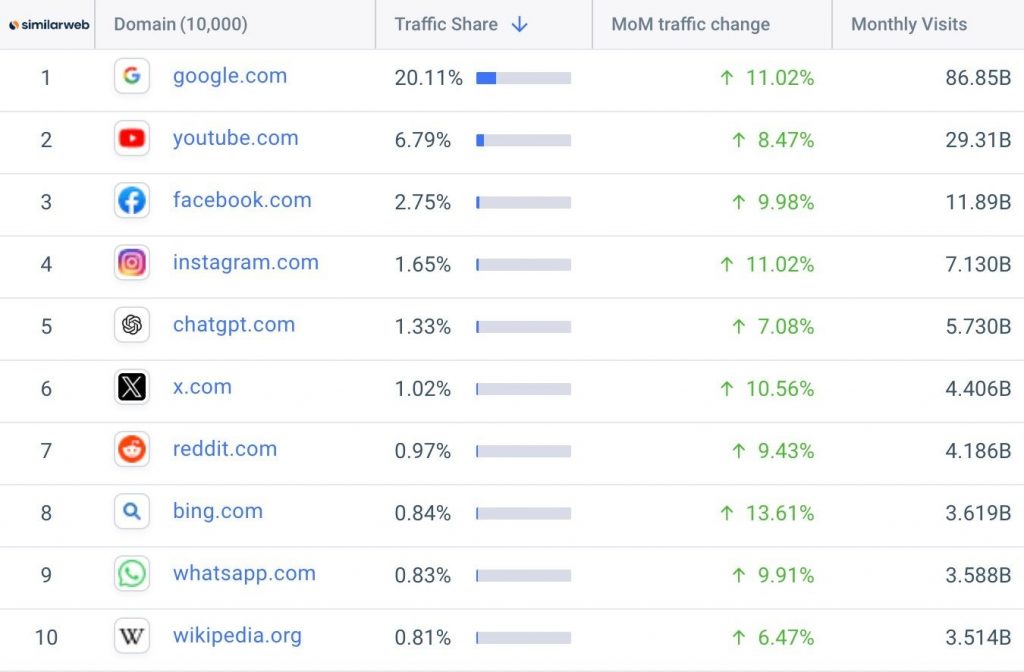
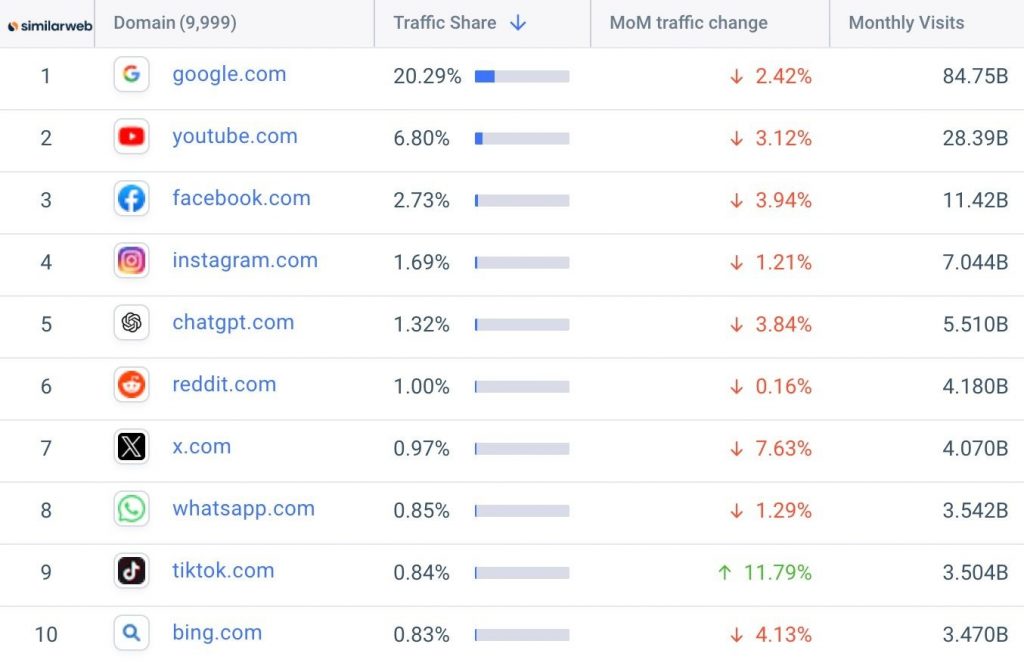
According to SimilarWeb data, Wikipedia dropped out of the global top 10 websites by traffic between March and April 2026. In March, it sat at #10 with 3.504B monthly visits — just barely clinging to the list. By April, it was gone entirely, replaced by a top 10 dominated by Google, YouTube, Facebook, Instagram, ChatGPT, X, Reddit, Bing, and WhatsApp. For a site that spent years as a permanent fixture in the global top 10, getting bumped off the list signals something structural, not seasonal.
The LLM Effect
The most obvious culprit is AI. For most of its existence, Wikipedia served a simple function: it was where you went when you wanted a quick, reasonably reliable answer about something. Who is this person? What is this event? How does this process work? That use case has now been almost entirely absorbed by large language models. ChatGPT, Gemini, Grok, Claude — they all synthesize information on demand, in conversational language, without the user ever having to click through to a reference page. Wikipedia was the internet’s reference page. LLMs have made reference pages feel unnecessary.
It’s a quiet kind of disruption. Wikipedia isn’t being replaced by a better encyclopedia. It’s being replaced by a paradigm where people don’t open encyclopedias at all anymore — they just ask.
The Bias Problem
AI is only part of the story. Wikipedia has been hemorrhaging credibility for years among a significant slice of its user base — specifically, those who feel the platform’s editorial culture skews sharply left.
Wikipedia’s co-founder Larry Sanger has himself turned into one of the site’s most vocal critics, saying it has become a propaganda vehicle for left-leaning establishment viewpoints. His argument: when only one version of the facts is permitted, it creates a powerful incentive for ideologically motivated editors to seize control of the platform — and that’s exactly what has happened.
David Sacks, the US crypto and AI czar, put it bluntly: “Wikipedia is hopelessly biased. An army of left-wing activists maintain the bios and fight reasonable corrections.” This isn’t a fringe view anymore. It’s a sentiment that has driven a meaningful portion of Wikipedia’s traditional audience to look elsewhere.
Enter Grokipedia
Elon Musk has been taking shots at Wikipedia for years — at one point offering to donate a billion dollars to the organization if it changed its name to “Dickipedia.” Now he’s done something more consequential: he’s built a competitor.
xAI has launched Grokipedia, a fully open-source, AI-generated encyclopedia that explicitly positions itself as the unbiased alternative to Wikipedia. Musk’s stated goal: “The truth, the whole truth and nothing but the truth.” Grokipedia already has over 800,000 articles and presents multiple perspectives on contested topics — a direct contrast to Wikipedia’s editorial monoculture. For users who had grown disillusioned with Wikipedia’s slant, Grokipedia offers a credible off-ramp.
It’s worth noting the irony: Grok was almost certainly trained on Wikipedia, meaning Grokipedia may carry some of the same embedded biases it’s trying to correct. But even an imperfect alternative is enough to peel away users who were already looking for a reason to leave.
Google’s Resilience, Wikipedia’s Vulnerability
The broader SimilarWeb data tells an interesting story about who is and isn’t being disrupted by AI. Google, which everyone assumed would be the biggest casualty of the LLM era, has held firm. Its monthly visits actually grew from 84.75B in March to 86.85B in April, and its traffic share stayed above 20%. AI tools like ChatGPT were supposed to eat Google’s lunch. Instead, Google has integrated AI Overviews into search and kept users on its platform.
Wikipedia had no such hedge. It couldn’t integrate AI. It couldn’t make its model more compelling. Its entire value proposition — human-curated, encyclopedic knowledge — is precisely what AI has made feel slow and dated.
For a site that has survived for over two decades on volunteer labor and donation drives, the road ahead looks harder than it ever has. Dropping out of the top 10, even temporarily, may be the canary in the coal mine.