While all the attenion has been focused on AI model companies, some “wrapper” startups are making some incredible businesses for themselves.
Higgsfield, the AI video generation startup founded by former Snap executive Alex Mashrabov, says it has crossed $1 billion in annualized revenue just 18 months after its browser-based product went live — a pace the company says outstrips Anthropic, OpenAI, Cursor, Surge AI and Ramp on the same metric.
Mashrabov announced the milestone in a post on X, framing it as a 20x jump in revenue since September 2025. He also used the moment to push back on a common argument in AI circles: that foundation model makers will eventually absorb most of the value created by AI, leaving little room for companies built on top of them. Mashrabov argued the opposite is happening at Higgsfield, where he says better underlying models have expanded what enterprises can do and made the applications built into their workflows more valuable, not less.
To back that up, the company’s own post pointed to three numbers: net revenue retention of 300 percent, enterprise adoption growing 115 percent month-over-month since June, and positive gross margin since the start of the year. A separate company statement put total users at more than 30 million worldwide and said the platform is now used across the Fortune 500, with enterprise adoption up tenfold since June alone.
The curve behind the headline
Higgsfield’s growth trajectory has been unusually steep even by AI-startup standards. According to reporting on the announcement, the company’s annualized run rate stood at roughly $200 million at the end of 2025, climbed to $500 million by June 2026, hit $700 million in August alongside a $400 million Series B that valued the company at $5.4 billion, and has now crossed the $1 billion mark. That August round, led by DST Global with participation from Goldman Sachs Alternatives and Intel Capital, came just seven months after an earlier round had valued the company at $1.3 billion.
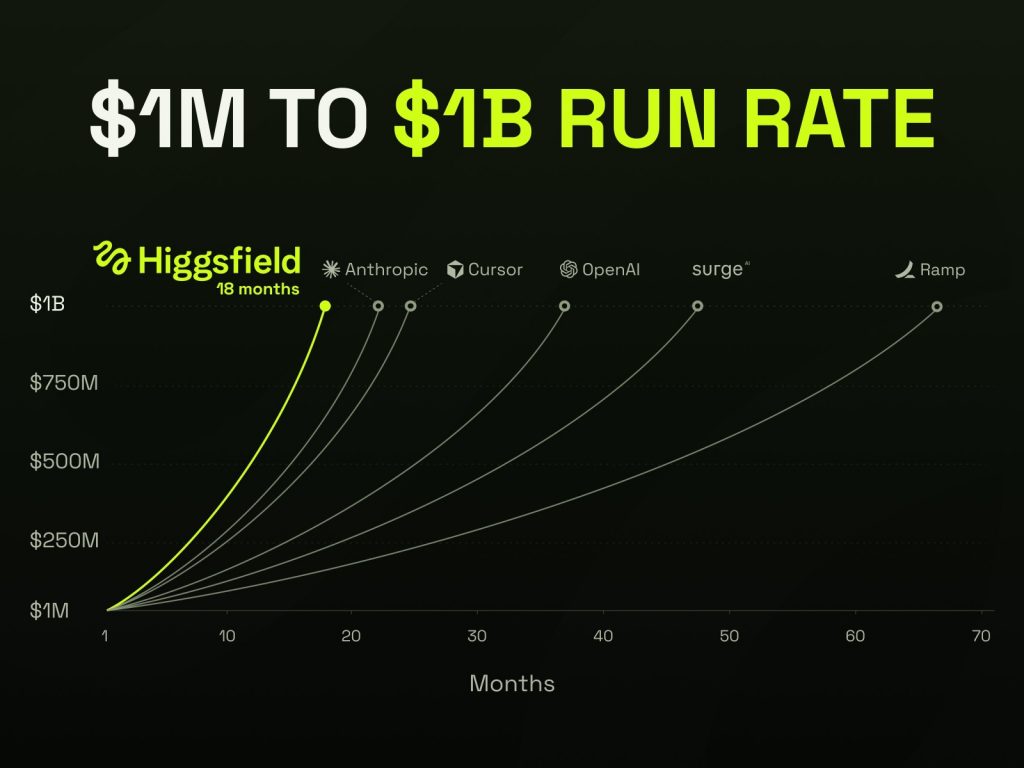
The comparison chart Higgsfield circulated alongside the announcement placed its 18-month climb to $1 billion ahead of Anthropic and Cursor (both around 22 months), OpenAI (roughly 37 months), Surge AI (about 47 months) and Ramp (around 66 months). It’s worth noting that annualized run rate is a projection based on a recent short period of revenue multiplied out to a full year, not audited annual revenue — a distinction that applies to Higgsfield’s number as much as it does to the figures Anthropic and OpenAI have themselves disclosed to investors over the past year. Ramp, notably, also tracks which AI labs are pulling in the most enterprise spend, and its recent data shows OpenAI and Anthropic still account for the overwhelming majority of it — a reminder that being fast to $1 billion in run rate doesn’t yet put Higgsfield in the same weight class as the model makers it’s benchmarking itself against.
Business built on advertising, not consumer hobbyists
Higgsfield originally expected individual creators to be its core audience after launching in March 2025. That’s shifted sharply: the company now says roughly 70 percent of its revenue comes from creative agencies, with advertising and marketing work — rather than one-off consumer video generation — driving most of the growth. Its product line spans a filmmaking tool called Cinema Studio, a Marketing Studio built for campaign video at scale, viral-ready templates and effects, and an API with integrations into ChatGPT and Claude.
The timing has also worked in Higgsfield’s favor. OpenAI’s own consumer video product, Sora, went dark this year as the company redirected compute toward its core chatbot business and its competition with Anthropic, leaving a gap in the AI video market that Higgsfield and rivals like Runway and Pika have been racing to fill.
The bigger debate Higgsfield is wading into
Whether Higgsfield’s run rate holds up as more than a snapshot of a hot few months remains to be seen — the company itself has leaned on the same run-rate math that critics have questioned when applied to larger AI labs. But for now, an 18-month-old video startup is using its growth chart to argue that picks-and-shovels businesses built on top of frontier models aren’t just surviving the foundation-model boom — they’re compounding faster than the labs that built the tools underneath them.