Seeing a trend early can reap some disproportionate rewards, no matter your backgrouond.
A screenshot of a 2016 text exchange is a reminder of how early some people saw the AI wave coming. Bloomberg’s Joe Weisenthal has shared a message thread from August 2, 2016, in which he asks Jack Clark, then a Bloomberg reporter, whether he has left the company. Clark confirms that he has, and says he is taking a couple of months to study AI properly before leaving journalism for something else connected to the field.
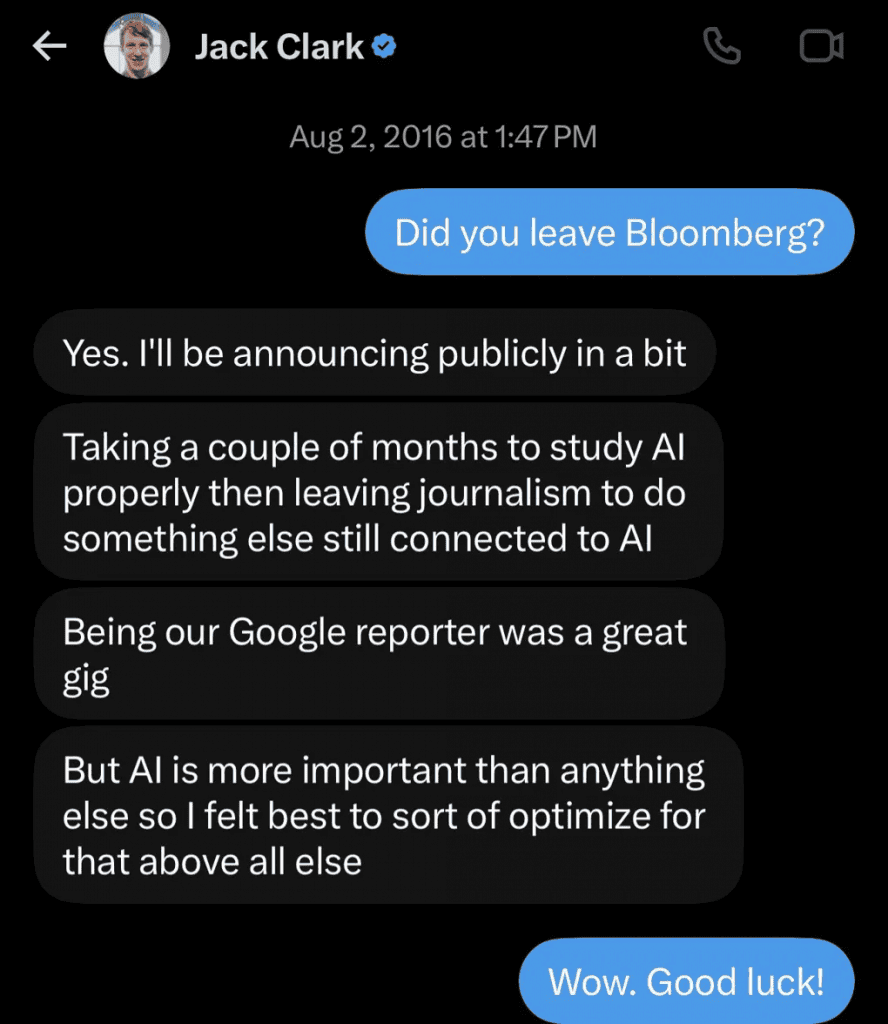
His explanation was blunt. Being Bloomberg’s Google reporter was “a great gig”, he wrote, but “AI is more important than anything else”, so he wanted to optimize for it above all else. Weisenthal’s reply: “Wow. Good luck!”
Ten years on, Clark is a co-founder of Anthropic, a company valued at $965 billion, and a billionaire on paper.
From Brighton to the Bloomberg newsroom
Clark is originally from Brighton, in the UK. He studied English literature with creative writing at the University of East Anglia, graduating in 2009. His formal training is in the humanities rather than engineering.
He started out as a technology journalist at The Register, where he covered distributed systems, before moving to Bloomberg, where he wrote about big tech and, increasingly, neural networks. Georgetown’s Center for Security and Emerging Technology, where he later became a fellow, describes him as having been the world’s only neural network reporter at Bloomberg.
That focus came at a time when few people were thinking about AI. A former Bloomberg editor later recalled that Clark was obsessed with the technology in 2015 and kept pushing to write about it. When Clark told him he was quitting to join OpenAI, the editor tried to talk him out of it, and failed.
OpenAI, then Anthropic
Clark joined the then-new OpenAI in 2016 and stayed for more than four years, working on strategy and communications before becoming policy director. Along the way he started Import AI, a weekly newsletter that is now read by more than 100,000 people, and went on to co-chair the steering committee of Stanford’s AI Index, which tracks progress in the field every year.
In 2021 he left with Dario and Daniela Amodei and four others to co-found Anthropic. Clark served as head of policy, building a team that tripled in size during 2025. In March 2026 he took on a new title, Head of Public Benefit, to lead the Anthropic Institute, an internal think tank studying the societal impact of powerful AI. He is also an inaugural member of the US National AI Advisory Committee and has advised the OECD and the Global Partnership on AI.
How big has it got?
In May 2026, Anthropic raised $65 billion at a $965 billion post-money valuation, ahead of OpenAI’s $852 billion valuation from March, with run-rate revenue crossing $47 billion. Anthropic does not disclose its founders’ stakes, so Clark’s holding is an estimate, and the two main estimates differ:
- Bloomberg Billionaires Index: a stake of almost 1%, worth about $8 billion after the May round. Bloomberg’s estimate relies on PitchBook data and past funding rounds, adjusted using Carta data on typical equity grants.
- Forbes: about 1.7% to 1.8% for each of the seven co-founders, which puts Clark’s net worth at $15.5 billion and places him on the Forbes 400.
Either way, the wealth is on paper and tied up in a private company. All seven co-founders have also pledged to donate 80% of their wealth, which on Forbes’ estimate would amount to well over $12 billion for Clark alone. He has also signed the Giving What We Can pledge.
What a non-technical background can do in an AI boom
Clark’s route is a useful counterexample to the idea that the AI boom belongs only to researchers and engineers. A few things stand out. His 2016 message shows a deliberate bet, made when AI was far from mainstream. He spent months studying the field before making the switch, instead of waiting for a clear signal.
Journalism had likely trained him to read dense technical material and explain it plainly. And as AI moved into the realm of regulation, export controls and national security, the people who could bridge labs and governments gained influence. Clark was in that role at OpenAI and then at Anthropic.
None of this means the move was without risk. A reporter with a stable job at Bloomberg walked away from it to join a newly formed nonprofit AI lab. As the screenshot shows, he wasn’t hedging. He told a former colleague that AI was the most important thing and that he intended to organise his career around it.
And a decade later, he’d say that the risk has most certainly paid off.