It’s the season of AI blogposts.
After an Anthropic researcher had resigned with a mega-viral blogpost, a DeepSeek kernel engineer has set off a wave of discussion in Chinese AI circles with a personal essay that starts as a meditation on being professionally outpaced by his own company’s models, and ends with him comparing the prospect of Anthropic controlling the world’s most advanced AI to a Nazi Germany scenario.
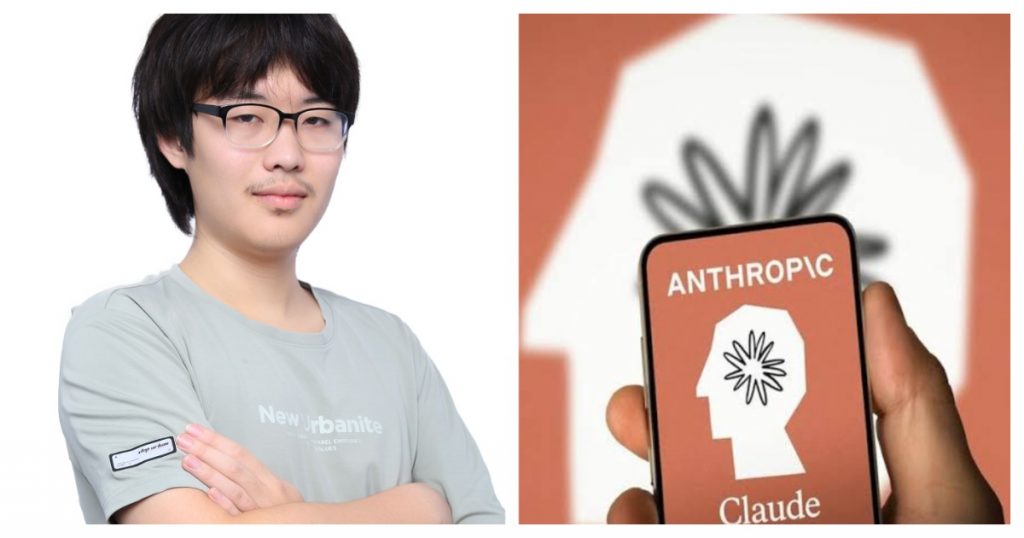
Shengyu Liu, who goes by interestingLSY online and works on kernel optimization at DeepSeek, published the post on WeChat shortly after the company shipped DeepSeek V4.1 Flash, the latest entry in DeepSeek’s efficiency-focused model line that the company has positioned as closing the gap with flagship models from OpenAI and Anthropic at a fraction of the cost. Liu says he wrote the main attention kernel that powers the release, and the essay is, on its surface, about what it feels like to watch AI get good enough at his own job to plausibly replace him.
From “I write kernels” to “I pilot agents”
Liu describes his craft in vivid, almost sentimental terms — the satisfaction of watching a kernel’s performance climb, the quiet afternoons spent optimizing code, a feeling he likens to a speedrunner breaking a personal record. He then walks through how quickly AI has closed the distance with him: from a tool that could barely check documentation two years ago, to one now capable of reading CUDA, PTX and SASS code and independently optimizing kernels today. His extrapolation is that within six months to a year, AI-written kernels could match or beat what he personally produces.
His conclusion isn’t that he’ll be unemployed — he expects his skills will let him “stay at the poker table” of the industry — but that he’ll be forced to abandon kernel-writing for good and become what he calls a “mecha pilot,” someone who directs AI agents rather than hand-optimizing code himself. He illustrates the shift with an analogy about a skilled sweater-knitter whose trade is overtaken by an automated knitting machine: the livelihood survives, the craft doesn’t.
He then extends the argument outward, worrying that students who can now get AI to produce full-score lab assignments in minutes will lose the underlying engineering instincts — the ability to structure systems, anticipate future requirements, and abstract cleanly — and that a world where poor engineers are paired with powerful AI is a world that produces more “spaghetti code” and hidden systemic risk, faster.
The Hitler comparison
The essay’s most attention-grabbing turn comes in its closing section, where Liu frames the future of AI development as a fork between two extremes: a communist-style outcome where productivity gains are broadly shared, and a “Cyberpunk 2077” outcome where a handful of tech companies hoard the most advanced models and lock in permanent class stratification. Liu is explicit about naming names in this scenario, singling out Anthropic as the company he most fears seeing hold that kind of unchecked lead, arguing its danger would be comparable to Hitler getting the atomic bomb before the Allies.
He frames this as the central reason he stays at DeepSeek, describing the lab’s mission as building powerful, fast, and open-sourced AI specifically to keep that advanced-AI concentration from happening. It’s a framing that puts a research engineer’s personal career anxiety and a geopolitical argument about AI concentration in the same essay — and it’s a big part of why the post has traveled well beyond DeepSeek’s usual technical audience.
Two labs that clearly don’t trust each other
Liu’s essay isn’t happening in a vacuum. It lands in the middle of a year of increasingly open hostility between Anthropic and the Chinese AI ecosystem, running in both directions.
On Anthropic’s side, the company has accused DeepSeek, Moonshot AI and MiniMax of creating tens of thousands of fake Claude accounts to distill its models, a claim that drew its own backlash over Anthropic’s own use of unlicensed training data. CEO Dario Amodei has separately argued that Chinese models are optimized to look good on public benchmarks rather than perform well in real-world use, and has long pushed for chip export controls aimed squarely at slowing Chinese labs down. More recently, Anthropic said it had uncovered and disrupted a large-scale, AI-orchestrated cyber-espionage campaign it attributed to a Chinese state-sponsored group, using Claude Code as the attack tool.
China’s state media has returned the suspicion in kind. When Amodei published his essay “We Must Pace the Frontier” arguing that frontier AI development needs to be deliberately slowed for safety reasons, China’s Global Times ran an editorial accusing him of dressing up a Cold War containment strategy as a safety proposal. Amodei’s own pacing proposal, notably, includes an explicit acknowledgment that reaching any global safety agreement with authoritarian governments like China will be difficult given the lack of visibility into Chinese labs — a mutual-distrust problem baked directly into his own plan.
Liu’s blogpost fits neatly into that pattern. Where Amodei frames China as the actor the rest of the democratic world needs to coordinate against, Liu frames Anthropic as the actor the rest of the world needs protecting from — right down to reaching for history’s most extreme available analogy to make the point. Neither side is short on reasons to distrust the other, and neither seems especially interested in dropping the framing anytime soon.
What happens to the people in the middle
Liu closes his essay without much optimism, writing that livelihoods can likely be preserved even as the specific work people love gets automated away, and that he doesn’t know whether engineering fundamentals will keep their value or go the way of hand-written assembly code. He offers no resolution to the geopolitical question either, other than reaffirming his own bet: that the safest path runs through keeping frontier AI open and cheap, rather than concentrated in the hands of any single company — American or Chinese.
Whether that bet pays off is, as Liu himself puts it, a question for the era to answer.