Anthropic has had an incredible few months, and it seems that there’s no stopping its momentum.
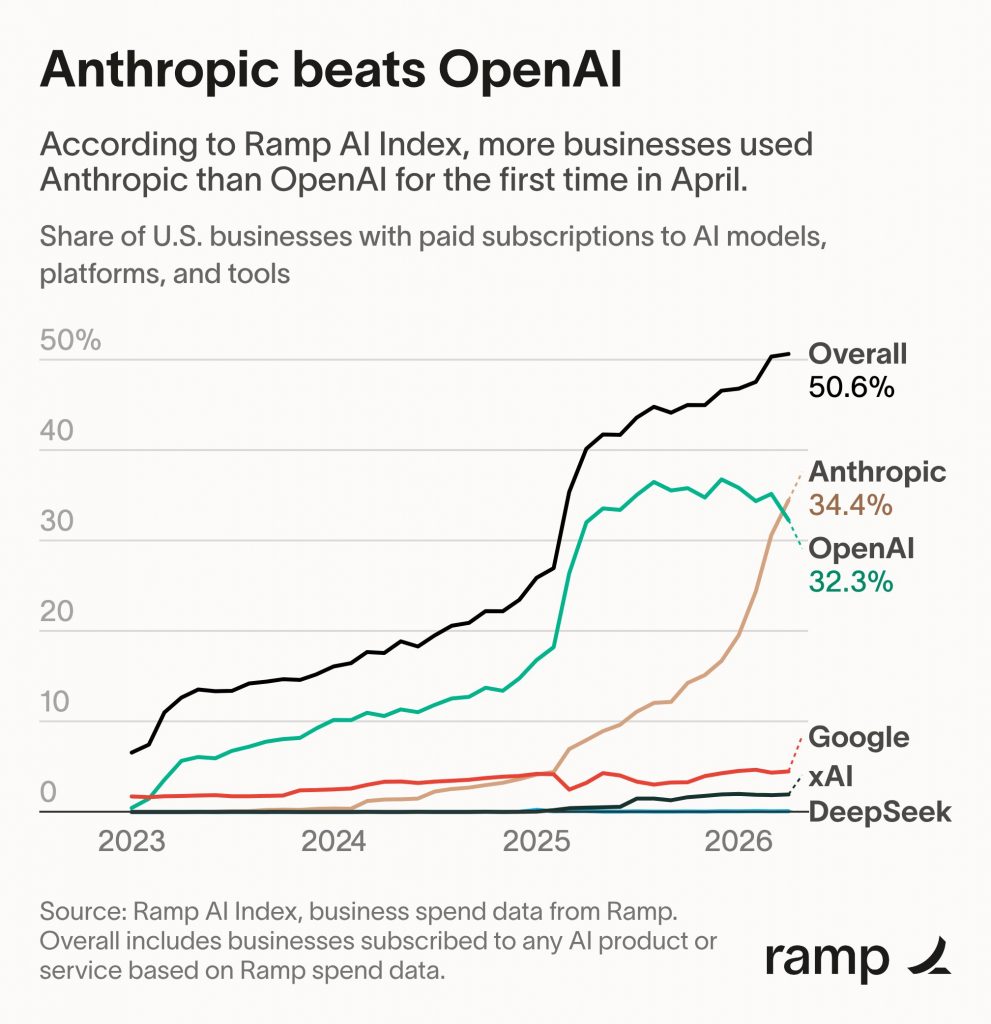
According to the latest update of the Ramp AI Index — which tracks paid AI subscriptions across more than 50,000 U.S. businesses using corporate card and bill-pay data — Anthropic now leads OpenAI in business adoption for the first time. The numbers: 34.4% of businesses are paying for Anthropic versus 32.3% for OpenAI. A year ago, only 9% of businesses were paying for Anthropic. That’s a gain of 26 percentage points in twelve months, while OpenAI’s share barely moved.
Ramp economist Ara Kharazian flagged the milestone on X, noting that Anthropic’s adoption has quadrupled over the past year while OpenAI rose just 0.3%.
A Long Time Coming
This didn’t happen overnight — Anthropic has steadily closed the gap. In February 2026, OpenAI still led by a wide margin — 36% to Anthropic’s 19.5%. By April 2026, the gap had narrowed to 4.6 points, and Kharazian was already predicting a crossover within months. That crossover has now arrived.
The Ramp data also showed an earlier structural shift: Anthropic’s share of combined OpenAI-plus-Anthropic business subscription spend went from roughly 10% in early 2025 to over 65% by February 2026 — meaning Anthropic now commands around twice the business subscription spend that OpenAI does within that two-company comparison.
A separate industry-level analysis added another dimension: the more deeply an industry uses AI, the more it prefers Anthropic. Software and information, finance, and professional services — the three highest-adoption sectors — all favour Anthropic. Among VC-backed companies, which have an 80% AI adoption rate, Anthropic (66%) already leads OpenAI (59%). Early sophisticated adopters are pointing the way for everyone else.
This pattern is corroborated beyond Ramp’s dataset. On OpenRouter’s leaderboard, which samples a different user base, OpenAI last ranked above Anthropic in December 2025. Menlo Ventures data has also shown Anthropic leading the enterprise LLM API market with roughly 40% share compared to OpenAI’s 27%.
Overall AI Adoption Crosses 50%
The Anthropic milestone sits inside a broader headline: overall business AI adoption has crossed 50% for the first time, reaching 50.6% of U.S. businesses on Ramp’s platform. That’s a significant psychological and commercial threshold, suggesting AI spend has become standard operating procedure for the majority of American businesses rather than an experiment for the few.
Google, xAI, and DeepSeek remain distant in the paid business adoption race, at low single-digit percentages.
What’s Driving Anthropic’s Rise?
Anthropic’s gains appear to be driven by a combination of model quality and a deliberate enterprise focus. The company has bet heavily on selling Claude to businesses — a strategy the Wall Street Journal noted last year was putting it on track to reach profitability faster than OpenAI. Claude’s strength in coding has been a key differentiator: in the information, finance, and professional services sectors, where knowledge workers need models that can draft, summarize, analyze, and build, Claude has become the preferred tool.
Claude Code, Anthropic’s agentic coding product, has also been a significant driver. Kharazian noted that despite being priced comparably to OpenAI’s Codex on certain tasks, Anthropic is struggling to meet its own demand — with usage limits and rate caps still in place across consumer, pro, enterprise, and API tiers. A company actively turning away revenue because it lacks the compute to serve it is an unusual problem to have.
The Limitations of the Ramp Index
The Ramp data is compelling, but it comes with important caveats that any serious reader should keep in mind. The index draws from Ramp’s 50,000-plus business customers — a large and diverse sample, but not representative of the entire U.S. business landscape. Ramp’s clientele skews toward tech-forward, venture-backed companies that are already predisposed toward Anthropic. This could overstate Anthropic’s lead in the broader market. It also measures paid subscriptions, not usage intensity, and also likely undercounts free-tier usage.
Kharazian too himself is skeptical the lead will last. In his writeup, the Ramp economist noted that OpenAI’s advantages — consumer brand recognition via ChatGPT, Microsoft distribution, and a mature enterprise sales organisation — remain real. He also flagged that Anthropic’s compute constraints, which have forced it to cap usage, could slow adoption if not resolved.
The Bigger Picture
None of this means OpenAI is in trouble. ChatGPT remains the fifth most-visited website in the world. And in the broader AI software market that includes Google, Microsoft, and others, the competitive dynamics are far more complex than a two-horse race.
What the Ramp data does show is that the enterprise AI market is genuinely contested in a way that it wasn’t twelve months ago — and that Anthropic’s strategy of targeting businesses directly, with a model that developers and knowledge workers trust, is working. For the first time, more U.S. businesses are paying for Anthropic than OpenAI. How long that lasts is the next question worth watching.