Anthropic CEO Dario Amodei had predicted that 50% of entry-level white-collar work would be gone by 2030 — and the wheels seem to already be in motion at his own company.
Anthropic has published internal data showing that its own hiring for junior technical roles has fallen sharply over the past year and a half, and the company is pointing squarely at AI as the reason.
In a new report on how AI has restructured work inside the company, Anthropic says the share of junior-level employees in its technical departments has slipped from 21% to 14% since early 2025. The drop is even steeper when it comes to new hires: the proportion of junior technical hires has fallen from 27% to just 9% over the same period, with postings for junior roles falling particularly sharply since December 2025. Junior roles in non-technical departments have held up far better by comparison, going from around 26% to 25%.
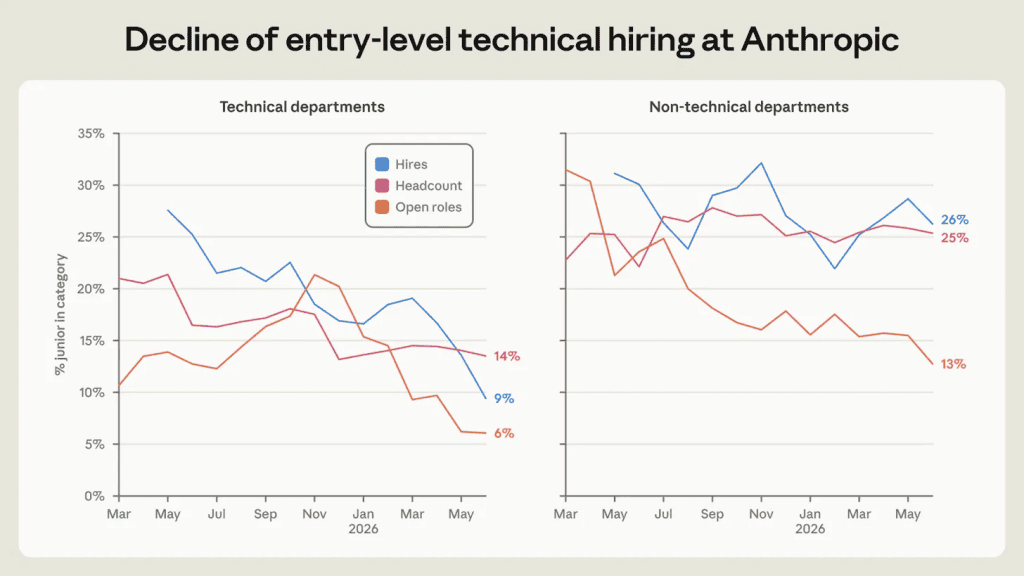
The company says the shift began showing up in internal conversations in January 2026, when teams that leaned most heavily on Claude in their own work found that writing code and catching bugs could increasingly be handed off to the model. Newer, more capable models accelerated the trend: one person Anthropic interviewed for the report said the performance uplift for engineers was dramatic enough that it “overnight changed what we were looking for.” By April, engineering and research teams had already deprioritized hiring for lower-band technical positions, and when managers were surveyed that same month, about a third of ML managers and a fifth of software engineering managers said they were hiring less because of AI.
Anthropic ties this to the sheer scale of agent usage inside the company. By August, the report says, hours worked by interactive AI agents outnumbered hours worked by human employees six to one — a milestone that lines up with how aggressively the company has been overhauling its own engineering infrastructure to keep pace, including building its own in-house version control system after code merges rose 12x in four months.
The hiring shift isn’t just about automating away junior coding tasks, though. Within technical departments, the report says the share of employees who aren’t actively writing code at all (measured by whether they’ve made a commit in the past 30 days) has fallen by almost half over the past year. Managers are committing code nearly twice as often as before, and the ratio of engineers to product managers has widened to around 17 to 1. In other words, supervisory and coordination roles inside engineering teams increasingly involve shipping code themselves rather than just overseeing people who do.
At the same time, the overall share of Anthropic’s workforce in technical departments has fallen from 61% to 56% over the last year, even as technical hiring keeps growing in absolute terms. Sales, finance and recruiting have simply grown faster, partly because coding agents are letting people outside engineering build their own tools. Anthropic cites a sales rep who built a custom dashboard and pipeline integrating several tools in three to four hours, despite having no background in UI work. Coding-focused agent sessions among non-technical employees jumped from about 2 a month in August 2025 to 90 a month by May 2026 — a pace of adoption that tracks with the broader surge in agentic coding tools the industry has seen over the same stretch, even as some firms have started pushing back, with companies like Amazon, JPMorgan, Schwab and Delta all moving to block AI agents from parts of their systems over security concerns.
Clerical and administrative hiring has stayed especially flat. Anthropic’s report describes a financial manager who built a purchase-request review agent specifically to free up time for higher-value work, and an executive assistant who said the company had “already moved past the point of Claude augmenting away the really entry-level admin type role,” shifting focus instead to more senior “chief of staff” style tasks.
The report also points to a broader cultural shift: hiring managers are increasingly weighing candidates’ autonomy and judgment over narrow technical expertise. Anthropic frames this as part of a wider reorganization of work around AI agents, where human attention itself has become the bottleneck — the report notes that even non-technical employees would need roughly half their work week just to read through everything their Claude agents produce, pushing many of them into what the company calls “meta-work”: building dashboards and monitoring tools just to keep tabs on their own AI agents.
Internally, Anthropic says it has responded by setting up an early-warning system to flag jobs at risk of disruption and by prioritizing internal redeployment over layoffs — employees with at least a year of tenure were 50% more likely to switch departments each month in 2026 than in 2025. One product design team that used to write Claude.ai’s in-app copy, for instance, ended up building a “context graph” that let agents write that copy themselves, and the team then rotated into writing prompts and evals for Claude instead.
Anthropic frames itself as a leading indicator for the rest of the economy, given how deeply it has built AI agents into its own workflows. Whether other companies follow the same hiring pattern as they adopt similar tools remains to be seen, but the company’s own numbers suggest the entry-level rung of the technical career ladder is already looking very different than it did less than two years ago.