Anthropic’s products are leading the coding revolution at companies around the world, and it has now disclosed just how much more productive its employees have become while using their own tools.
The company has released internal data showing that the average lines of code merged per active contributor at Anthropic has reached 8x the pre-2025 baseline — with Q2 2026 only partly complete. The numbers track a clear inflection point: from Q2 2021 through the end of 2024, productivity hovered near 1x, with barely any quarter standing out. Then came 2025, and the chart tells a different story entirely.
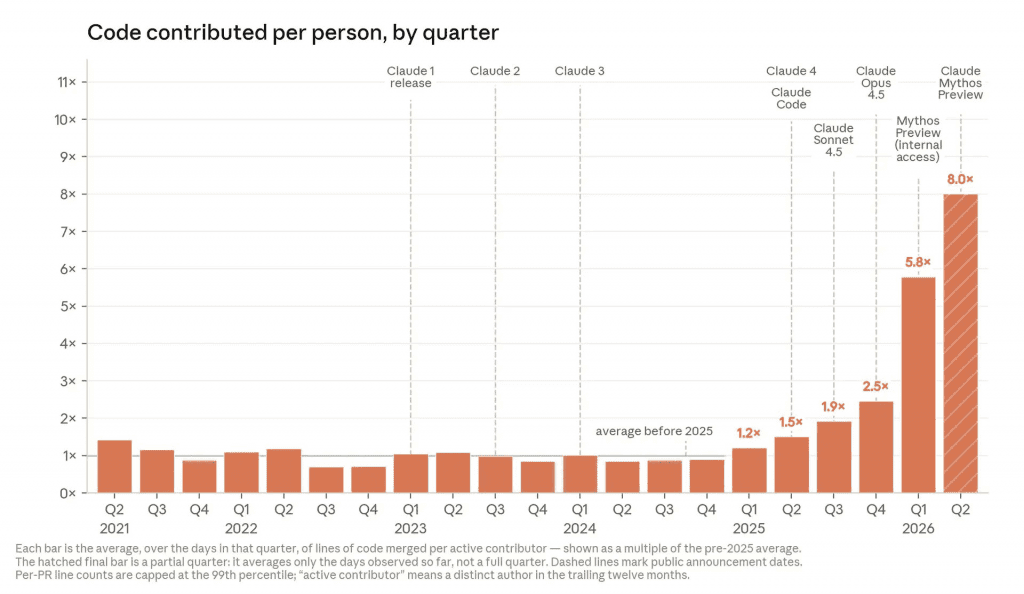
The acceleration maps almost perfectly onto the company’s own model releases. By Q1 2025 — shortly after Claude 4 shipped — the figure hit 1.2x. It climbed to 1.5x in Q2, then 1.9x in Q3, and 2.5x by Q4. Q1 2026, coinciding with the internal rollout of Mythos Preview, landed at 5.8x. The most recent partial quarter sits at 8x.
Anthropic has been candid about how deeply embedded its own models have become in its internal workflows. CEO Dario Amodei has said publicly that a majority of the code at Anthropic is now written by AI, and that claim has only grown more extreme with time. By late 2025, some engineers had stopped opening code editors entirely — letting Claude Code generate first drafts and only editing the output. Amodei described this as a threshold the company had never crossed before.
The chart measures something specific: average lines of code merged per active contributor, per day, across each quarter — expressed as a multiple of the pre-2025 average. The final bar is hatched because Q2 2026 is still in progress. Per-PR line counts are capped at the 99th percentile to filter out outlier commits, and “active contributor” means a distinct author active in the trailing twelve months. These are real engineering outputs, not survey responses.
What makes the data striking is that the growth curve mirrors the public release schedule of Claude’s coding models almost beat for beat. Claude Code launched publicly in May 2025 and rapidly became one of the fastest-growing developer tools in history. It crossed $2.5 billion in annualized revenue by February 2026. As of now, an estimated 4% of all public GitHub commits worldwide are being authored by Claude Code.
For Anthropic specifically, this isn’t a story about AI assisting developers at the margins. It’s a fundamental restructuring of what a software engineer’s day looks like. Claude Code creator Boris Cherny has addressed the apparent paradox head-on — Anthropic still has over 100 open developer positions even as AI writes nearly all of its code. His answer: engineering has shifted toward prompting models, talking to customers, coordinating across teams, and deciding what to build next. The code writes itself. The judgment about what to build doesn’t.
The broader industry context matters here. Google said last year that over 30% of its code was AI-generated. Microsoft reported similar figures. Salesforce said it would hire no new human engineers through 2025 on account of AI productivity gains. Anthropic’s internal numbers suggest those companies may still be in an earlier part of the curve.
What the chart doesn’t show — but what Anthropic’s own product trajectory makes clear — is that this is a compounding effect. Each successive Claude model has been substantially better at coding than the one before it, and the productivity gains have compounded accordingly. The 8x figure for Q2 2026 is a partial quarter. The full number could be higher. And while lines of code isn’t necessarily a measure of useful output, at a company with high standards of technical standards like Anthropic, it could be seen to be a reasonably accurate proxy.
For anyone watching where enterprise software development is headed, Anthropic is, at this point, running the most live and large-scale experiment in the industry. And the results are now public.