There are several AI labs looking to move to the frontier, but only two have been deemed worthy of a named mention in Anthropic’s IPO filing.
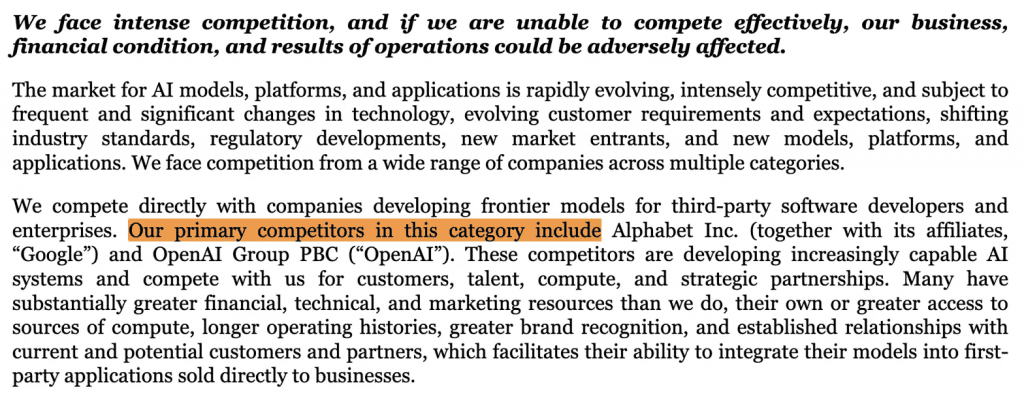
Anthropic’s S-1 includes the standard “we face intense competition” risk factor that every tech IPO prospectus carries. But when it comes time to actually name names, the list is short. In the section on competition from other frontier model developers, Anthropic names exactly two companies: OpenAI and Alphabet (Google).
What the S1 says
The relevant language, under the heading “Model Developers,” reads: “We face direct competition from companies building frontier models for third-party software developers and enterprises, including OpenAI and Google, and large, well-capitalized technology companies investing to reach the frontier.” Anthropic goes on to say these competitors are “developing increasingly capable AI systems” and compete with it “for customers, talent, compute, and strategic partnerships,” adding that many of them have “substantially greater financial, technical, and marketing resources” than Anthropic does, along with greater access to compute, longer operating histories, and established customer relationships that make it easier for them to bundle AI directly into first-party products.
No other frontier lab — not Meta, not xAI, not DeepSeek, not Mistral — is named as a primary competitor in that section. The “large, well-capitalized technology companies investing to reach the frontier” phrasing leaves room for others to be read in, but OpenAI and Google are the only two the filing calls out explicitly.
Why that’s notable
It’s a short list given how crowded the frontier AI conversation usually sounds. There has been a three-way race at the top of the benchmarks for most of the year — Claude, Gemini and GPT models have been trading the top spot on the Artificial Analysis Intelligence Index repeatedly, and Google’s most recent model, Gemini 4 Argon, clawed its way back into that conversation after a stretch where Anthropic and OpenAI had pulled ahead. On coding specifically, Google’s Argon running in its Antigravity harness has landed just behind Anthropic’s Claude Code models and ahead of OpenAI’s Codex entries on independent benchmarks. By any measure of day-to-day model competition, this has been a three-horse race, which makes naming only two of the three horses in a legal filing stand out.
It also leaves out Meta, despite Meta investing heavily in frontier model development through its Muse and Llama lines, and xAI, despite Elon Musk’s Grok models climbing the same leaderboards. Microsoft is mentioned elsewhere in the S-1’s risk factors — but as a cloud supplier and distribution partner with its own competing AI services, not as a named frontier-model rival in this particular section. That distinction matters: Anthropic pays Microsoft, Amazon and Google fees in a joint go-to-market arrangement for distribution, while also relying on two of those same three companies for compute and counting Google as a direct model competitor.
The OpenAI rivalry
Of the two, OpenAI is the more personal rival. Anthropic was founded in 2021 by a group of researchers, including CEO Dario Amodei, who left OpenAI over disagreements about the direction of AI safety and commercialization. The two companies have spent the better part of this year sparring over whose growth numbers are more real — OpenAI told its own employees that Anthropic was overstating its revenue run rate by roughly $8 billion due to how it accounts for cloud marketplace revenue, a dispute that’s become a semi-regular feature of how the two companies talk about each other publicly. Anthropic has separately claimed to be growing revenue roughly three times faster than OpenAI on a percentage basis.
OpenAI has also filed confidentially for its own IPO, expected to list in early 2027 — which means the S-1 language calling out OpenAI by name as Anthropic’s top competitor is being written at almost exactly the moment both companies are making their pitches to the same pool of public market investors.
The Google wrinkle
Naming Google as a primary competitor carries its own irony, because Google is also one of Anthropic’s largest shareholders and compute suppliers at the same time. Google has quietly built roughly a 14% stake in Anthropic, and the S-1 separately discloses that Anthropic has committed to spend at least $114.5 billion with Google Cloud on TPU capacity through 2033. So the same company the filing names as a direct competitor for customers and talent is also a top-five shareholder and one of Anthropic’s two largest infrastructure landlords — exactly the kind of overlapping investor-supplier-competitor relationship Anthropic flags elsewhere in its risk factors as a potential conflict of interest.
What it signals to investors
Naming only two competitors, rather than listing a longer roster of AI labs the way some companies pad out their risk factors, reads as a deliberate signal about how Anthropic sees the competitive landscape: not as a wide field of similarly positioned labs, but as a narrower, three-way contest for the enterprise frontier, with Anthropic positioning itself against the two companies with the resources to match its spending. It also leaves Anthropic in the slightly odd position of naming one of its own biggest financial backers as a primary rival — a reminder of just how tangled the relationships between AI labs, their cloud suppliers, and their investors have become heading into what could be the largest IPO in history.