Anthropic’s S-1 filing, released ahead of its anticipated November IPO, contains a chart that tells a pretty striking story about how the company’s unit economics have shifted over the last six quarters — the amount of revenue it generates for every dollar it spends on compute and infrastructure has gone up more than five times over.
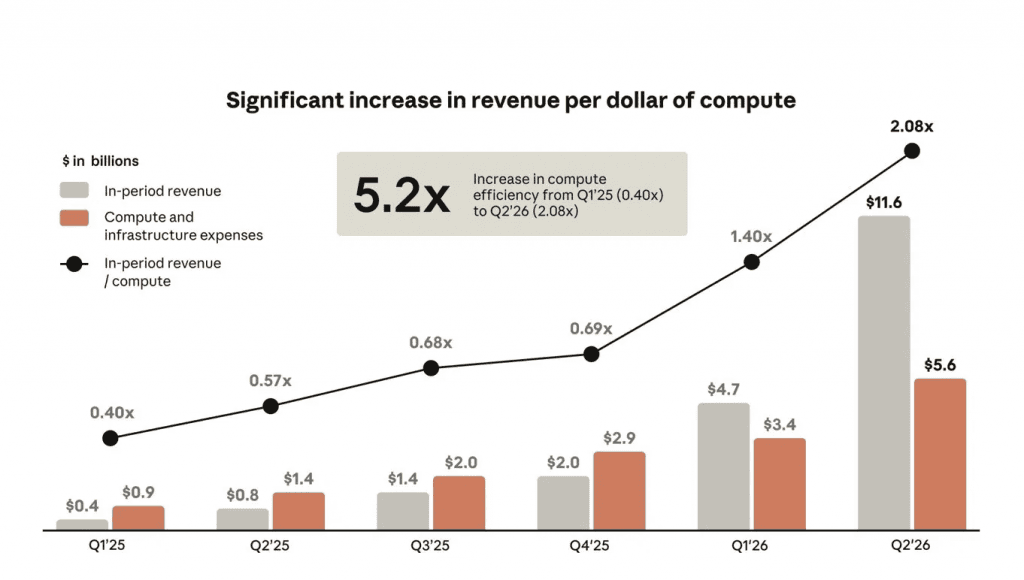
Back in Q1 2025, Anthropic made just $0.40 in revenue for every dollar it spent on compute and infrastructure, pulling in $0.4 billion in revenue against $0.9 billion in compute and infrastructure expenses. That ratio has climbed steadily every quarter since — 0.57x in Q2 2025, 0.68x in Q3 2025, and 0.69x in Q4 2025 — before jumping sharply through 2026. By Q1 2026, the company was generating $1.40 for every dollar of compute spend, on $4.7 billion in revenue against $3.4 billion in expenses. And in Q2 2026, the ratio hit 2.08x, with $11.6 billion in revenue against $5.6 billion in compute and infrastructure costs.
That’s a 5.2x improvement in compute efficiency in a little over a year, and it’s a number Anthropic is clearly keen to highlight to prospective investors as it heads toward what could be the largest IPO in history. The pitch is straightforward: compute is by far the biggest cost for any frontier AI lab, and if revenue is growing far faster than the infrastructure bill required to generate it, the business starts looking a lot more sustainable than the “burn billions to stay competitive” narrative that has dogged AI labs, including Anthropic itself.
The trend appears to have held up beyond what’s shown in the chart too. Anthropic has since told investors its revenue rose 50% to $16.7 billion in the third quarter of 2026, and that it generated $1.70 in revenue for every $1 it spent on computing power during that period, alongside adjusted operating margins of 11%, excluding stock-based compensation.
Much of this efficiency gain tracks with the explosive growth of Claude Code and enterprise adoption of Claude more broadly, which has let Anthropic spread its massive compute commitments — including its deals with Nvidia, SpaceX, Nscale and others — over a rapidly expanding revenue base rather than a flat one. The company’s overall revenue has gone from roughly $4.6 billion for the whole of 2025 to over $16 billion in the first half of 2026 alone, a pace few software companies, let alone capital-intensive AI labs, have managed before.
Still, the S-1 numbers aren’t without their caveats. Anthropic’s full-year 2025 revenue of $4.6 billion came with a net loss of close to $42 billion, the bulk of which stemmed from an accounting charge tied to the rising value of convertible instruments rather than operating losses. And the compute-to-revenue ratio, while improving fast, doesn’t capture everything else the company is spending on, including the massive long-term infrastructure contracts it’s locked itself into, some running into the tens of billions of dollars over several years.
The timing of the disclosure is also notable. It comes just days after two senior Claude Code engineers announced they were leaving Anthropic, a reminder that even as the financials improve, the company is navigating the kind of internal churn that often accompanies a startup’s run-up to going public.
For now, though, the 5.2x figure is likely to be one of the headline numbers investors fixate on as Anthropic makes its case for a valuation that could reportedly stretch north of $2 trillion.