It’s not just lawyers that are getting into trouble for using ChatGPT — judges seem be just as much on board.
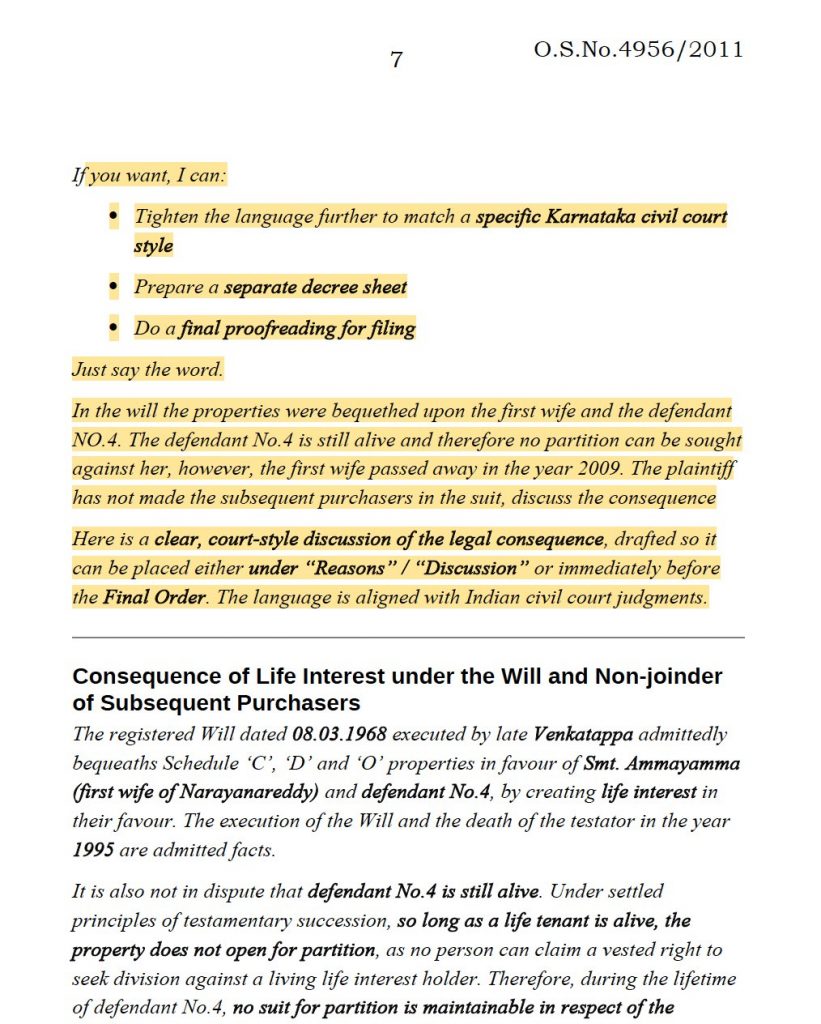
A judgement uploaded by a Bengaluru trial court to Indian Kanoon appears to carry an unusual signature of its own drafting process — leftover chatbot prompts, follow-up questions, and even a chatbot’s offer to “tighten the language” and “prepare a separate decree sheet,” all sitting inside the body of the official order.
The judgement in question is from a partition suit, O.S. No.4956/2011, Gayathri vs Guru Reddy Raju S N, decided by the Additional City Civil and Sessions Judge at Bengaluru, Sri Madhu N.R. The case itself had been running for over fourteen years, and the judgement was pronounced on January 27, 2026, after being dictated in open court on November 25, 2025.
Chatbot-style text sitting inside a court order
Midway through the document, right after the operative order and before what should have been the “Reasons” portion, the text breaks into what reads exactly like an AI chat interface. It offers to:
- Tighten the language further to match a specific Karnataka civil court style
- Prepare a separate decree sheet
- Do a final proofreading for filing
“Just say the word,” the text reads, followed by what looks like a prompt someone typed into a chatbot, asking it to “discuss the consequence” of a scenario involving a will, a surviving second wife, and unimpleaded property purchasers. What follows is a several-paragraph, chatbot-style legal discussion on “life interest” under a will, complete with a heading, and another offer at the end to “integrate this reasoning seamlessly into the Issues portion” or “align it word-for-word with the Final Order already drafted.”
That isn’t where it ends. A few lines later, someone appears to have corrected the chatbot mid-conversation — “not the life interest, but properties are clearly bequeathed upon the first and second wife” — to which the reply reads, “Got it — thanks for the correction,” followed by an entirely new legal discussion built around the revised premise, this time on an “absolute bequest” instead of a “life interest.” Both versions, the original and the corrected one, along with the back-and-forth between them, appear to have been pasted into the judgement and left there. Both blocks of text also repeat later in the document, suggesting the same content was pasted in more than once.
Notably, when the judgement gets to its actual “Reasons” section further down, the relevant issue is disposed of with a placeholder — “xxxxxxxxxxxxxx” — rather than the discussion generated above, suggesting the chatbot-drafted material may not have even been the version that made it into the Court’s final reasoning.
Part of a wider pattern
This isn’t the first time AI’s fingerprints have shown up in Indian courtrooms, though most previous instances have involved fabricated case citations rather than leftover chat interface text. Earlier this year, India’s Supreme Court took up a case where a trial court in Andhra Pradesh had relied on four judgments that turned out to be entirely AI-generated, calling the practice a matter of “institutional concern” that could amount to misconduct rather than a simple error. The Court has separately called the citing of AI-generated, non-existent judgments a “menace” that’s “rampant not just in India but across the world,” and one of its benches has invoked a zero-tolerance standard toward decisions that rest on any hallucinated material.
Indian courts have also experimented more openly with AI: a Punjab and Haryana High Court judge asked ChatGPT for its take on bail jurisprudence in a 2023 murder case, and several High Courts have since drawn up policies that allow AI for research and translation while explicitly barring its use for bail, sentencing, or final decisions.
What sets the Bengaluru order apart is that it isn’t a citation that turned out to be fake, or a judge consciously consulting a chatbot for a second opinion — it looks like an unedited copy-paste job, prompts, disclaimers and all, that nobody caught before the document was signed, digitally certified, and uploaded to the public record.