Corporate spending on the two biggest AI labs is still growing, but the pace has cooled off dramatically.
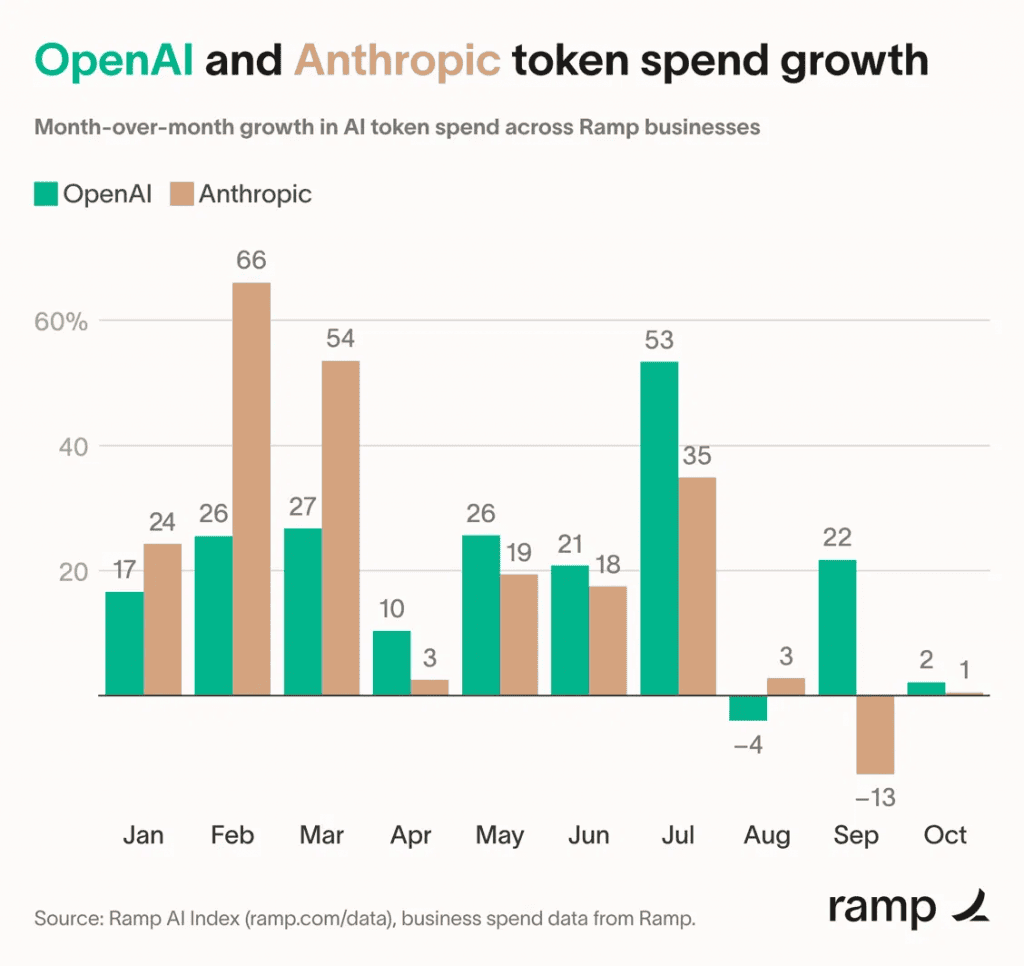
According to the latest Ramp AI Index, month-over-month token spend on OpenAI rose just 2% in October, while Anthropic grew only 1%, a sharp slowdown from the double-digit, and sometimes triple-digit, monthly jumps both companies were posting for most of this year.
The numbers come from Ramp’s monthly tracker, which pulls transaction data from more than 85,000 American businesses that use its corporate cards and bill-pay platform. The index has become one of the more closely watched proxies for enterprise AI demand precisely because it’s based on actual payments rather than surveys or self-reported usage.
A year of wild swings, now flattening out
Looking back over 2026, the month-over-month growth figures for both companies have been anything but steady. OpenAI’s token spend grew 17% in January, climbed into the mid-20s through February, March, and May, dipped to just 10% in April, and then spiked to 53% in July before turning negative in August (-4%) and bouncing back to 22% in September. Anthropic’s trajectory has been even choppier, with a 66% spike in February and a 54% jump in March, followed by a near-collapse to 3% in April, a rebound to 35% in July, and then a steep 13% contraction in September.
October’s reading of 2% for OpenAI and 1% for Anthropic is the calmest the chart has looked all year. Neither company is shrinking, but neither is anywhere close to the growth spurts that defined earlier months either.
This cooling trend builds on what Ramp had already flagged earlier this fall, when it reported that token spend grew just 1.5% across August and September combined, a sharp deceleration from 42% growth in July. Token volumes, meanwhile, kept climbing even as dollar spend stalled, pointing to falling prices per token rather than falling usage as the likely explanation.
Engineering teams are still footing most of the bill
The breakdown by department tells a familiar story. Engineering teams accounted for 72% of AI spend in October, Ramp’s data shows, with customer service and leadership rounding out the next biggest buckets. That concentration lines up with Ramp’s broader finding that a small sliver of companies, mostly venture-backed, high-growth tech firms, account for the vast majority of total AI spend across its platform. Median firms are still spending in the range of $12 to $15 per employee per month, while the top 1% of spenders are in a completely different universe, running into the thousands of dollars per employee.
Why a slowdown now
Part of the explanation is simply arithmetic: both companies have been cutting prices this year, so a flat or declining dollar figure doesn’t necessarily mean usage is falling. Ramp’s lead economist Ara Kharazian has pointed to price competition and an increasingly savvy buyer base as reasons why spend growth doesn’t track usage growth one-to-one anymore. There’s also a timing element, July’s unusually large jump for both companies made the following months look weak by comparison, and the index has been see-sawing between strong and soft months since.
Kharazian flagged the October numbers in a post on X, framing the modest growth, combined with what he called “new competitive dynamics that may stick around,” as a reason for the market to start looking toward “new fronts in the AI trade” beyond the usual OpenAI-versus-Anthropic framing. That shift is already visible in Ramp’s own dataset: besides the new department-level breakdown, Ramp also reported that a third challenger, SpaceXAI, posted the fastest adoption growth of any provider in October, with the share of businesses paying for it rising 2.2 percentage points month-over-month to 6.3%, still tiny next to OpenAI and Anthropic, but the quickest mover in the index.
Whether October’s slowdown is a blip or the start of a longer plateau is hard to say from one month of data. Ramp’s index has shown similar pauses before, including a stretch of flat adoption between August and October last year that was followed by renewed growth heading into year-end. For now, the headline number is simple: the two companies that have dominated enterprise AI spend all year just posted their quietest month since the index started tracking token-level data.