Mark Zuckberg is no longer as hands on with tech as he was when he’d founded Facebook, but he’s trying to make sure his team has the best chance of succeeding at AI.
In a recent conversation, Zuckerberg was candid about the limits of his own technical involvement in Meta’s AI push, and instead laid out what he sees as his actual job description as CEO — assembling talent and building the infrastructure to support it.
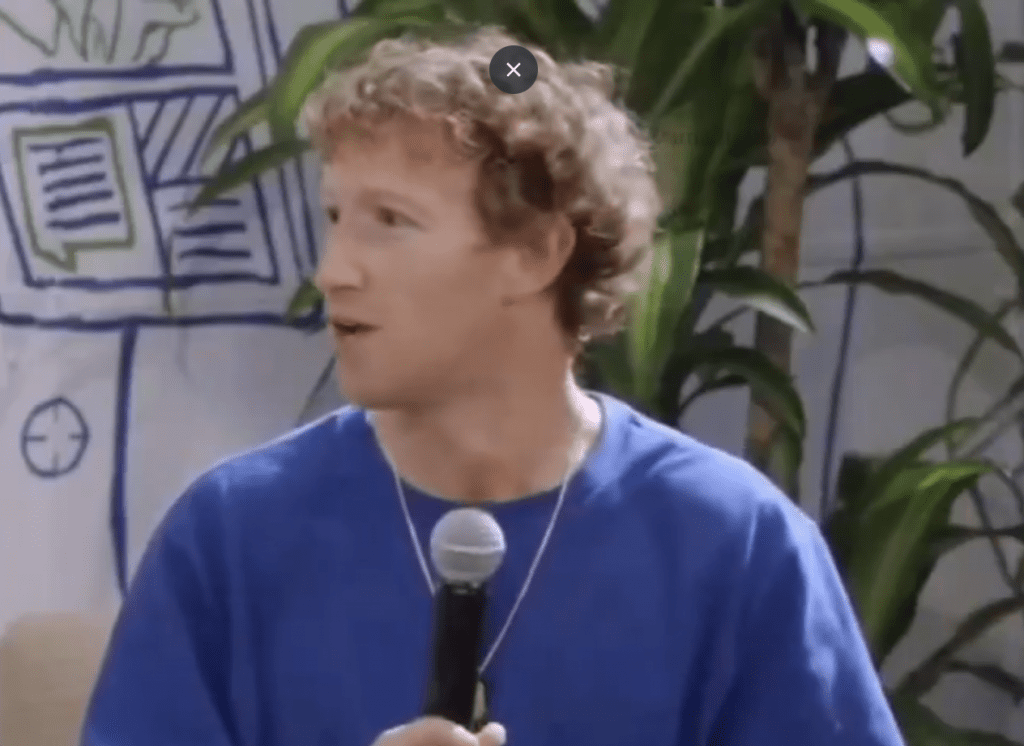
“I’m not an AI researcher. So it’s not like I’m in there telling them what research ideas to do,” Zuckerberg said. “The things that I can do as CEO of the company are, I can make sure that we have the very best people and talent density. I can make sure that we have by far the highest compute per researcher, and that we do whatever it takes to go build out all that capacity.”
That framing — CEO as talent magnet and infrastructure provider rather than research director — has effectively been Meta’s operating model since the Meta Superintelligence Labs reorg last year. Zuckerberg went on a hiring spree that saw the company dangle nine-figure pay packages at researchers from OpenAI, Google DeepMind, and Anthropic, on the theory that if you get the smartest people in a room together with enough compute, the research ideas take care of themselves.
The compute Zuckerberg is putting behind it
Zuckerberg pointed to Meta’s data center buildout as proof of that conviction. “We’re building this Prometheus cluster, which is going to be the first kind of gigawatt plus single cluster that’s a contiguous cluster for training coming online next year,” he said. He also referenced the company’s Louisiana campus, known internally as Hyperion, calling it a five gigawatt project, and said Meta is building “several more clusters like that, that are just going to be multiple gigawatts.”
These aren’t small numbers even by the standards of an industry that has gotten used to throwing around the word “unprecedented.” A single gigawatt-plus cluster puts Meta ahead of the pack on a metric that has become the industry’s preferred bragging right, and the company has been explicit that its edge over labs like OpenAI is that it can fund all this from its own advertising cash flows rather than negotiating with outside investors.
Zuckerberg acknowledged the scale of the bet directly. “That obviously takes some conviction. We’re talking about many hundreds of billions of dollars of capital, so you both need to have a good business model that can support it and you need to believe in it,” he said.
Why the reorg happened in the first place
Zuckerberg’s current pitch — hire the best, hand them the most compute per head, get out of the way — is a direct response to what didn’t work. Meta’s Llama 4 release in April 2025 landed with a thud, and the company’s own researchers later admitted some of the benchmark numbers had been massaged. That failure is what triggered the formation of Meta Superintelligence Labs under Alexandr Wang, and it’s what pushed longtime Chief AI Scientist Yann LeCun out the door entirely, after 12 years running Meta’s fundamental research arm.
LeCun’s exit was as much a cultural statement as a personnel change. He rarely crossed paths with Wang’s TBD Lab, the unit built out of Zuckerberg’s marquee hires that now owns Llama development, and he’d grown skeptical that scaling large language models was even the right path to advanced AI in the first place. Meta laid off 600 people from the Superintelligence Labs division in October, some of them from the FAIR unit LeCun had spent over a decade building. He has since started his own venture pursuing what he calls world models, a bet that Meta itself no longer seems interested in funding internally.
The contrast is instructive. LeCun’s version of Meta AI was built around long-horizon academic research and open publishing. Wang’s version is built around dense talent, closed development, and infrastructure that dwarfs almost anything else in the industry. Zuckerberg’s comments make clear which model he’s backing, and money is being deployed accordingly. Whether that approach produces a model that actually competes with the top labs, or just a very expensive and very well-staffed operation, is the question Meta still has to answer.
Zuckerberg isn’t claiming to have the technical judgment to pick winning research directions himself, and he doesn’t seem to think that’s the job. His bet is that if he gets talent density and compute per researcher right, the rest is downstream of those two inputs. It’s a wager that plenty of people at Meta have already been paid handsomely to help prove correct.