Traders on prediction markets have sharply raised the odds that Jensen Huang will leave his job as Nvidia CEO, after two reports on Wednesday suggested his position is far more precarious than it looked a day earlier.
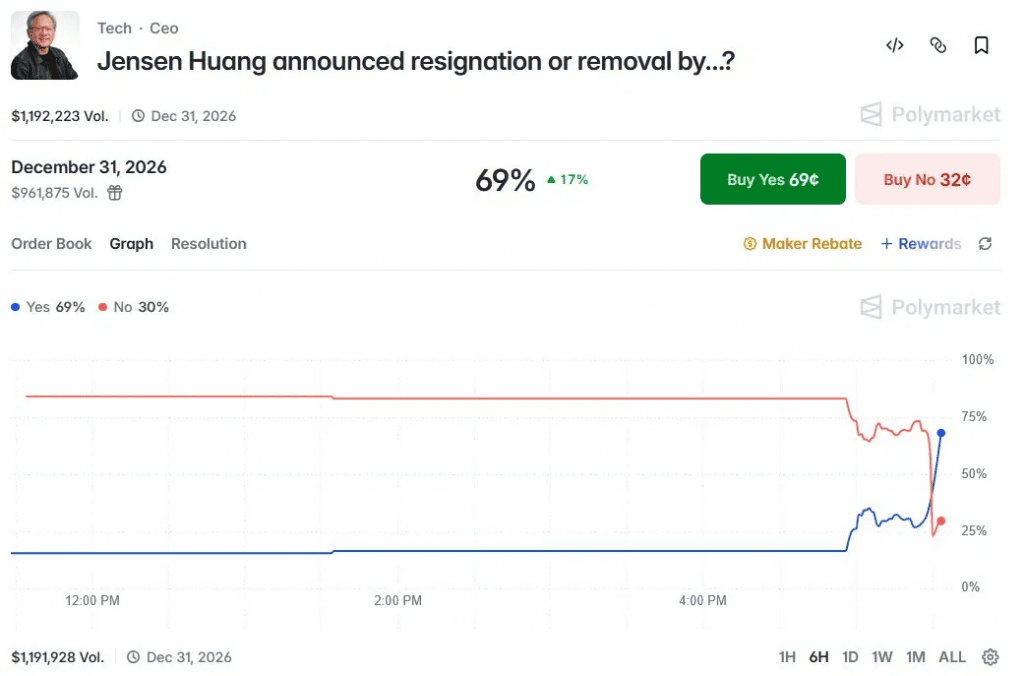
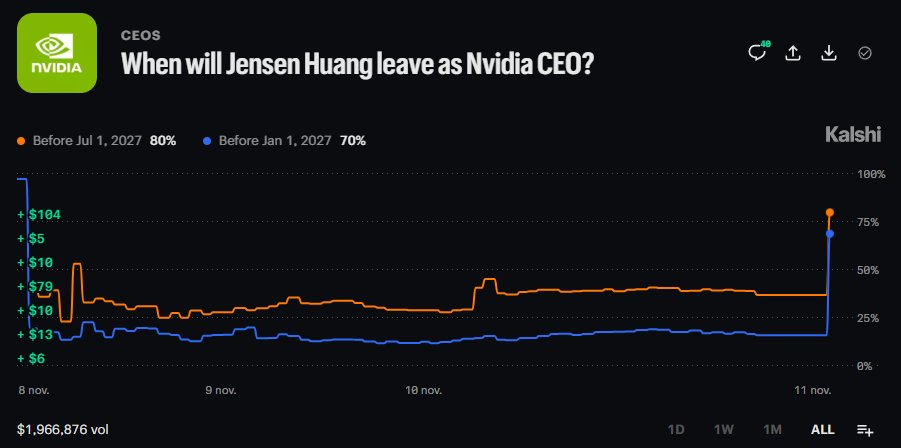
On Kalshi, the odds that Huang leaves before July 1, 2027 jumped to 80%, with a 70% chance of an exit before January 1, 2027. On Polymarket, which asks whether Huang will announce his resignation or be removed by December 31, 2026, the “Yes” price climbed to 69 cents, an implied probability of 69%.
From Roughly 15% To Near-Certainty
The charts show how abrupt the move was. Polymarket’s year-end contract had sat at around 15% for most of the day before the news broke. Within an hour or so it climbed to around a third, then spiked to 69% as the second report landed. The market has now drawn about $1.19 million in trading volume.
On Kalshi, the odds that Huang would leave by the start of 2027 had hovered at roughly 12% to 20% since the market opened on November 8, and the odds of an exit by mid-2027 had stayed in the 25% to 40% range. Both jumped to 70% and 80% respectively almost vertically on Wednesday. The market has about $1.97 million in volume.
What Moved The Markets
The jump follows the New York Times report that Huang also had a relationship with Kimberly Powell, Nvidia’s vice president of healthcare, who reports to him, and the Wall Street Journal’s report that Nvidia’s board is preparing to oust him. The Journal said the board could meet as soon as Wednesday to decide his future. Both reports rely on anonymous sources, and Nvidia’s board has not publicly announced any decision. Powell is profiled here for those who want more background on her role at the company.
Nvidia’s stock had already come under pressure. After the reports, shares fell nearly 8% in after-hours trading, having closed the regular session up about 2.9%.
How Sentiment Has Turned
Until Wednesday, bettors had largely backed Huang to hold on. When he admitted in a memo to employees on Sunday that he had been unfaithful to his wife, traders priced the odds of an exit by the end of the year at only 13% to 15%. The board had opened an independent investigation into whether he was targeted by a Chinese intelligence operation, but said it retained confidence in his leadership. Elon Musk had backed him as irreplaceable for American AI leadership, and President Donald Trump said Huang told him he had no idea Alice Huang was a spy.
The first affair centred on Alice Huang, a Megaspeed executive who U.S. officials believe was a Chinese intelligence asset. The allegations against her remain unproven, and China has denied them. The Powell report adds a different problem: a governance question about a relationship with a direct report, which markets appear to see as harder for the board to overlook.
Reading The Odds
The two contracts measure different things. Polymarket’s market resolves “Yes” if Huang announces his resignation or is removed by December 31, 2026. Kalshi’s market asks when Huang actually leaves the role, and an announcement of a future departure alone does not count, so the two aren’t directly comparable. That likely explains why Kalshi’s year-end figure is slightly higher than Polymarket’s.
Prediction market prices reflect what traders are betting, not what will happen. The markets are thinly traded compared with equities, can swing on rumours, and can reverse quickly if the board’s decision, or the reporting behind it, turns out differently. The Journal’s report said the board was preparing to act, not that it had.
What happens next depends on whether the board meets as planned, how it responds to the second allegation, and what its investigation, led by the law firm Wachtell, Lipton, Rosen & Katz, concludes. Huang has also been asked by three House Republican committee chairs to appear for a closed-door briefing by November 18.
Odds are as shown on Polymarket and Kalshi on the evening of November 11 and may have changed since. This article is based on reporting by The New York Times and The Wall Street Journal, whose claims have not been independently verified. Nvidia, Jensen Huang and Kimberly Powell have not publicly confirmed the reports. This is not investment or betting advice.