The massive amounts ploughed into AI capex over the last couple of years are making for some pretty dramatic charts.
The latest one comes from Bank of America Research, and it tracks the 12-month forward free cash flow of hyperscalers against semiconductor companies going all the way back to 2007. For most of that period, the two lines barely have anything to do with each other. Hyperscalers climb steadily upward while chipmakers sit close to flat near the bottom of the chart, occasionally posting a small bump before settling back down.
That relationship has now completely flipped.
The hyperscaler line — which includes Amazon, Alphabet, Meta, Microsoft and Oracle — peaks somewhere around 2024 at close to $280 billion in forward free cash flow, then rolls over hard. By the edge of the chart, that line is projected to go negative, dropping below zero for the first time in the entire dataset. Meanwhile the semiconductor line, made up of Nvidia, Micron, Broadcom and Applied Materials, does the opposite. After two decades of staying mostly flat, it shoots almost vertically upward, crossing well past $400 billion right as the hyperscaler line is falling through the floor.
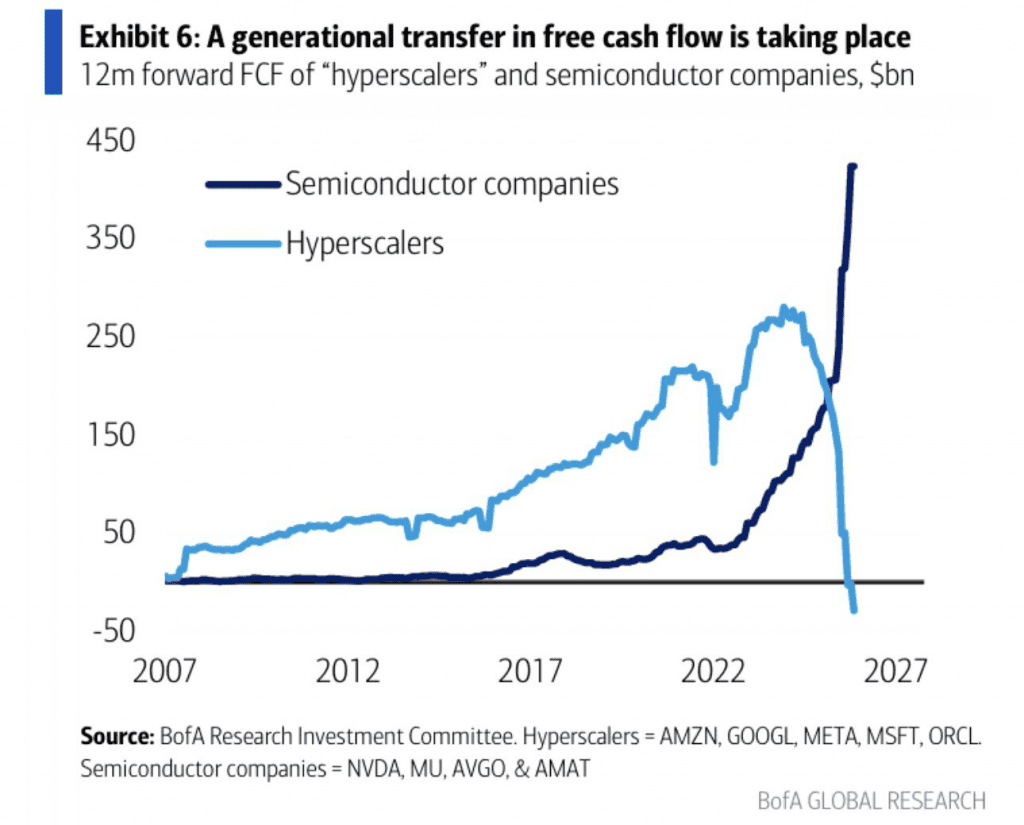
The mechanics behind this are not particularly mysterious once you connect it to what’s been happening across earnings calls this year. Hyperscalers are spending unprecedented sums building out AI infrastructure, and a huge chunk of that spending flows directly to the companies making the chips. BofA’s own reporting on hyperscaler capex points to roughly 60% of AI infrastructure spend going toward chips and accelerators, with Nvidia alone controlling 92% of the GPU market. Every dollar a hyperscaler spends on GPUs shows up as revenue, and eventually cash flow, on a semiconductor company’s books.
The scale of the transfer is easier to grasp with specific numbers. Barclays projects Alphabet’s free cash flow could fall by nearly 90% to $8.2 billion in 2027, down from $73.3 billion in 2025. Microsoft is expected to hold up better but still faces a projected 28% decline before any recovery. Goldman Sachs has put total hyperscaler capex from 2025 through 2027 at $1.15 trillion, more than double everything spent across the three years before that. None of that money disappears — it lands on someone else’s income statement.
What makes this cycle different from prior tech spending booms is how it’s being financed. The hyperscalers used to fund growth almost entirely out of their own cash generation. That’s no longer the case. Bank of America forecasts hyperscaler debt issuance will hit $175 billion in 2026, more than six times the $28 billion annual average of the previous five years. Companies that spent the better part of two decades sitting on enormous cash piles are now borrowing at a pace nobody has seen from this group before, and the semiconductor makers on the other end of those purchase orders are the ones absorbing the cash the debt is meant to cover.
There’s also a structural argument that this is deliberate rather than a sign of trouble. Google Cloud’s backlog of contracted data center rental agreements has grown past $460 billion, and Microsoft is sitting on an $80 billion backlog of Azure orders it can’t currently fulfill because of power constraints, according to the same BofA-adjacent reporting. If the bottleneck really is supply rather than demand, then hyperscalers burning through cash to build capacity looks less like distress and more like a land grab, with whoever builds fastest capturing outsized share of whatever AI revenue eventually materializes. NYU’s Ashwath Damodaran, who has been openly skeptical of current AI valuations, has called this the biggest infrastructure run-up he’s ever seen a business attempt, and has flagged that unlike the dot-com boom, this one is running on debt as much as equity — which changes who’s exposed if the payoff doesn’t arrive on schedule.
For semiconductor companies, riding this wave has been straightforwardly good news so far. For hyperscalers, the picture is murkier. Free cash flow going negative doesn’t automatically mean anything has gone wrong — companies can choose to spend down cash reserves and take on debt when they believe the long-term payoff justifies it. But it does mean the enormous cushion these companies have relied on for years is being spent down at a pace this chart makes hard to ignore, and the semiconductor industry is the direct beneficiary of where that money is going.