Similarweb’s latest rankings for May 2026 show all ten of the world’s most visited websites posting month-over-month growth — a cleaner sweep than April, when mixed results were the norm. But within that broadly positive picture, one number stands out: ChatGPT’s 0.99% growth, the smallest gain of any site on the list.
The top 10 rankings stayed intact from April. Google leads comfortably with a 20.45% traffic share and 87.5 billion monthly visits, growing 3.25% month-over-month. YouTube sits second at 6.98% share and 29.88 billion visits, up 5.24%. Facebook, Instagram, Reddit, X, WhatsApp, TikTok, and Bing all grew between 1.66% and 5.24%. TikTok held its place in the top 10 for a second consecutive month. ChatGPT, at fifth with 5.565 billion monthly visits, grew the least of the lot.
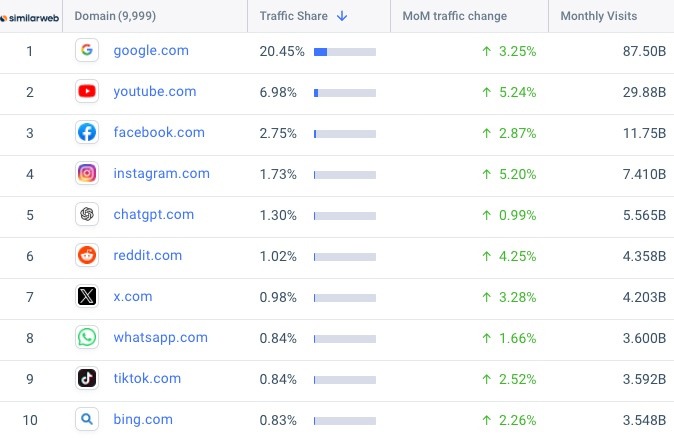
A 0.99% MoM growth for a site doing over 5.5 billion visits a month is far from catastrophic in absolute terms. But the contrast with the rest of the list is hard to ignore, particularly given how aggressively ChatGPT had been climbing the rankings over the past two years.
The Student Effect
One plausible explanation for the slowdown is the summer vacation cycle. ChatGPT’s user base skews heavily toward students — for writing help, research, coding assignments, and exam prep. As schools and universities wind down for the summer across North America and Europe, that demand drops off sharply. The sites that kept growing in May — YouTube, Instagram, TikTok, Reddit — are entertainment and social platforms that tend to do better when people have more free time, not less.
This isn’t a new dynamic for the AI industry. Seasonal dips tied to the academic calendar have shown up in ChatGPT’s traffic patterns before, and May sits right at the tail end of exam season in most Western markets. If a meaningful chunk of ChatGPT’s daily users are students reaching for it to get through coursework, the wind-down of that use case in late spring would show up in the numbers.
A Broader Context Worth Noting
The May data comes at a point where ChatGPT’s grip on the generative AI market has been loosening for several months running. Google Gemini, which held just 7.27% of generative AI web traffic share a year ago, had climbed to 26.7% by April 2026, while ChatGPT had slid from 77.6% to 53.7% in the same window.
At the same time, ChatGPT’s absolute user numbers remain formidable. Its DAU/MAU ratio of 36% — nearly double Gemini’s 21% — shows that existing users are still coming back far more consistently than on competing platforms. The growth story has cooled; the retention story has not.
The year-over-year picture tells a similar tale: in February 2026, Gemini grew 643% year-over-year while ChatGPT grew 37%. The gap in momentum between the two platforms is wide and has been widening steadily. OpenAI is increasingly competing from a position of scale rather than velocity.
For now, the May data is probably best read as a seasonal footnote rather than a turning point. Whether ChatGPT bounces back in June — when summer usage patterns tend to shift again, and when students may be using it for personal projects rather than coursework — will be a more telling indicator of where things actually stand.