Gemini’s growth appears to have slowed in recent months as it’s looked to upstage ChatGPT in consumer usage.
New SimilarWeb data for June 2026 shows ChatGPT holding steady at 52.7% of global generative AI web traffic, unchanged from May. Gemini, meanwhile, ticked up to just 27.8%, a gain of half a percentage point from the month before. For a rival that had been closing the gap on OpenAI at a remarkable pace for the better part of a year, that’s the smallest monthly move Gemini has posted in this entire stretch. In addition, Gemini didn’t gain any places in the list of the world’s most popular websites, staying at 12th place.
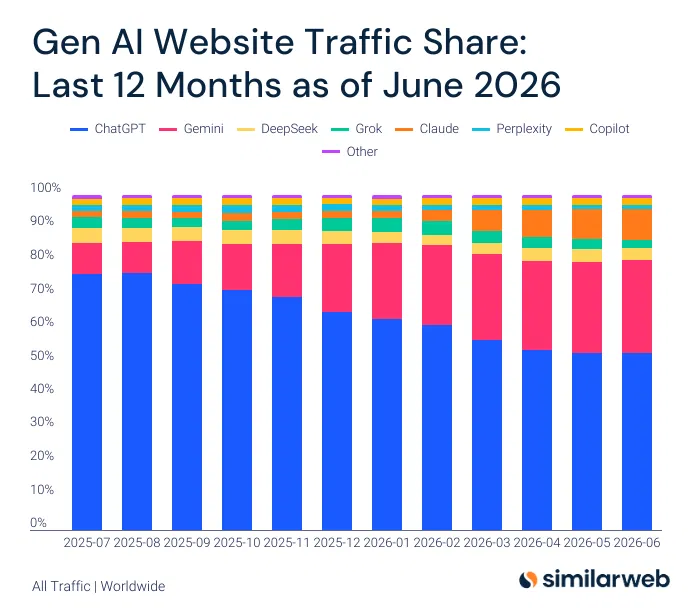
The deceleration is easier to see when laid out across the full twelve months. A year ago, in June 2025, ChatGPT commanded 76.4% of traffic while Gemini sat at 9.1%. By December, ChatGPT had slipped to 63.2% and Gemini had climbed to 22.6% — a jump of more than 13 points in six months, or roughly 2.25 points a month. From there through March, Gemini added another 4.1 points, a pace of about 1.4 points a month. Since March, though, Gemini has gained barely more than a point, landing at 27.8% in June against 26.7% three months prior. Whatever was fuelling that earlier surge has clearly cooled off.
As reported last month that ChatGPT was just about clinging on to a majority share, with the trajectory suggesting it was only a matter of time before it fell below 50%. That hasn’t happened yet, and June’s numbers suggest the timeline for it might be less certain than it looked a few weeks ago. ChatGPT holding flat month-on-month, after years of near-continuous decline, is itself worth noting.
The more interesting story in the June data belongs to Claude. Anthropic’s assistant has gone from 1.6% a year ago to 2.2% six months ago to 8.0% three months back, and now sits at 9.2% — the only major platform besides ChatGPT to gain share, and gain it consistently, every single period measured. Claude’s rise has been the sharpest of any platform tracked over the past six months, and it’s increasingly framed as the third real player in a market that not long ago looked like a straight ChatGPT-versus-Gemini contest. Anthropic’s momentum was also flagged in SimilarWeb’s March data, where Claude nearly tripled its share in a single quarter.
The rest of the field tells a story of stagnation rather than growth. DeepSeek has drifted between 3.3% and 4.6% over the past year without ever establishing a clear direction, currently sitting at 3.6%. Grok has actually gone backwards, falling from 4.1% six months ago to 2.5% today despite periodic bursts of attention around new model releases. Copilot has been remarkably flat throughout, holding at 2.0% for most of the year. Perplexity has had the roughest run of the group, sliding from 1.8% a year ago to 1.1% now, making it the smallest of the seven platforms SimilarWeb tracks.
Traffic share alone doesn’t capture the whole picture, of course. Engagement metrics have consistently shown ChatGPT users returning to the platform far more habitually than Gemini’s — a gap Pew’s own survey data broadly echoed earlier this year, and one that geography complicates further. Gemini’s gains have never been uniform; it has made real inroads in markets like Japan and South Korea while barely denting ChatGPT’s lead in the US and India. A slowdown in the headline global number could simply mean Gemini has picked off most of the markets where it was going to win easily, and is now grinding against tougher ones.
Whether June marks a genuine plateau for Gemini or just a pause before the next model release reignites growth is the question worth watching heading into the second half of the year. Google has rarely gone more than a couple of months without a product push of some kind, and a single strong release has been enough to move the needle by several points before. For now, though, ChatGPT has bought itself a bit more breathing room above the 50% line than it looked like it would have a month ago.