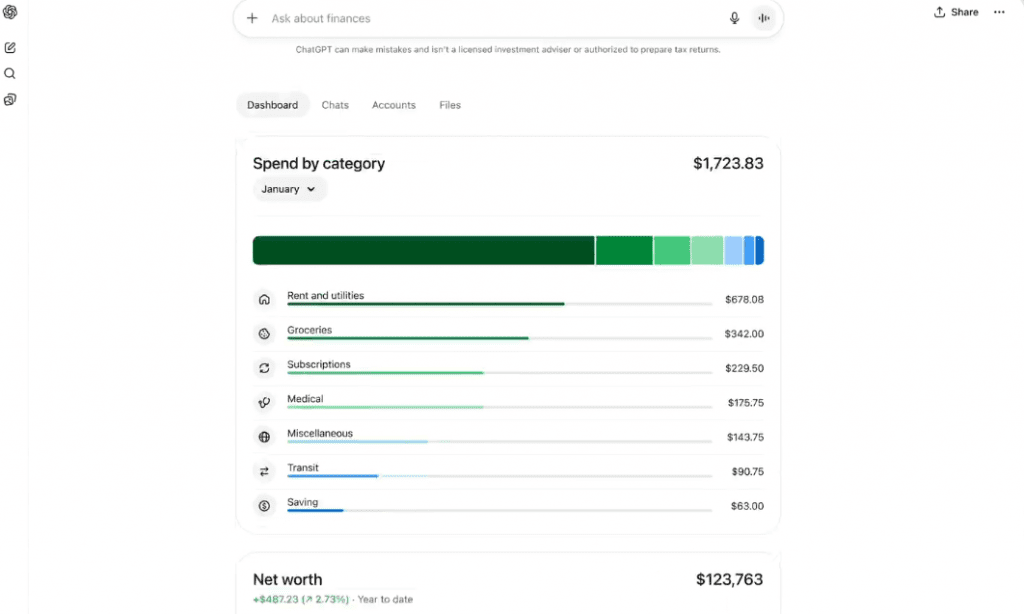
AI model companies are venturing further and further into building personalized, specific use-cases for their users. OpenAI’s latest move is a prime example: ChatGPT now lets Pro users in the U.S. securely connect their financial accounts, get a real-time spending dashboard, and ask context-aware questions grounded in their actual financial data.
What It Does
The feature, rolling out in preview on web and iOS, supports connections with more than 12,000 financial institutions through Plaid, with Intuit integration coming soon. Once linked, users get a dashboard covering portfolio performance, spending by category, subscriptions, and upcoming payments. ChatGPT can then field questions that draw on all of that — from goal planning and subscription audits to investment risk and scenario modeling.
The difference from a standard ChatGPT conversation is significant. Without connected accounts, the model offers generic budgeting frameworks. With them, it can analyze actual spending patterns, identify specific levers, and suggest a personalized savings plan — down to category-level caps and projected monthly savings.
Beyond raw account data, users can also feed in soft context: a savings goal, an informal loan, a planned big purchase. ChatGPT stores these as “financial memories” that carry across future conversations, giving the experience continuity that most standalone budgeting apps lack.
The Strategic Play
This isn’t OpenAI just adding a feature. It’s a calculated move to deepen user lock-in at a moment when ChatGPT’s market share is under real pressure from Google Gemini and others. Financial data is among the stickiest data a user can share — once someone connects their bank accounts and builds up financial memories, switching costs go up sharply.
OpenAI has also missed its own revenue targets in recent months, and the company needs stickier, higher-value use-cases to justify its Pro subscription tier. Personal finance — a domain where people already pay for tools like Mint, YNAB, or Copilot — is a logical place to plant a flag.
The Intuit partnership hints at the longer-term monetization angle. OpenAI envisions users moving from a ChatGPT recommendation directly to a credit card application, or from a tax question to booking a live session with a tax expert — all inside ChatGPT, powered by Intuit. That’s the kind of embedded, transactional workflow that could meaningfully expand revenue beyond subscriptions.
Model and Performance
Conversations in the Finances feature default to GPT-5.5 Thinking, OpenAI’s latest reasoning model. OpenAI built an internal benchmark with input from over 50 finance professionals to evaluate response quality on complex personal finance tasks. GPT-5.5 Thinking scored 79 out of 100; GPT-5.5 Pro — available to ChatGPT Pro subscribers — scored 82.5. Earlier models lagged significantly, underscoring why the rollout is pegged to the latest generation.
Privacy and Control
OpenAI has been careful to outline what the feature can and cannot do. ChatGPT can read balances, transactions, investments, and liabilities — but cannot see full account numbers or make any changes to accounts. Users can disconnect accounts at any time, with synced data deleted within 30 days. Financial memories can be individually reviewed and deleted from the Finances page. Temporary chats don’t access connected accounts at all.
The feature follows the same model training settings a user selects across ChatGPT, adjustable under Settings > Data Controls.
The Bigger Picture
OpenAI has grown from a research lab into a product with hundreds of millions of weekly users by finding domains where conversational AI delivers obvious value. Personal finance is one of the most universal pain points — and one where most people feel underserved by existing tools. Connecting a reasoning model to live financial data is a credible answer to that gap.
The rollout starts with Pro users, with Plus and broader availability planned as OpenAI refines the experience. It’s a measured approach — unsurprising given the sensitivity of the data involved. But the direction is clear: ChatGPT is moving from general-purpose assistant to a platform with deep, personalized, domain-specific utility. Personal finance is just the first major vertical.