The US has been relying on its hardware advantage to keep it ahead in the AI race, but this advantage might not remain for much longer.
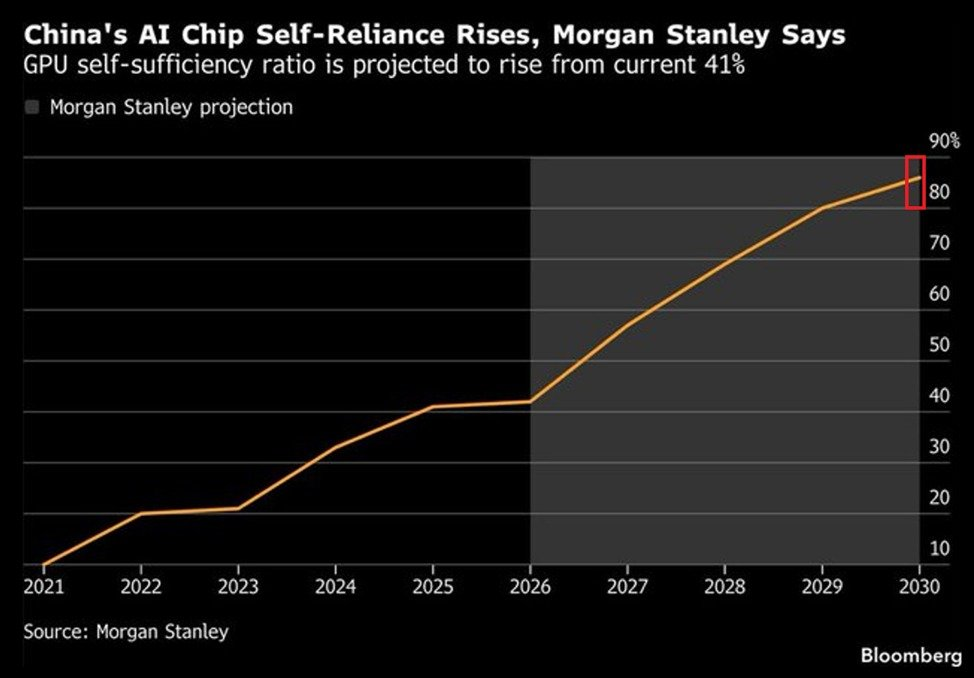
New data from Morgan Stanley shows that China’s GPU self-sufficiency ratio — the share of domestic AI chip demand met by locally produced chips — has crossed 41%, up from roughly 20% in 2023. That’s a doubling in just three years, and a quadrupling from where things stood in 2021. More strikingly, Morgan Stanley projects this ratio will climb to approximately 85% by 2030. At that level, China would be meeting nearly all of its own AI chip demand without relying on foreign supply.
A Forced Acceleration
The story behind these numbers is well-known: US export controls, progressively tightened since 2022, cut Chinese firms off from the world’s most advanced chips. The logic was straightforward — deny access to frontier hardware, slow down China’s AI development.
What happened instead was different. Denied access to Nvidia’s best GPUs, Chinese firms were pushed to build their own. Huawei’s Ascend series emerged as the flagship domestic alternative, with SMIC — China’s largest chipmaker — manufacturing chips using processes once considered beyond its reach. The Huawei-SMIC partnership has effectively become the backbone of China’s AI chip independence drive. Restrictions have, paradoxically, accelerated the very self-sufficiency they were designed to prevent.
The 2030 Trajectory
Morgan Stanley’s projection of ~85% self-sufficiency by 2030 is not a fringe estimate. The trend line is already moving steeply. Between 2021 and 2025, the self-sufficiency ratio rose modestly — from near zero to around 40% — as the domestic chip ecosystem was still maturing. The projected acceleration from 2026 onward reflects the compounding effect of years of investment now coming online: new fabs, more refined domestic tooling, and a growing software ecosystem around chips like the Ascend series.
For context, Chinese open-source AI models have already overtaken US models in global downloads — and much of that development has happened under chip constraints. An 85%-self-sufficient China is one that can train and run frontier models without worrying about US supply chains or export rule changes.
The Research Layer Is Shifting Too
Hardware is only part of the picture. China has simultaneously been building out its AI research base. It has surpassed the US as the working location of first authors at NeurIPS — the world’s premier machine learning conference — for the first time, with 2,152 top researchers compared to 1,810 from the US. Jensen Huang has noted that 50% of the world’s AI researchers are Chinese. If the hardware gap closes by 2030 as Morgan Stanley projects, the research momentum China has built starts to compound very differently.
Critics point out that Chinese models have so far been strong at efficiency and fast-following rather than foundational breakthroughs. Google DeepMind’s Demis Hassabis has argued that Western labs still hold the algorithmic edge. Anthropic CEO Dario Amodei has suggested that Chinese models are optimized for benchmarks rather than real-world tasks. These are legitimate points — but they describe the present, not 2030.
What Changes at 85%
A self-sufficiency ratio of 85% doesn’t just mean China can train its own models. It means US export controls lose most of their leverage. It means Chinese AI firms — Huawei, Alibaba, Baidu, ByteDance, DeepSeek — can scale compute without navigating Washington’s rule changes. It means China’s AI deployment, already aggressive domestically, faces fewer external bottlenecks.
The hardware chokepoint was always a time-limited strategy. The Morgan Stanley data suggests the window may be closing faster than expected. The US still leads in chip design, manufacturing equipment, and software ecosystems. But the gap between “leading” and “decisive advantage” is narrowing — and at 85% domestic sufficiency, that gap may no longer matter much.
The AI race has always been about more than chips. But chips were the one area where the US had a clear, enforceable structural advantage. According to Morgan Stanley, that advantage has a five-year shelf life.