When Z.AI listed on the Hong Kong Stock Exchange on January 8, 2026, the Beijing-based AI lab — formally known as Knowledge Atlas Technology — became the first major large language model company in the world to go public. The stock priced at HK$116.20, raising around $558 million. It was a milestone, not a moonshot. Or so it seemed.
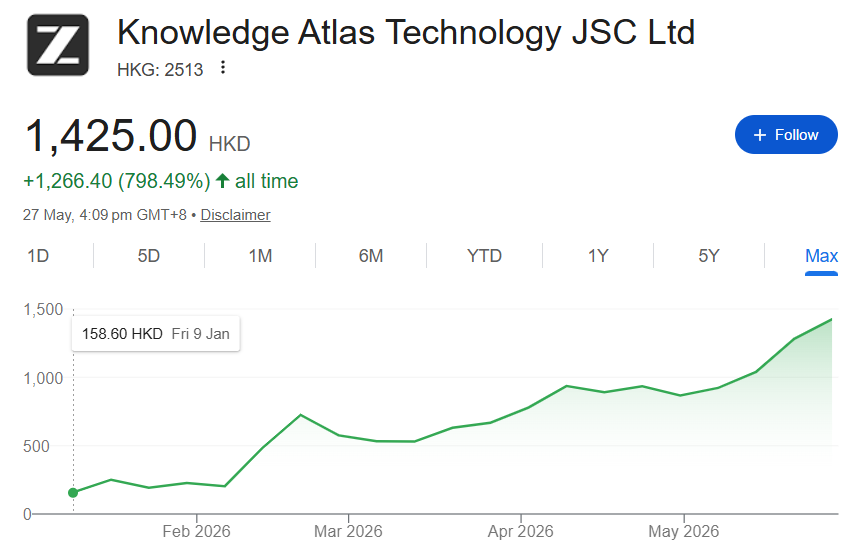
Fast forward to late May 2026, and the stock is trading at HK$1,425 — an all-time gain of nearly 800%, or roughly 10x its IPO price. Whatever expectations the market had, the reality has blown past them.
From Tsinghua Lab to Global Frontier
Z.AI didn’t emerge from a startup garage. The company traces its roots to Tsinghua University’s Knowledge Engineering Group, founded in 2019 by researchers Tang Jie and Li Juanzi. Its flagship product, the GLM (General Language Model) series, released China’s first proprietary pre-trained large-model framework in 2021. The company rebranded internationally as Z.ai in 2025, the same year it pivoted to releasing its models under the MIT open-source license — a move that dramatically accelerated developer adoption.
By the time it filed for its IPO, Z.AI held a 6.6% share of China’s large language model market by revenue, ranking it first among independent LLM developers and second overall in the country, according to Frost & Sullivan data.
The IPO and the Early Surge
The January 2026 debut was strong but not explosive. The stock opened 3.3% above its issue price and closed its first day at HK$131.5 — a respectable 13% pop. Cornerstone investors were in, JPMorgan had slapped an “Overweight” rating with a HK$400 price target, and the market was watching.
Then GLM-5 dropped.
On February 11, 2026, Z.AI released GLM-5 — a 744-billion-parameter Mixture-of-Experts model trained entirely on Huawei Ascend chips with zero dependency on Nvidia hardware. The model hit #1 among open-weight models on LMArena’s Text Arena and ranked as the best open-source model on Artificial Analysis, ahead of DeepSeek, OpenAI, and Kimi K2. The stock surged 29–34% in a single day, briefly spiking as high as 42%. By then, it had more than tripled from its IPO price.
Chips, Sanctions, and a Hardware Narrative
Part of what makes Z.AI’s rise so striking is the context in which it’s happening. The company has been on the US Entity List since January 2025, barred from acquiring American-made accelerators. And yet, rather than slowing down, it has doubled down on Huawei’s Ascend ecosystem and the MindSpore framework.
GLM-5 — and its successor GLM-5.1 — were built entirely on this domestic chip stack. GLM-5.1, released on March 27, 2026, scored 58.4 on SWE-Bench Pro, clearing GPT-5.4 (57.7) and Claude Opus 4.6 (57.3), making it the first Chinese model to top the most demanding software engineering benchmark in the industry. For investors, this is a compelling subplot: a company under Western sanctions building frontier AI on Chinese hardware and beating US labs at their own benchmarks.
That narrative has been a rocket beneath the stock.
The Release Cadence That Markets Love
Post-IPO, Z.AI has moved fast. GLM-5 launched February 11. GLM-5-Turbo followed on March 15. GLM-5.1 arrived March 27. Three significant model updates in six weeks. The $558 million raised in January is visibly compressing the company’s development timelines.
Management has set a bold target: $1 billion in cloud ARR by end-2026, roughly a 4x jump from March 2026 levels. DBS Bank, in a May 2026 research note, set a fair value of HK$1,300 — implying 19% upside from the report date — and flagged GLM-5.5 (expected June 2026) as a key upcoming catalyst.
The company is not yet profitable. It’s burning through cash on R&D, much like its Western counterparts. First operating profit is expected in FY2029, per DBS projections. But in a market that rewards model momentum over margins, Z.AI is playing the right game.
The Bigger Picture
Z.AI’s stock run isn’t just a company story — it’s a signal. China’s AI tigers are no longer just impressive in the lab. At least one of them is now a public market phenomenon, with a chart that would look at home alongside the West’s most celebrated AI stocks.
OpenAI and Anthropic remain private, but are both slated to go public this year. DeepSeek has no public listing. MiniMax has followed Z.AI to market, and is already worth more than Baidu.
For global investors trying to get direct exposure to frontier AI model development, Knowledge Atlas amd Minimax are currently the only pure-play options on a major exchange. That scarcity premium alone may explain a portion of the move. But the underlying model performance, the chip sovereignty narrative, and the relentless release pace all suggest this isn’t just a mania — it’s a company that has earned a significant part of its valuation.
The question now is whether GLM-5.5, the ARR targets, and the broader Chinese AI wave can keep the momentum going. Given what’s happened in the five months since the IPO, betting against Z.AI has not been a good trade.