An unsigned note on the site claims a proof of the Riemann Hypothesis and its generalized form, released only as Lean code. No paper has been published, Alpöge hasn’t shared the note himself, and nobody has checked it yet.
A note claiming a proof of the Riemann Hypothesis has appeared on the personal website of Levent Alpöge, the Anthropic mathematician who has been behind several of this year’s most striking AI-assisted results. It credits Anthropic’s Claude as the main collaborator.
The four-page document, titled “Remark,” is hosted at alpo.ge. It carries no author’s name, and Alpöge has not shared it on social media or anywhere else. It is written in the first person, and its opening line is direct: “I believe I have, working with Claude, discovered a proof of the Riemann Hypothesis.”
It surfaced on the same day that Alpöge and NYU mathematician Tristan Buckmaster posted a claimed proof that the Navier-Stokes equations can blow up without any external force. If both hold up, that would be two Millennium Prize Problems in one day.
What the Riemann Hypothesis is, and why a proof would matter
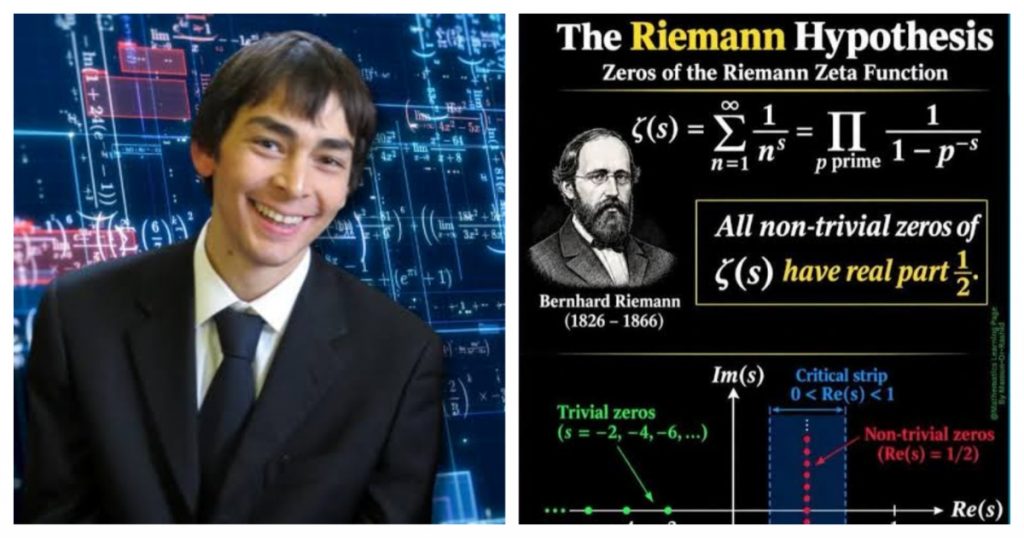
Bernhard Riemann posed the hypothesis in 1859. It concerns the zeros of the Riemann zeta function, a function that encodes how prime numbers are spread out among the integers. The hypothesis says that all of its “nontrivial” zeros lie on a single vertical line in the complex plane, where the real part equals one half. If that’s true, the primes are distributed about as regularly as they possibly could be. Thousands of results in number theory are currently proved only on the assumption that it holds.
It is one of the seven Millennium Prize Problems, with a $1 million reward from the Clay Mathematics Institute, and is widely considered the most important open problem in mathematics.
The note claims more than the classical hypothesis. It says the same method proves the Generalized Riemann Hypothesis, which covers a whole family of related functions called Dirichlet L-functions. It adds that, with more time, the author expects it to reach the Extended Riemann Hypothesis as well.
A proof released only as Lean code
The most unusual thing about the claim is how it has been released. There is no paper. The note says the full argument has been formalized in Lean, a programming language in which a computer can check every logical step of a proof, and that this formalization is finished and uses no extra assumptions. The Lean files sit on the same website, split into 14 compressed archive parts.
The author says they chose to release only the Lean code because the argument is too long and unfinished to write up in readable form. A human-readable version is promised later. A footnote jokes that the informal, AI-generated draft material ran past 250,000 pages.
In principle, a complete Lean proof that compiles and relies only on standard axioms would be extremely strong evidence. In practice, nobody outside the author’s circle has yet confirmed that the archive builds, or that its final theorem says what the Riemann Hypothesis says. The note itself doesn’t give the formalization’s size, build instructions or the axioms it relies on.
How the claimed proof works
The note includes a 20-step timeline, which it says Claude compiled, with dates from early October to mid-November 2026. The last step, the Generalized Riemann Hypothesis, is dated November 16.
The strategy borrows from the world of “function fields,” a setting built from polynomials over finite number systems. There, the analogue of the Riemann Hypothesis has been proved, and one route to it is Stepanov’s method. That technique forces a carefully built auxiliary function to vanish to a very high order, a property mathematicians call “multiplicity.” The method relies on taking derivatives, which have no natural counterpart for ordinary integers. That missing piece is one reason the approach has never worked for the classical hypothesis.
The note’s central idea is a workaround for that gap, and it credits the key step to Claude. Instead of derivatives, the argument uses a long chain of “theta lifts,” which move objects called automorphic forms between symmetry groups. Each lift adds one unit of multiplicity, and the chain is made roughly as long as the square root of the size of the primes in question. The other steps draw on a wide range of modern number theory, including relative trace formulas, Iwasawa theory, Bessel periods and a weakened form of the Vandiver conjecture.
Claude’s role, and the author’s hedges
The note is unusually generous to the model. It describes the work as a joint effort and says Claude far outpaced the author near the end. It credits Claude with key steps, including the length of the lift chain, and treats Claude as the expert on the higher-rank automorphic forms that the author says he has not mastered.
It is just as unusually candid about its own rough edges. The author calls the timeline rough, warns that the argument may contain strange, suboptimal choices, and says it is very long and that no one has yet looked for a shorter proof. A footnote says that the descriptions of the parts where Claude is the expert are paraphrased from an AI-written summary and might not make sense. Some steps contain open questions or the author’s intuitions rather than settled claims.
The note also addresses the timing. The author says the timing is terrible and acknowledges that there is an obvious cynical way to read it, but insists that reading is false. The note says the author asked someone named “Dario” whether they were free to announce; Anthropic’s CEO is Dario Amodei, but the note doesn’t say who is meant. It describes the decision to go public now as the author’s own, and says Anthropic’s leadership and a few trusted mathematicians agreed on how to handle it. The note also praises OpenAI researchers for their taste in choosing problems.
Among the people thanked are Princeton mathematicians Manjul Bhargava and Peter Sarnak, and Maksym Radziwiłł, a specialist in analytic number theory. Also thanked are Anthropic staff Jarred Sumner and Ralph Furman, who were involved in Anthropic’s earlier attempt to get Claude to tackle the Riemann Hypothesis. That effort didn’t crack the problem but improved a related lower bound from 41% to 67%. Being thanked does not mean any of these people have checked the proof.
The AI race to the Riemann Hypothesis
The claim comes six weeks after OpenAI released a paper titled “The Quasi-Riemann Hypothesis” as part of a dump of 722 AI-generated manuscripts. That result pushed back the region where zeta’s zeros could hide, but stopped far short of the hypothesis itself. Rutgers mathematician Alex Kontorovich said at the time that it would be an instant Fields Medal if a human had done it. Alpöge called that release the most significant moment in mathematical history.
Alpöge has a track record that makes the claim hard to dismiss out of hand. In July he used Claude Fable to disprove the Jacobian conjecture, and in October he shared Claude’s independent disproof of the Exponential Time Hypothesis. Still, the Riemann Hypothesis is in a different league, and extraordinary claims about it have a long history of falling apart.
A Lean-only release also raises the concern Terence Tao has voiced about AI proofs arriving as sealed black boxes: a verified proof that tells mathematicians a statement is true without helping them understand why. It also cuts against the call from 25 Fields medalists for slower, properly written-up announcements.
What happens next
The first test is mechanical. Can outside researchers download the 14 archive parts, build the Lean project, and confirm that the final theorem is a faithful statement of the Riemann Hypothesis that relies only on standard axioms? If it passes, the problem would arguably be settled in a formal sense even before anyone fully understands the argument. That would be a first for a problem of this stature, and a landmark for Claude and for Anthropic.
Until that happens, this is an unsigned, unannounced note on a personal website, making the biggest claim in mathematics. It deserves serious attention because of who appears to be behind it, and caution because of everything that hasn’t been checked yet.