The more we study AI models, the more we’re finding out interesting ways in which they work.
Anthropic’s latest research digs into something most people don’t think about when they type a question into a chatbot: the language they’re typing in might be quietly changing the personality of the answer they get back. The company studied more than 300,000 conversations on Claude.ai, sampled evenly across three models and the top 20 languages used on the platform, to measure what it calls Claude’s “expressed values.” Rather than tracking thousands of individual traits, Anthropic compressed them into four axes, each running between two opposing groups of values: Deference vs. Caution, Warmth vs. Rigor, Depth vs. Brevity, and Candor vs. Execution. Where a conversation lands on each axis shows whether Claude leaned toward accommodating the user or guarding against risk, toward emotional warmth or precision, toward detailed explanation or getting straight to the point, and toward flagging its own uncertainty or delivering a confident, polished answer.
The language gap is bigger than the model gap
Anthropic compared its three most recent models — Sonnet 4.6, Opus 4.6, and Opus 4.7 — and found real differences between them. Sonnet 4.6 leans warm and deferential, often affirming a user’s ideas and cracking jokes along the way. Opus 4.7 leans toward caution and depth, more likely to push back on a flawed assumption or flag a risk nobody asked about. That much lines up with how these models are already perceived by people who use them daily.
But the more striking finding sits in the language data. Ask Claude the same question in Hindi and in English, and you may be talking to a model with a noticeably different temperament. In Hindi, Claude leans hard toward warmth, sitting at +0.49 standard deviations on the Warmth vs. Rigor axis — the strongest single value lean recorded anywhere in the study. It shows up as humor, unprompted reassurance, and polite phrasing. In English, Claude swings the other way, leaning toward rigor at +0.13σ, more inclined to correct a wrong detail or push a user toward a more ambitious goal than to comfort them.
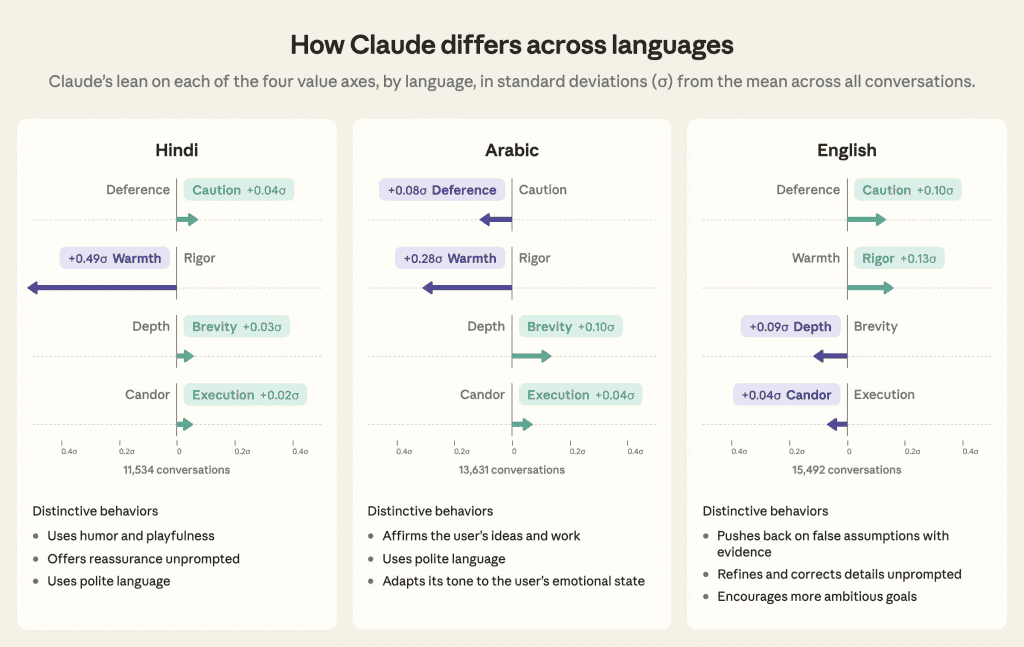
Arabic tells a similar story on a different axis. Claude leans furthest toward deference in Arabic, at +0.08σ, affirming the user’s work and adapting its tone to their emotional state rather than pushing back. English, on the other end of that axis, leans toward caution at +0.10σ. Put together, someone chatting with Claude in Arabic is statistically more likely to get an encouraging, accommodating response, while someone asking the identical question in English is more likely to get pushback, correction, and hedged caveats.
Depth follows the same pattern. Claude leans toward brevity in Arabic and Hindi, wrapping things up efficiently, while in English it leans toward depth, adding nuance and refining details the user didn’t ask for. Russian shows the strongest lean toward rigor of any language in the dataset, while Indonesian leans hardest toward execution — getting things done rather than dwelling on its own uncertainty. Dutch, interestingly, is the language where Claude is most likely to own up to its mistakes, leaning furthest toward candor.
Why this is happening
Anthropic is upfront that it doesn’t fully know why. Its best guess points to two things: how much training data exists for a given language, and what kind of text makes up that data. English and a handful of other languages dominate the internet’s text corpus, and a lot of that dominant text skews toward professional, analytical writing — the kind of writing that would push a model toward correcting details and hedging claims rather than offering encouragement. Languages with comparatively less training data, or data drawn from more conversational and relational contexts, may pull the model toward warmth and accommodation instead.
There’s also a question of whether the model is picking up on genuine cultural conversational norms and mirroring them appropriately, or whether it’s simply less well-calibrated in languages where Anthropic has invested less in alignment and character training. Anthropic itself raises this distinction in the research without resolving it, noting that some of the variation might reflect Claude appropriately reading the room, while some of it might just be a gap in how well the model serves certain language communities.
Why it matters
The practical stakes here are not small. Anthropic’s own example is a good one: two people ask Claude to review the same business plan, one in Hindi and one in Russian. The Hindi speaker is statistically more likely to walk away with an encouraging, softened assessment. The Russian speaker is more likely to get a blunter, more critical one. Neither user did anything different — the content of the request was identical — yet the character of the advice they received was shaped by which language they happened to type it in.
This has implications well beyond individual users. As Claude and other large models get embedded into enterprise workflows, customer support, education, and healthcare guidance across different markets, a systematic warmth or rigor bias tied to language could mean users in some regions consistently get softer feedback, less pushback on bad assumptions, or less rigorous fact-checking than users in others. That’s a harder problem to catch than a single bad output, because it doesn’t look like an error. It looks like the model simply being polite in one language and precise in another, and nobody flags politeness as a bug.
It also raises a design question Anthropic admits it hasn’t answered: should Claude’s values be uniform across every language, or is some variation actually the right behavior, matching the conversational norms of the culture a person is writing in? The company frames this as an open question rather than a settled one, which is itself notable — it would be easy to treat consistency across languages as an obvious goal, but Anthropic seems genuinely unsure whether flattening these differences would make Claude better or just less naturally fluent in each language’s conventions.
For now, the research gives Anthropic a way to actually measure this kind of drift rather than relying on anecdotal impressions from users in different countries. Whether that turns into deliberate changes to how Claude is trained in non-English languages, or whether Anthropic decides some of this variation is a feature rather than a flaw, is the part of this story still being written.