Cognition, the startup behind the autonomous AI coding agent Devin, has released SWE-2, a new coding model it says lands almost on par with today’s frontier models while costing dramatically less to run.
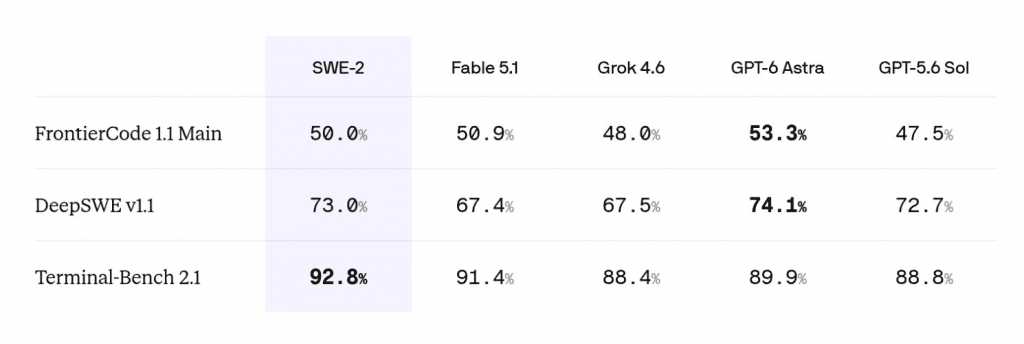
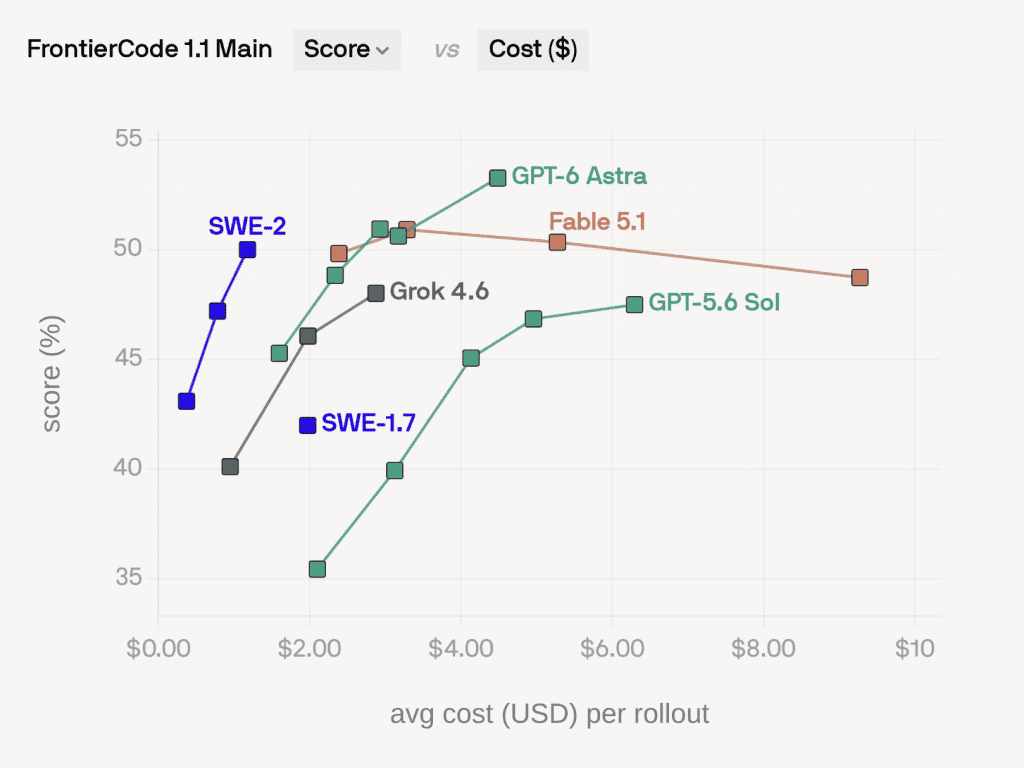
Announcing the model on Wednesday, Cognition said SWE-2 scores 50.0% on FrontierCode 1.1 Main, its own benchmark for evaluating whether AI-written pull requests would actually be merged by a human maintainer. That puts SWE-2 within a single point of Fable 5.1, Anthropic’s frontier-tier coding model, while Cognition says it costs 64% less to run at that score. On the same benchmark, Cognition claims SWE-2 also beats SWE-1.7, its previous model, as well as xAI’s Grok 4.6, and comes within a few points of OpenAI’s GPT-6 Astra at roughly a quarter of the price. The “70% lower cost” figure in the headline reflects the top end of these savings across the benchmarks Cognition tested.
SWE-2 is built on top of Kimi K3, a 2.8-trillion-parameter open model from Moonshot AI that had already gone through substantial reinforcement learning for coding tasks before Cognition got hold of it. This continues a pattern from SWE-1.7, which was built on Kimi’s earlier K2.7 Code model — rather than training a foundation model from scratch, Cognition’s approach has been to take a strong open base model and layer its own large-scale RL training on top to specialize it for real-world software engineering work inside Devin.
According to Cognition, the standout technical contribution this time is an RL method that trains multiple “effort levels” — medium, high and max — in a single training run, rather than needing separate runs or separate models for cheaper, faster responses versus slower, more thorough ones. The company says this let it push the entire cost-to-performance curve upward at once, instead of improving one point on the curve at the expense of others.
The efficiency gains Cognition is pointing to aren’t just about the price per token. The company says SWE-2 medium matches or beats SWE-1.7’s score on FrontierCode 1.1 Main while taking 58% fewer turns to get there and costing 81% less on average. Cognition attributes this to the model being more targeted in how it explores a codebase before making changes — it says SWE-2 medium makes its first real code edit after a median of 18 steps, compared to 48 steps for SWE-1.7, which had drawn user feedback for over-exploring simple tasks.
Alongside the performance numbers, Cognition also published results from its internal trustworthiness evaluations, covering propaganda/censorship behavior and context-dependent vulnerability in generated code, run across SWE-2 and five other models including Kimi K3, GLM 5.3, GPT-5.6, Fable 5.1 and Anthropic’s Opus 5.
SWE-2 is rolling out today across Devin Desktop, CLI, Web and Fusion.
The release comes as Cognition has been on a rapid growth run this year. The company was recently valued at $48 billion following backing from investors including a16z and Accel. It’s also part of a broader trend of AI labs building coding models on top of Chinese open-weight bases and undercutting frontier pricing — a race that also includes Chinese labs shipping their own aggressively priced models, such as DeepSeek’s recently released V4.1 Flash.