As AI costs have risen for companies, some are looking at innovative ways to bring them down — and seeing plenty of success.
Databricks has published a detailed breakdown of how large enterprises are managing the ballooning expense of agentic coding tools, drawing on its own internal data as well as conversations with Stripe, Coinbase, Uber and Ramp. The company says the techniques it has documented, ranging from switching models to trimming token overhead, are collectively saving some organisations up to 90 percent on their AI coding bills.
The post says agentic coding has delivered real productivity gains at the company, with some teams reportedly seeing order-of-magnitude improvements in output. But the cost curve associated with that productivity has grown exponentially, and left unaddressed, Databricks warns it will eventually eat into the very efficiency gains companies are chasing.
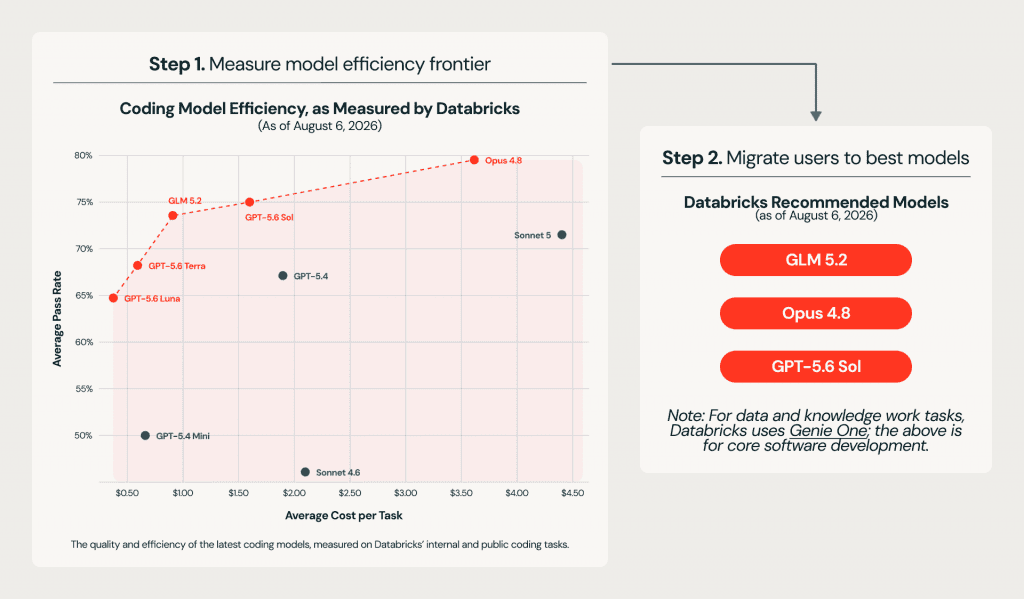
Chasing the efficiency frontier, not the intelligence frontier
The central argument in the piece is that most companies are optimising for the wrong thing. Frontier labs compete on peak intelligence, building models capable of solving Olympiad-level math problems or novel cybersecurity challenges. Databricks argues that the bulk of day-to-day software engineering doesn’t need that kind of horsepower, and that what actually matters at scale is what it calls the “efficiency frontier”: the models offering the best intelligence per dollar.
That frontier, the company says, is moving faster than the intelligence frontier itself, with new releases arriving almost weekly that beat older models on price-to-performance. Databricks points to its own adoption of Z.ai’s GLM models as an example, after internal benchmarking showed the open Chinese models were competitive on cost and quality against proprietary alternatives.
Not every new release clears that bar, though. Databricks says its own testing found Opus 5.0 came with a cost regression relative to Opus 4.8, and it cites Stripe’s internal finding that Opus 4.7 didn’t meaningfully improve on Opus 4.6 while costing more, leading Stripe to keep it out of its internal toolchain. The company’s framing suggests that evaluating new model releases has become a constant, almost weekly exercise for platform teams, rather than a one-off decision.
Meta-harnesses over hard lock-in
A recurring theme in the report is the tension between developer tooling and model flexibility. Coding harnesses like Claude Code, which now accounts for roughly 4 percent of all public GitHub commits, are often tuned to work best with a specific model family, which can make switching costly even when a cheaper model becomes available. Databricks says companies broadly take one of two approaches to this problem: ask developers to manually switch harnesses when the company wants to shift spend, or adopt a “meta-harness” that presents one interface to developers while routing requests across different underlying models and harnesses behind the scenes.
Databricks has built its own meta-harness, called Omnigent, which it has open-sourced alongside a cost-management layer called Unity AI Gateway. The company says this is the default setup for its own developers.
Routing, budgets and cutting token bloat
Beyond model selection, the report lays out three ways companies are automating the choice of which model handles a given task: routing individual requests through a proxy that picks the cheapest capable model, routing entire tasks to different harnesses based on complexity, and pairing a cheap and expensive model together within a single harness so the cheaper one escalates only when needed. Databricks says its own Smart Router feature has cut average task cost by more than 30 percent while holding quality roughly steady against the most expensive model available.
On budgets, Databricks pushes back on the instinct to simply cap spend per developer. It argues that hard cutoffs tend to be counterproductive, since the highest spenders are often the developers extracting the most value from AI tools in the first place. Instead, the companies surveyed favour real-time spend visibility, self-clearing warnings as usage climbs, and downshifting developers to cheaper models before resorting to full suspension.
The report also flags token overhead as an underappreciated cost driver. A simple request like “fix this bug” can trigger a cascade of tool calls, codebase searches and context-gathering before any actual model inference happens, meaning the user’s original prompt often makes up a tiny fraction of what the model is billed for. Databricks says tuning its harness and caching settings cut generated tokens by almost 50 percent with no drop in output quality.
The company is positioning its own infrastructure, Omnigent and Unity AI Gateway, as reference implementations of the approach, while acknowledging that other companies it spoke with have built similar systems internally.