Chinese labs aren’t only releasing flagship models, but they’re also innovating on models for specific use-cases.
DeepSeek has put out an experimental model called V4-Flash-Vision-Exp, and it’s a fairly narrow addition to the company’s lineup rather than a new flagship. The model is a multimodal variant of DeepSeek-V4-Flash, the smaller and faster of the two models DeepSeek released back in April alongside V4-Pro. According to DeepSeek, V4-Flash-Vision-Exp holds onto the text capabilities of the base V4-Flash model, including its agentic behaviour, reasoning and general knowledge, while adding image understanding on top. The headline claim from the company is that on multimodal agent benchmarks, the new model brings performance close to Claude Opus 4.8, Anthropic’s current flagship model.
The model is live now on the DeepSeek API platform, accessible with the identifier deepseek-v4-flash-vision-exp. DeepSeek has also shipped version 0.1.1 of its Harness framework on the same day, with built-in support for the new model, and a Files API that lets developers upload an image once and reference it repeatedly across requests using a file ID instead of re-uploading the same data each time.
What The Benchmarks Show
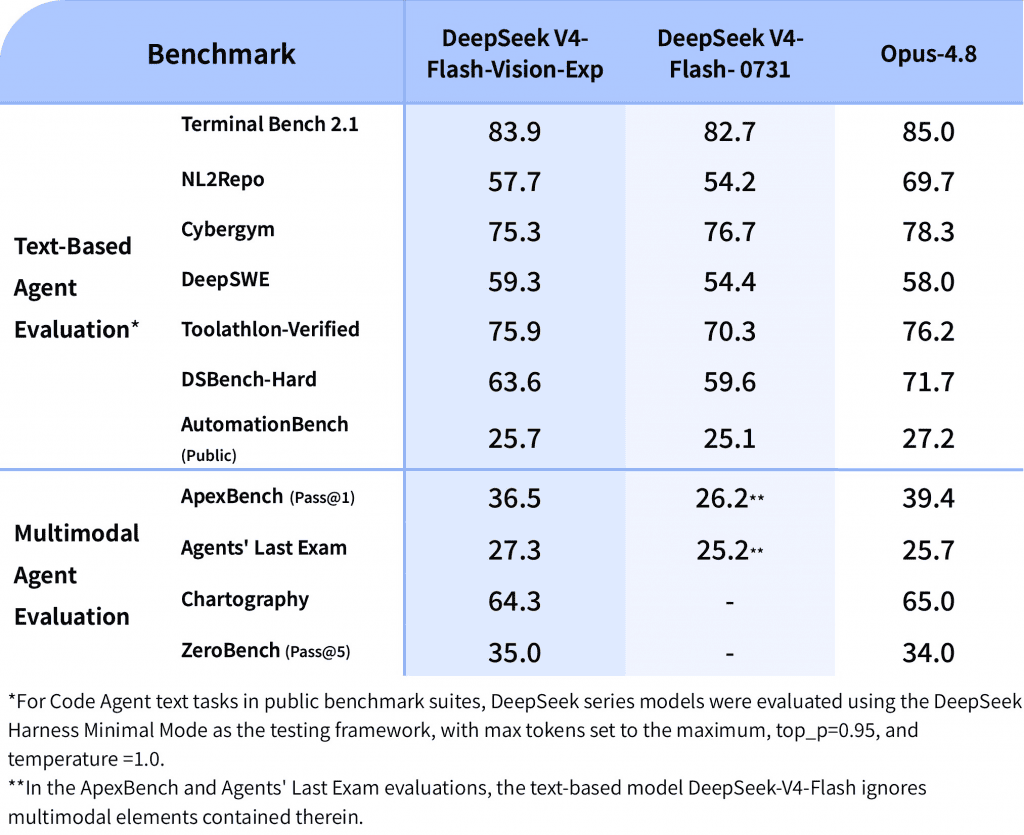
The numbers DeepSeek has put out compare three models: V4-Flash-Vision-Exp, the older text-only V4-Flash-0731, and Claude Opus 4.8. On text-based agent evaluations, the two DeepSeek models land close to each other, which tracks with the company’s claim that the vision variant doesn’t sacrifice text performance to gain multimodal ability. On Terminal Bench 2.1, V4-Flash-Vision-Exp scores 83.9 against 82.7 for the older V4-Flash and 85.0 for Opus 4.8. On NL2Repo, the gap to Opus 4.8 is wider — 57.7 versus 69.7 — and a similar pattern shows up on DSBench-Hard, where DeepSeek’s new model trails Opus 4.8 by roughly eight points.
Where the release earns its billing is on the multimodal side. On ApexBench, measured at Pass@1, V4-Flash-Vision-Exp scores 36.5, a sizeable jump from the 26.2 the text-only V4-Flash manages when it’s forced to ignore image inputs in the same test. That still leaves it behind Opus 4.8’s 39.4, but the gap has narrowed considerably compared to what a text-only model without vision could ever achieve on a benchmark built around visual reasoning. On Agents’ Last Exam, V4-Flash-Vision-Exp actually edges past Opus 4.8, scoring 27.3 against 25.7. The same happens on ZeroBench (Pass@5), where DeepSeek’s model comes in at 35.0 versus Opus 4.8’s 34.0. Chartography is the one benchmark where DeepSeek publishes no comparison figure for the older V4-Flash, presumably because the test leans heavily enough on visual input that a text-only model isn’t a meaningful baseline; here V4-Flash-Vision-Exp scores 64.3 against Opus 4.8’s 65.0.
Two footnotes on the chart are worth flagging. DeepSeek evaluated its own models using what it calls DeepSeek Harness Minimal Mode, with max tokens set to their ceiling, top_p at 0.95 and temperature at 1.0 — a testing setup that DeepSeek controls end to end, which is standard practice for a lab benchmarking its own release but still means these aren’t independently verified numbers. And on ApexBench and Agents’ Last Exam specifically, the text-only V4-Flash score reflects a model that simply ignores any multimodal elements in the test, so the comparison there is really showing what a model without vision loses on tasks that expect it.
An API Built Around Agent Workflows
DeepSeek is framing this release less as a benchmark chase and more as infrastructure for agent use cases that need to see as well as reason. The company says V4-Flash-Vision-Exp works across existing agent frameworks, pairing visual understanding with tool use in a way that opens up workflows a text-only model couldn’t handle — reading a dashboard screenshot before deciding on an action, say, or parsing a diagram as part of a longer task.
On pricing, images are billed by token count, capped at 384 tokens per image, at the same rate as V4-Flash’s existing pricing. That keeps the economics simple for developers who are already building on V4-Flash and want to add vision without restructuring their cost model. The API supports Chat Completions, Messages and Responses formats, along with mixed text-and-image input via base64 encoding, external URLs, or the new Files API. The Files API itself is free to use, and its main pitch is bandwidth — upload an image once and call it repeatedly by ID rather than resending the same payload on every request.
This is the kind of release that doesn’t move the needle on where China’s frontier labs stand relative to the likes of Anthropic, OpenAI or Google DeepMind, but it does say something about how those labs are now approaching the market. DeepSeek already has a flagship pair in V4-Pro and V4-Flash, priced well below what US labs charge for comparable capability, and it has been climbing usage charts on aggregators like OpenRouter on the strength of that value proposition. An experimental vision variant of an already-cheap model is a way of extending that reach into agentic and multimodal territory without the cost or risk of training a new flagship from scratch, and it fits a pattern that’s shown up elsewhere too, with labs like MiniMax and Zhipu AI also pushing multimodal and agentic capability into their mid-tier models rather than reserving it for a single top-line release.
Whether V4-Flash-Vision-Exp graduates from “experimental” to a permanent part of DeepSeek’s lineup will likely depend on how developers actually use it. For now, it’s a fairly clear signal that the next round of competition among Chinese AI labs isn’t only about who has the biggest model, but about who can make a cheap, fast model good enough at seeing the world to be useful in production.