The US is overall quite wary of AI progress, but attitudes differ across party affiliations too.
A new Pew Research Center survey — conducted February 17–23, 2026, and part of its “Americans and AI 2026: Chatbots, Smart Devices and Views on Impact” report — has found that Democrats and Democrat-leaning independents have become significantly more skeptical of both the government’s ability to regulate AI and US companies’ ability to develop it responsibly. The flip is notable because it represents a direct reversal of the pattern seen in 2024.
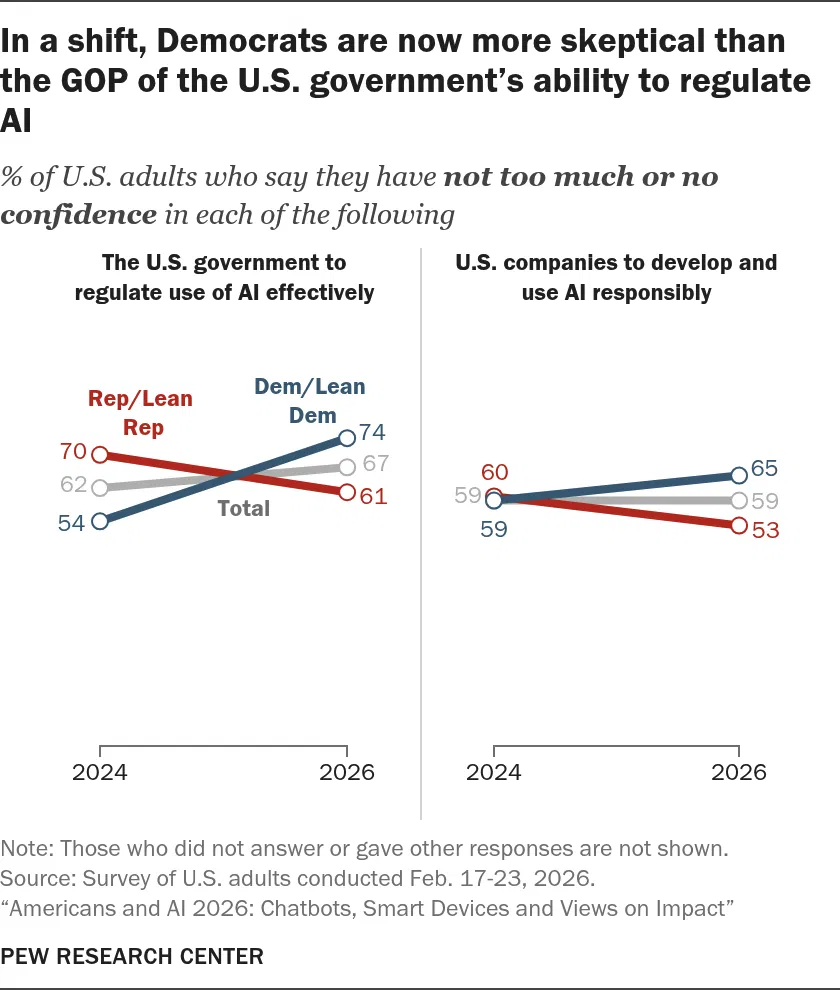
In 2024, 54% of Democrats said they had “not too much or no confidence” in the US government to regulate AI effectively. By 2026, that figure had climbed to 74% — a 20-point jump in two years. Republicans moved in the opposite direction: from 70% in 2024 down to 61% in 2026. The lines crossed somewhere in the middle, and the gap between the two parties is now 13 points — with Democrats on the more skeptical end.
The story on corporate confidence follows a similar arc. In 2024, both parties were nearly identical in their distrust of US companies to develop and use AI responsibly — 60% among Republicans and 59% among Democrats said they lacked confidence. By 2026, Republicans had dropped to 53% while Democrats had risen to 65%. Again, the parties swapped places.
The overall population has also grown more skeptical of government regulation during this period, with the total figure rising from 62% to 67%, though the partisan crossover is the more striking development. Trust in US companies to handle AI responsibly held roughly flat in aggregate (59% in both years), masking the divergence happening underneath.
The timing matters. The survey was conducted in February 2026, which places it squarely in the middle of growing tensions between AI companies and the Trump administration. The Anthropic controversies — including public standoffs over military deployment terms and export controls — have kept AI governance questions in the headlines for months. Republicans under the current administration have generally favoured a lighter regulatory touch on AI, while many Democrats have grown increasingly vocal about the risks of moving too fast with too little oversight. That ideological environment likely informed how respondents from each party interpreted the questions.
There is also a broader context worth noting: Americans have consistently ranked among the most skeptical populations in the world when it comes to AI governance, regardless of party. Surveys across multiple years have found that US citizens trust their government to regulate AI far less than citizens in countries like Singapore. The Pew data doesn’t change that picture — it adds a partisan layer to an already cautious public.
What the data doesn’t tell us is whether the shifting Democratic skepticism reflects a principled view about AI risks, a reaction to the current administration’s approach to tech policy, or simply partisan repositioning in response to who is seen as “pro-AI” at the federal level. Probably some combination. What it does tell us is that faith in the institutions responsible for managing AI — whether government regulators or the companies building it — is eroding faster on the left than on the right, and that the political coalitions around AI governance are no longer where they were even two years ago.
For the AI industry, this is worth watching. Palantir CEO Alex Karp has already warned that AI companies risk nationalization if they alienate educated, politically active workers while simultaneously avoiding military obligations. A public that is broadly skeptical — now including a Democratic base that was previously more trusting — gives politicians on both sides room to run on tighter AI oversight. The question is what form that pressure eventually takes.