The impacts of AI are showing up in all kinds of unexpected places.
New data from a16z, citing an NBER working paper by Reimers & Waldfogel (2026), shows that monthly ebook releases on Amazon have roughly tripled since ChatGPT launched in late 2022. Before the release of OpenAI’s chatbot, Amazon was seeing around 80,000–110,000 new ebooks per month — a figure that had held relatively steady for nearly three years. Today, that number stands at close to 300,000 per month, with a peak of over 310,000 in early 2026.
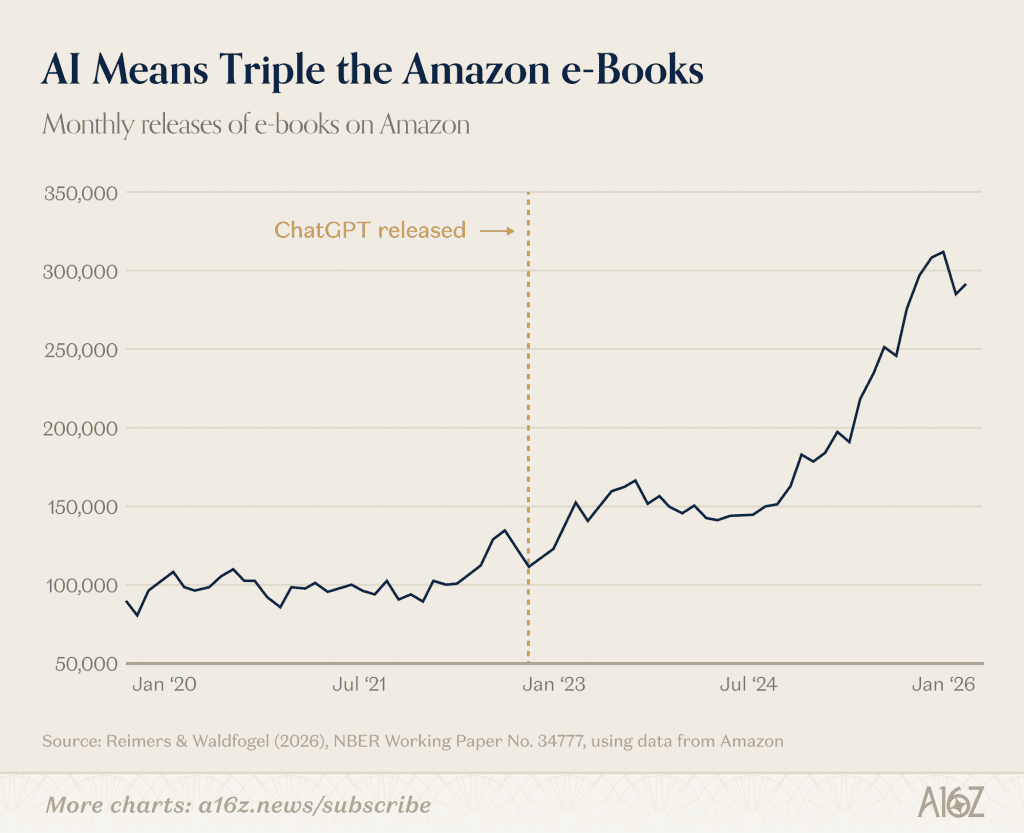
The Chart That Tells the Story
The inflection point is hard to miss. For most of 2020, 2021, and early 2022, the monthly ebook count on Amazon flatlined. Then ChatGPT dropped in November 2022 — and the curve broke sharply upward. Within months, publications were surging past 150,000 per month, and by mid-2025 had crossed 200,000. The climb has continued since.
This is what AI disruption looks like in practice: not a dramatic overnight collapse of an industry, but a quiet, relentless flood of output.
A Low Barrier Just Got Lower
Amazon’s Kindle Direct Publishing (KDP) platform was already one of the most accessible publishing pipelines in the world — free to use, globally distributed, no gatekeepers. AI has now removed what was arguably the last remaining bottleneck: the time and effort required to actually write a book.
The result is an explosion of content. As Sam Altman noted back in early 2023, creative and white-collar work would be among the first to feel AI’s impact. Ebook publishing is a case study in exactly that — and it happened faster than most expected.
What It Means for Authors and the Publishing Industry
For working writers, the numbers are sobering. When supply triples without a corresponding tripling in reader demand, prices drop and discoverability suffers. Human authors are now competing not just with each other, but with an essentially unlimited stream of AI-generated content.
This is part of a broader pattern. Anthropic’s own usage data shows that creative fields are among the heaviest users of AI tools, suggesting the ebook wave is no accident — writers and content creators are actively integrating these tools into their workflows. Also, plenty of text is now being generated by AI — AI-generated text has surpassed human-written text on the internet this year.
Meanwhile, Andrej Karpathy has argued that books themselves are becoming prompts for AI synthetic data generation, rather than just end products — which suggests the relationship between AI and publishing will only deepen.
The Signal in the Noise
Not all 300,000 monthly ebooks are pure AI output. Many are likely AI-assisted — written, edited, or formatted with the help of language models. The distinction matters less and less, though. What the data captures is a fundamental shift in the cost of production.
When producing a book takes hours instead of months, volume explodes. And when volume explodes, the economics of the entire market reorganize around that new reality. We are already watching it happen.
The ebook market is an early and unusually clean example of what AI does when it encounters an industry with low distribution costs and a purely informational product. Other industries are watching — or should be.