Anthropic has set the cat among the pigeons for yet another industry.
The AI company launched Claude Design, a product that lets users collaborate with Claude to create designs, prototypes, slides, one-pagers, and more — powered by its newly released Claude Opus 4.7 model. The market’s reaction was swift and brutal for Figma: shares of the design software company (NYSE: FIG) fell as much as 7.28% on the day, settling at $18.84 — well below the previous close of $20.32.
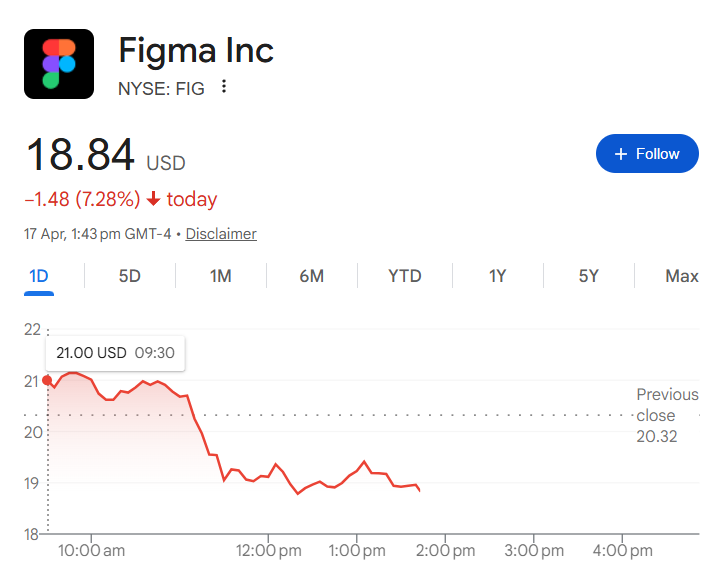
The drop didn’t come entirely out of nowhere. Earlier this week, Anthropic’s Chief Product Officer Mike Krieger quietly resigned from Figma’s board on April 14 — the same day reports of the upcoming design tool first emerged. Figma’s stock had already slipped 6% on that news. Today’s launch confirmed what investors feared: Anthropic wasn’t building around Figma, it was building against it.
What Claude Design Actually Does
Claude Design is not a minor feature add. It’s a full creative collaboration layer that lets anyone — designer or not — describe what they want and receive a working first version. From there, users refine through conversation, inline comments, direct edits, or custom sliders. Critically, it ingests a team’s existing design system — reading codebases and design files during onboarding — and applies colors, typography, and components automatically to every project.
The feature set is aggressive. Designers can turn static mockups into shareable interactive prototypes without touching a PR queue; product managers can sketch feature flows and hand them straight to Claude Code for implementation; founders can go from a rough outline to a complete pitch deck — exported as PPTX or sent directly to Canva — in minutes; and marketers can build landing pages, social assets, and campaign visuals without waiting on a design queue. At the more experimental end, Claude Design can produce code-powered prototypes with voice, video, 3D, and built-in AI.
The export options — standalone HTML, PDF, PPTX, or direct handoff to Claude Code — mean Claude Design is designed to slot into existing workflows rather than demand a full migration.
The Boardroom Prelude
The Krieger resignation deserves more scrutiny than it’s received. He co-founded Instagram, built the AI news app Artifact (acquired by Yahoo in 2024), joined Anthropic as CPO in 2024, and took a board seat at Figma less than a year ago. His departure on April 14 — disclosed to the SEC the same day reports of Anthropic’s design ambitions broke — was no coincidence.
Figma had been a close Anthropic partner, integrating Claude models into its products as AI assistants for designers. That relationship now looks more complicated. The two companies aren’t just operating in adjacent spaces — they’re competing directly for the same design workflows.
Collateral Damage
Figma wasn’t the only casualty when the initial reports broke on April 14. Adobe fell 2.7%, Wix dropped 4.7%, and GoDaddy declined 3% — a signal that investors see Claude Design as a threat to the broader design and web creation ecosystem, not just Figma. Presentation-maker Gamma and Google’s AI design tool Stitch were also cited as potential targets. Figma has additional headwinds beyond today’s news. Since its IPO last summer — one of the year’s biggest — the stock has fallen more than 80% from its post-IPO high.
The Bigger Pattern
Anthropic’s move into design follows a pattern worth noting. The company has been systematically expanding from a model provider into a product company. Claude’s traffic is up roughly 5x over the past year, it raised $30 billion at a $380 billion valuation in February, and eight of the Fortune 10 are now customers. Claude Code has already disrupted the developer tooling space. Claude Design is the same playbook applied to visual work.
The launch of Opus 4.7 — with vision capabilities more than three times sharper than its predecessor — is not incidental to Claude Design. Higher-resolution image understanding directly enables better interface generation, slide creation, and document output. The model and the product were built together.
For Figma, the path forward isn’t obvious. The company’s moat has always been collaboration and the network of designers who live inside it. Claude Design, at launch, is available to Claude Pro, Max, Team, and Enterprise subscribers — a large and growing base. Whether Anthropic can replicate the community and workflow depth that Figma has built over a decade is a fair question. But the fact that markets are asking it at all is the real story today.