Even as AI is making big strides in knowledge work, it appears that blue-collar jobs won’t be safe for much longer either.
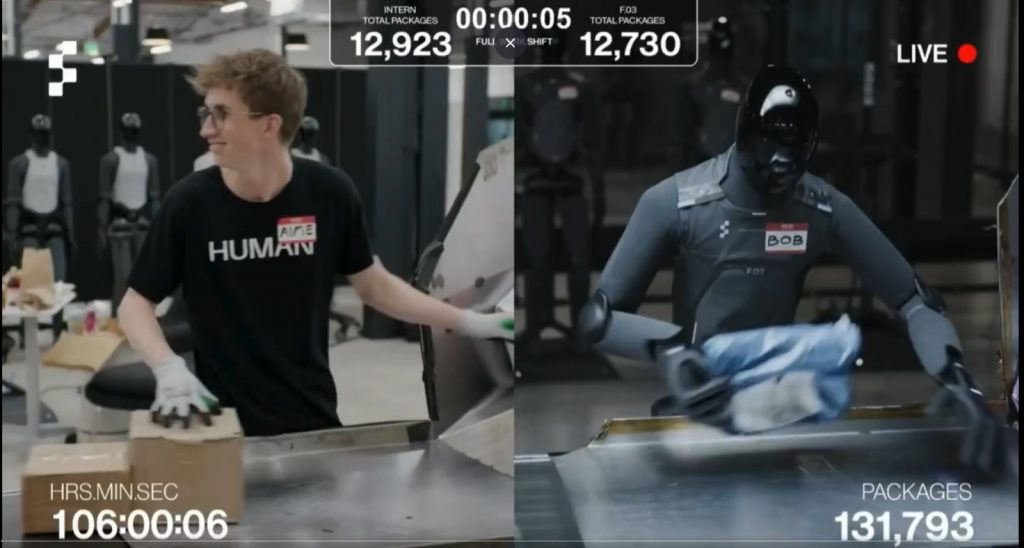
Figure AI, the California-based humanoid robotics startup, recently staged a live-streamed “Man vs. Machine” challenge — pitting a human intern named Aime against its F.03 humanoid robot, Bob, in a 10-hour package-sorting marathon. The result was closer than anyone expected: Aime won, but barely.
The Rules
CEO Brett Adcock kept the setup simple and fair. Each competitor had to detect a barcode on a package, pick it up, and place it barcode-face-down onto a conveyor belt — repeatedly, for 10 straight hours. Aime, following California labor law, received both meal breaks and paid rest breaks during the shift. The robot, naturally, did not.
A Human Win — For Now
The final scores told a tight story:
- Aime (Human): 12,924 packages — 2.79 seconds per package
- F.03 (Robot): 12,732 packages — 2.83 seconds per package
Aime won by just 192 packages. The margin, however slim, carried real weight — Adcock himself declared it would be “the last time a human will ever win.” The robot had actually overtaken Aime around hour five, when the intern took a bathroom break, before Aime clawed back the lead. Aime, for his part, reportedly came out the other side with his left forearm “basically broken”, and with blistered hands.
The F.03 ran the entire shift fully autonomously, powered by Figure’s proprietary Helix-02 AI system — a unified visuomotor neural network capable of full-body control, with no teleoperation and no cloud connection required. Every inference ran onboard the robot.
This Was No One-Off Stunt
The Man vs. Machine event came on the heels of an even more ambitious demonstration. Just days earlier, Figure had streamed three F.03 robots — named Gary, Bob, and Frank — completing a full, uninterrupted eight-hour autonomous shift doing the same task. That stream crossed 38 hours before it ended, with over 28,000 packages sorted in the first day alone. The livestream drew more than two million viewers, a mix of awe and anxiety flooding the comments in equal measure.
The trigger for that marathon stream was a public challenge from robotics evangelist Scott Walter, who argued that humanoid robots hold limited commercial value unless they can independently complete a full work shift. Adcock responded by going live.
The Hardware Behind It
The F.03, unveiled in October 2025, is a significant hardware leap. Each fingertip carries a tactile sensor capable of detecting forces as small as three grams — fine enough to distinguish a secure grip from an incipient slip. Its vision system offers twice the frame rate, a quarter of the latency, and a 60% wider field of view compared to its predecessor. The robot also supports 10 Gbps millimeter-wave data offload, allowing the fleet to continuously upload operational data for model improvement.
Figure’s manufacturing facility, BotQ, has gone from producing one F.03 per day to one per hour — a 24-fold throughput increase in under 120 days — with over 350 third-generation robots already delivered.
The Bigger Picture
The humanoid robotics race is accelerating on all fronts. US AI chief David Sacks has predicted that robots could be capable of performing everything humans can within five years. Meanwhile, Elon Musk has argued that with tens of billions of robots eventually deployed, goods and services could become nearly free — though the question of human purpose and fulfillment in such a world remains open.
Competitors are not standing still. Tesla’s Optimus program continues to develop, Agility Robotics is deploying its Apollo robot with logistics partners, and OpenAI has entered the robotics space by hiring its first dedicated robotics engineers. Figure, meanwhile, has said that it is deployed with BMW in manufacturing settings.
There are, of course, still open questions. Industrial buyers care about repeatable uptime, maintenance costs, failure recovery on damaged or oddly-oriented packages, and total cost per unit — not livestream drama. A robot that performs for 38 hours in a controlled setting is a signal; one that does it every week with predictable service economics is a product.
The Tortoise Has Almost Caught Up
What makes the Man vs. Machine result genuinely striking isn’t that the human won. It’s how close it was — and the direction of travel. A tired intern, running on adrenaline and legally mandated breaks, beat a machine by four-hundredths of a second per package over ten hours. The machine never got tired. It never needed a bathroom break. And it’s getting faster.
Adcock’s prediction — that this was the last time a human would win — is hard to argue with. The question for the future of work isn’t whether humanoid robots will eventually match or surpass human performance on physical tasks. At this pace, it’s a matter of when.