It might be debated as to how much it’s adding to productivity, but employees are certainly trying out AI at work at an ever-increasing rate.
According to a new Gallup survey, exactly half of all U.S. employees now report using artificial intelligence in their role — a figure that has more than doubled since mid-2023, when total AI usage sat at around 21%. The milestone, reached in early 2026, marks the first time AI adoption at work has crossed the 50% threshold in Gallup’s tracking data.
Adoption Is Broad, But Daily Use Is Still Modest
The headline number deserves some unpacking. That 50% figure captures anyone who uses AI at least a few times a year — a deliberately wide net. Frequent users (those using AI daily or a few times a week) stand at 28%, while just 13% of employees report using AI every single day. In other words, the majority of AI “users” are still dipping in occasionally rather than weaving it into their daily workflow.
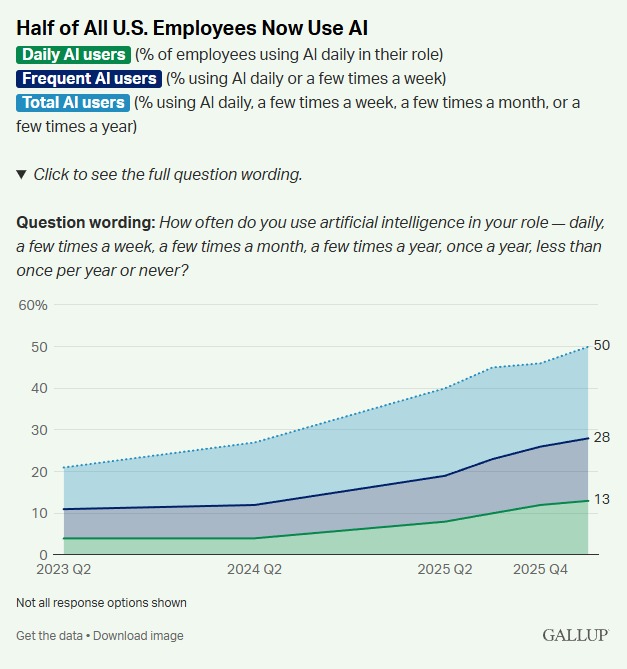
The trajectory, however, is clear. Every category has grown substantially since 2023, and the acceleration has been particularly sharp over the past year. Daily use has roughly doubled since 2024, suggesting that occasional experimenters are gradually becoming habitual users.
Employees Like It — When Their Employer Provides It
Among workers at organizations that have formally adopted AI, sentiment is largely positive. A Q1 2026 Gallup survey found that 65% of employees in AI-adopting organizations say the technology has had a positive impact on their individual productivity and efficiency — 16% describing the impact as extremely positive, and 49% as somewhat positive. Only about 5% report a negative experience.
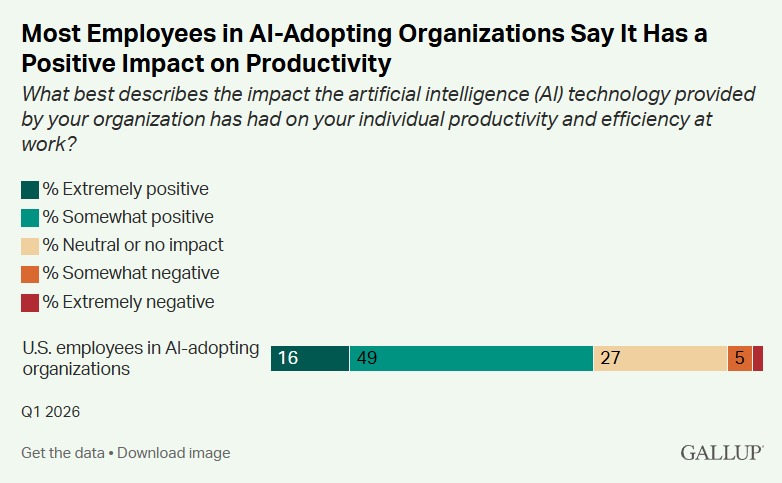
That’s a strong endorsement. But it comes with a significant caveat: these are employees whose organizations have invested in AI tools and, presumably, some degree of training or support. The experience of workers who’ve simply been told to “use AI” without much guidance is likely messier.
Transformation Is A Different Story
Here’s where the data gets more sobering. Despite the widespread adoption and broadly positive productivity sentiment, only 31% of employees in AI-adopting organizations agree that AI has actually transformed how work gets done in their organization. A plurality — 28% — remain neutral, and 42% disagree to some degree, including 18% who strongly disagree.
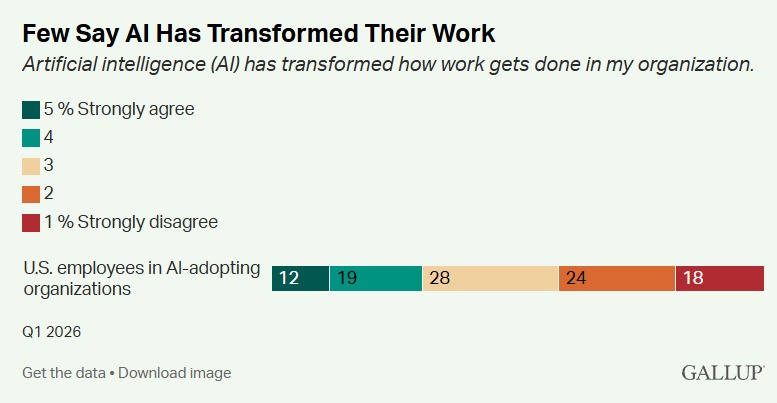
This gap between “AI is useful to me personally” and “AI has changed how we work as an organization” is significant. It suggests that most AI usage is still additive and individual — people using chatbots to draft emails faster or summarize documents — rather than a fundamental re-architecture of workflows and processes.
That tension is not unique to this data. It echoes a broader debate playing out across the industry. Anthropic CEO Dario Amodei has warned that AI could eliminate roughly half of entry-level white-collar jobs within five years — a claim that Meta’s Yann LeCun has sharply contested, arguing that AI executives are poorly qualified to forecast macroeconomic labour-market effects. The Gallup data, at least for now, suggests that organizational transformation is lagging well behind the adoption numbers.
The Productivity Question Remains Open
The broader productivity payoff from AI is still unclear. Individual workers report feeling more efficient, but firm-level and economy-wide productivity data haven’t yet shown a decisive AI-driven uplift — a pattern that echoes earlier technological transitions, where gains took years to show up in aggregate statistics.
There’s also a skills angle. PayPal co-founder Max Levchin has argued that the future belongs to workers who can engage meaningfully with AI tools — not just prompt them, but bring enough domain expertise to guide and evaluate the output. On that reading, the 13% of employees using AI daily may be developing a durable edge over those still in occasional-use territory.
What This Means
The 50% adoption milestone is real and notable. But the data also reveals a more complicated picture: adoption is broad, satisfaction is high among supported users, yet genuine organizational transformation remains elusive. The tools are in people’s hands. The harder work — redesigning processes, reskilling workforces, and actually measuring what changes — is still mostly ahead.