Google’s always been focused on speed — in its early days, it would list how long long each search query took — and it appears to have carried over the same DNA in the AI space.
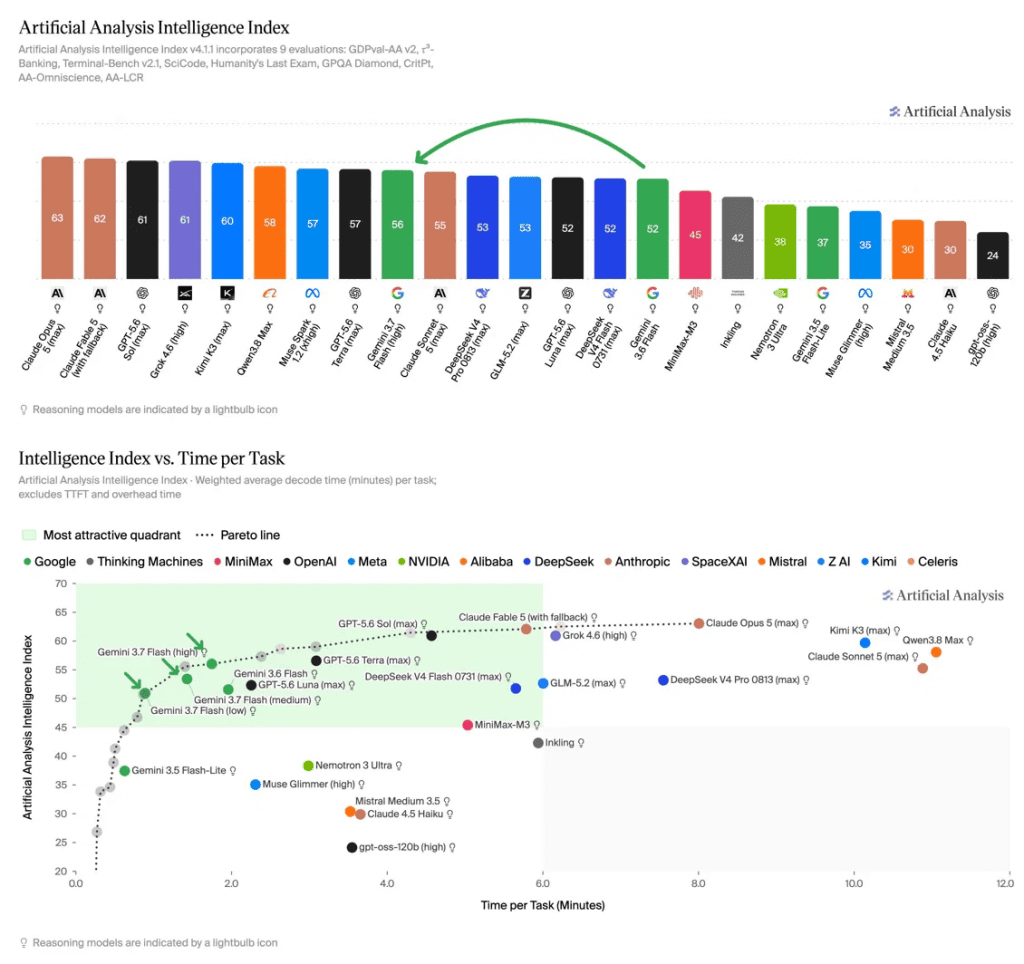
The company has released Gemini 3.7 Flash, its third new Flash-tier model in as many months, and according to benchmarking firm Artificial Analysis, the model now sits on the Pareto frontier for intelligence versus time per task, meaning no other model currently available offers a better combination of the two.
Artificial Analysis ran Gemini 3.7 Flash across all three of its reasoning levels, high, medium and low, ahead of its release. With high reasoning turned on, the model scores 56 on the Artificial Analysis Intelligence Index, a four point jump over Gemini 3.6 Flash, which had only been out for a few weeks. That places it just behind GPT-5.6 Terra (max) and Meta’s Muse Spark 1.2 (xhigh), both of which score 57, and just ahead of Claude Sonnet 5 (max), which scores 55.
The intelligence gain is one part of the story. The more interesting number is speed. Gemini 3.7 Flash produces roughly 340 output tokens per second, nearly three times the output speed of GPT-5.6 Terra and Z AI’s GLM-5.2. That throughput translates into an average Time per Task of 1.7 minutes at high reasoning, about 40% faster than GPT-5.6 Terra needs to hit a comparable intelligence score. Plotted against every other model Artificial Analysis tracks, that combination of score and speed puts Gemini 3.7 Flash right on the frontier line, the set of models where you cannot get more intelligence without giving up speed, and cannot get more speed without giving up intelligence.
Where the gains are coming from is fairly specific. Artificial Analysis attributes most of the four point improvement to agentic evaluations rather than general reasoning. The model picked up 3 points on Tau3 Banking, 8 points on Terminal-Bench v2.1, and 103 Elo on GDPval-AA v2, a benchmark meant to simulate real, economically valuable work rather than academic problem sets. On Artificial Analysis’s own AA-Briefcase evaluation, which measures agentic knowledge work, Gemini 3.7 Flash (high) climbs to an Elo of 1132, up 169 points from its predecessor and just ahead of MiniMax-M3.
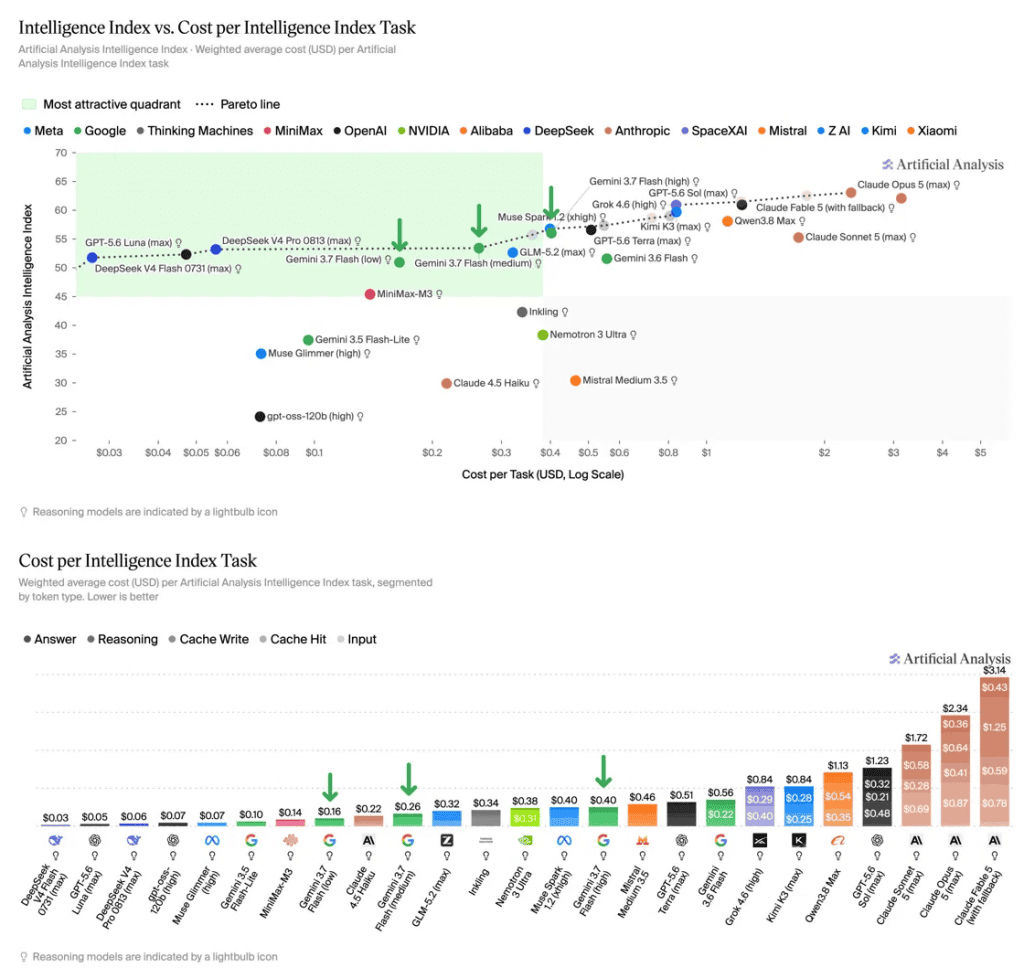
Pricing has moved in the same direction. Gemini 3.7 Flash keeps 3.6 Flash’s standard list price of $1.50 per million input tokens and $7.50 per million output tokens, but Google is running discounted pricing through the end of the year at $0.75 and $3.75 respectively. At that discounted rate, Artificial Analysis calculates the high-reasoning version costs $0.40 per Intelligence Index task, about 30% less than Gemini 3.6 Flash and level with Muse Spark 1.2. Dial the reasoning down to medium and the cost per task drops further, to $0.26, which is enough to put that configuration on the separate intelligence-versus-cost Pareto frontier as well. Google previously took a similar swing at the price-performance question with Gemini 3.1 Pro, which briefly topped the Intelligence Index at roughly half the running cost of its closest rivals.
There’s a catch worth noting: getting to the higher score costs more tokens. Gemini 3.7 Flash uses about 40% more output tokens than 3.6 Flash to complete the same tasks, averaging around 37,000 tokens per task, putting it in the same range as Claude Fable 5 and Alibaba’s Qwen3.8 Max. The model is also doing more thinking per answer than its predecessor did, which is part of why the intelligence score moved as much as it did.
On task-specific evaluations, the model performs well beyond its general index score. On AA-AnalystAgent, Artificial Analysis’s benchmark for answering questions about spreadsheets and documents, Gemini 3.7 Flash (high) posts the highest pass^5 score in the field at 60%, ahead of Claude Opus 5 (max) at 54% and Claude Fable 5 at 49%. It also tops AutomationBench-AA, a simulated SaaS-environment benchmark, with a score of 62.7%, ahead of Kimi K3 (max) at 53% and GPT-5.6 Sol (max) at 51.2%.
The release keeps up a cadence that Google has stuck to with unusual discipline this year. Gemini 3.5 Flash launched at I/O in May, Gemini 3.6 Flash followed in July as something of a stopgap after Gemini 3.5 Pro slipped its release window entirely, and now Gemini 3.7 Flash arrives roughly three weeks after that. Each release has stayed in the Flash tier rather than the flagship Pro line, and each has leaned on the same pitch: fast, cheap, and good enough to sit near the top of the leaderboard without needing the biggest model Google can build. With Gemini 3.7 Flash landing on two separate Pareto frontiers at once, on speed and on cost, that pitch is starting to look less like a workaround for a delayed Pro model and more like a deliberate strategy in its own right.
Gemini 3.7 Flash is live now in the Gemini API, Google AI Studio, Antigravity, and other developer surfaces, with a context window of 1 million tokens carried over from 3.6 Flash. It supports text, image, video and speech input, with text output, and retains the same cached-token discount of 90% that Google has offered across the Gemini 3 family.