Gemini 4 Argon does seem to be frontier-level on several benchmarks.
Google DeepMind’s Gemini 4 Argon has posted a 97.5% score on ARC-AGI-3, the interactive reasoning benchmark that has become one of the most closely watched tests of agentic AI. The result places Argon second only to OpenAI’s GPT-6 Astra, which holds the top spot at 99.9%, and makes Google the second frontier lab to clear 95% on the benchmark.
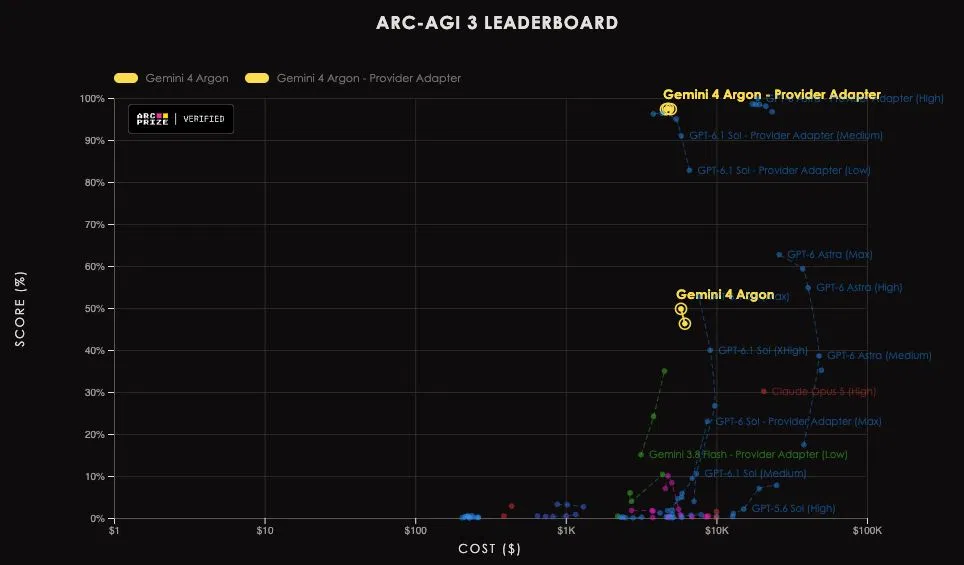
The score comes from ARC Prize’s verified testing of Argon, the model Google introduced on September 30 as its first entrant in the Gemini 4 line, built for long, complex workflows spanning software engineering, enterprise knowledge work, and cybersecurity defense.
How Argon scored across the board
ARC Prize tested Argon across all three generations of the ARC-AGI suite. On ARC-AGI-1, which measures core fluid intelligence through abstract pattern puzzles, Argon scored 98.5% at a cost of $0.16 per task. On ARC-AGI-2, a harder successor designed to resist memorization, it scored 91.3% at $0.32 per task.
The headline number is ARC-AGI-3, a newer benchmark that drops an AI agent into unfamiliar, turn-based game environments with no instructions and measures how efficiently it figures out the rules. Argon’s 97.5% came using what ARC Prize calls the provider adapter harness, a setup that preserves a model’s internal reasoning state between turns and automatically compacts long conversations so the model can build on earlier progress rather than starting fresh each turn. The run cost roughly $4.8K.
Under ARC Prize’s standard harness, a more constrained, provider-neutral setup that only lets a model carry forward notes it chooses to keep, Argon’s verified score dropped sharply to 49.8%, at a cost of about $5.8K. This is a familiar pattern: when Astra was tested the same way, its score fell from 99.9% under the provider adapter harness to 62.7% under the standard one, underlining how much of these headline numbers depend on how much scaffolding the model is given, not just what the base model can do.
ARC Prize noted that testing Argon on the standard harness ran into API issues that stopped it from completing every game. At low reasoning effort, Argon scored 49.8% but only finished runs on 42 of 55 games; at medium effort, it scored 46.3% with 46 of 55 completed; at high effort, only 19 of 55 games finished, so ARC Prize declined to publish a score for that setting. The published numbers include partial credit from the incomplete runs. Costs were calculated using Gemini 4 Argon’s introductory pricing of $2 per million input tokens and $10 per million output tokens.
Matching Astra on efficiency
Beyond the raw score, ARC Prize’s analysis focused on action efficiency, how many moves a model needs to solve a game compared with how many an average human takes. The organization built its human baseline by running roughly 500 people through the same 25 public ARC-AGI-3 games.
Argon used 62% fewer actions than that human baseline across the public games, matching the same efficiency gain GPT-6 Astra had already shown when it crossed the human-parity line on action efficiency earlier this year. Argon also matched or beat the speedrun record on three of the 25 games and came within 10% of it on six others, a sign that its play strategies are approaching near-optimal efficiency on at least a subset of the test environments.
Why the harness matters
ARC Prize’s methodology distinguishes between two testing conditions. The standard harness enables a model to carry forward notes it chooses to keep as it plays through an environment, a minimal, provider-neutral interface meant for comparing raw model capability on equal footing. The provider adapter harness, by contrast, preserves a model’s opaque reasoning between turns and compacts longer conversations automatically, letting the model reuse prior work without re-deriving it.
That distinction has become central to how ARC-AGI-3 scores are read. Both Argon and Astra post near-saturation scores under the provider adapter harness, but their standard-harness numbers tell a more modest story, with Astra at 62.7% and Argon’s best completed configuration at 49.8%. ARC Prize has said a model that can solve ARC-AGI-3 under the standard harness, without the extra scaffolding, is the more meaningful bar for what the organization would consider progress toward AGI-level efficiency.
Argon’s ARC-AGI-3 result arrives alongside the model’s broader rollout. Google has largely positioned Argon as a tool for long-horizon coding and cybersecurity defense, and the model remains limited mostly to trusted testers through Google’s Fairwind Program, alongside Google AI Ultra and Pro subscribers who can now access it in the Gemini app.
ARC Prize’s organization has repeatedly cautioned that saturating ARC-AGI-3 should not be read as proof that AGI has arrived. The benchmark’s environments, however novel to the models being tested, remain closed and deterministic puzzle worlds rather than anything resembling the open-endedness of the real world. Still, with two frontier labs now past the 95% mark on a benchmark that sat in the single digits just months ago, the pace of progress on agentic reasoning tasks shows little sign of slowing.