Google is back with a bang in the AI race.
Google has introduced Gemini 4 Carbon, its newest frontier model, barely two weeks after rolling out Gemini 4 Argon. The pace of the follow-up is itself the headline — Google CEO Sundar Pichai framed Carbon’s speedy arrival as proof of how fast the company now intends to push the frontier, and the benchmark numbers Google has published back that claim up, with Carbon edging out both OpenAI’s GPT-6 Astra and Anthropic’s Claude Opus 5.5 across the majority of the evaluations the company disclosed.
Announcing the model, Pichai wrote that Carbon “ranks #1 on the recently updated v5.0 of Artificial Analysis’ Intelligence Index at 59,” and highlighted its cybersecurity results — 88.2% on SEC-bench Pro for finding vulnerabilities, 54.8% on ExploitGym for exploitation, and 71.0% on CWE-bench for patching. “We’re seeing significant improvements in long-horizon tasks even compared to Argon, and we’ve strengthened frontier safeguards,” he added, noting that access will roll out gradually, starting with trusted cyber defenders this week before expanding through Google’s Fairwind Program.
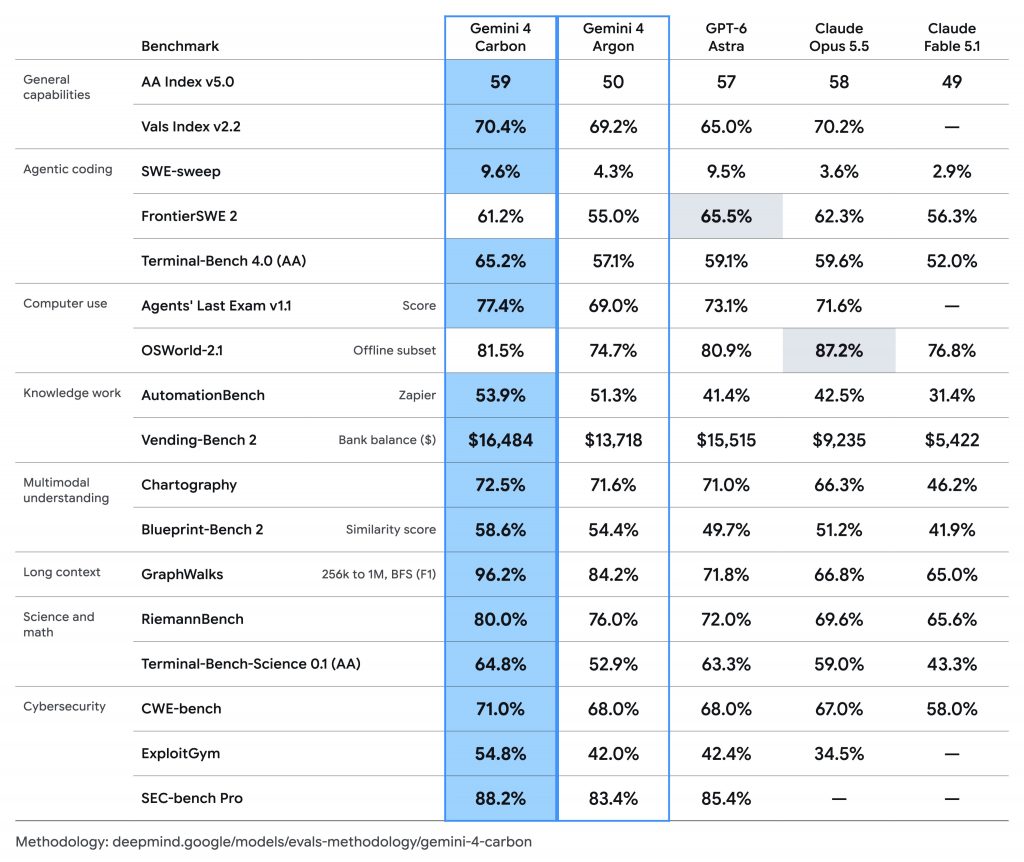
Gemini 4 Carbon Benchmarks
General capabilities
On the two broadest composite scores in the comparison table, Carbon comes out on top. It scores 59 on Artificial Analysis’ newly refreshed Intelligence Index v5.0, ahead of Claude Opus 5.5’s 58, GPT-6 Astra’s 57, Gemini 4 Argon’s 50, and Claude Fable 5.1’s 49. On the Vals Index v2.2, Carbon posts 70.4%, a shade ahead of Opus 5.5 at 70.2%, with Argon at 69.2% and GPT-6 Astra trailing at 65.0%. Fable 5.1 has no reported score on this benchmark.
Agentic coding
Results are mixed here. On SWE-sweep, Carbon leads narrowly with 9.6% against GPT-6 Astra’s 9.5%, while Argon (4.3%), Opus 5.5 (3.6%) and Fable 5.1 (2.9%) all land well behind. On FrontierSWE 2, however, GPT-6 Astra actually takes the top spot with 65.5%, ahead of Carbon’s 61.2%, Opus 5.5’s 62.3%, Argon’s 55.0% and Fable 5.1’s 56.3% — the one agentic-coding benchmark where Google isn’t out front. Carbon reclaims the lead on Terminal-Bench 4.0 (AA) with 65.2%, comfortably ahead of GPT-6 Astra (59.1%), Opus 5.5 (59.6%), Argon (57.1%) and Fable 5.1 (52.0%).
Computer use
Carbon posts 77.4% on Agents’ Last Exam v1.1, ahead of GPT-6 Astra’s 73.1%, Opus 5.5’s 71.6% and Argon’s 69.0% (Fable 5.1 has no listed score). On the OSWorld-2.1 offline subset, though, Claude Opus 5.5 is the clear leader at 87.2%, with GPT-6 Astra at 80.9%, Carbon at 81.5%, Fable 5.1 at 76.8% and Argon at 74.7% — a rare benchmark where Anthropic’s model sits comfortably ahead of the field.
Knowledge work
Carbon’s lead widens considerably on real-world work tasks. On AutomationBench, it scores 53.9%, well clear of Argon (51.3%), GPT-6 Astra (41.4%), Opus 5.5 (42.5%) and Fable 5.1 (31.4%). On Vending-Bench 2 — which measures how much simulated bank balance a model can accumulate running a virtual business — Carbon finishes with $16,484, ahead of GPT-6 Astra’s $15,515, Argon’s $13,718, Opus 5.5’s $9,235 and Fable 5.1’s $5,422.
Multimodal understanding
Carbon again leads both multimodal benchmarks: 72.5% on Chartography versus Argon’s 71.6%, GPT-6 Astra’s 71.0%, Opus 5.5’s 66.3% and Fable 5.1’s 46.2%; and 58.6% on the Blueprint-Bench 2 similarity score, ahead of Argon (54.4%), Opus 5.5 (51.2%), GPT-6 Astra (49.7%) and Fable 5.1 (41.9%).
Long context
This is Carbon’s single biggest margin of victory. On GraphWalks (256k to 1M tokens, BFS F1 score), Carbon scores 96.2%, far ahead of Argon’s 84.2%, GPT-6 Astra’s 71.8%, Opus 5.5’s 66.8% and Fable 5.1’s 65.0% — a more than 12-point jump over its own predecessor and a roughly 24-point gap over GPT-6 Astra.
Science and math
Carbon leads on RiemannBench with 80.0%, ahead of Argon (76.0%), GPT-6 Astra (72.0%), Opus 5.5 (69.6%) and Fable 5.1 (65.6%). On Terminal-Bench-Science 0.1 (AA), Carbon again tops the chart at 64.8%, with GPT-6 Astra close behind at 63.3%, followed by Opus 5.5 (59.0%), Argon (52.9%) and Fable 5.1 (43.3%).
Cybersecurity
This is the category Pichai called out specifically, and the numbers support the emphasis. Carbon scores 71.0% on CWE-bench (patching), 54.8% on ExploitGym (exploitation) and 88.2% on SEC-bench Pro (vulnerability discovery) — leading GPT-6 Astra and Argon on all three, and leading Opus 5.5 on the two benchmarks where Anthropic has a reported score (CWE-bench at 67.0%, ExploitGym at 34.5%). Neither Opus 5.5 nor Fable 5.1 has a published SEC-bench Pro score, and Fable 5.1 has no listed score on ExploitGym either.
The bigger picture
Across the 15 benchmarks Google disclosed, Carbon leads outright on 11, ties or trails narrowly on a couple, and is beaten decisively only on OSWorld-2.1 (by Opus 5.5) and FrontierSWE 2 (by GPT-6 Astra). That’s a notably stronger showing than Argon’s own debut, which led on 12 of 18 comparisons against GPT-6 Astra and Opus 5.5 at the time. Carbon’s gains over Argon are sharpest on long-context retrieval (GraphWalks), science reasoning and cybersecurity defense, matching Pichai’s note about long-horizon task improvements.
As with Argon’s release, Google is not opening Carbon up broadly right away. Trusted cyber defenders get access first this week, with the Fairwind Program used to extend access to more partners ahead of a wider rollout. That staged approach is consistent with how Google introduced Argon as well, and reflects the industry-wide caution models with strong offensive cybersecurity capabilities are now being released under — cybersecurity has also been the subject of a string of other recent incidents rattling the industry this month.
Carbon’s release also comes at a moment of intensifying competition over benchmark supremacy between Google, OpenAI and Anthropic, with Artificial Analysis itself refreshing its flagship Intelligence Index to version 5.0 just as Carbon launched. Whether the lead holds is likely to be short-lived either way — at the current cadence, Google has gone from Argon to Carbon in under a month, and all three labs have shown they’re willing to ship again just as quickly if a rival pulls ahead.