Google is making a play in the agentic space, and it could placing it right into Gemini with Gemini Spark.
What Is Gemini Spark?
Gemini Spark appears to be Google’s bid to move Gemini from a chatbot you consult to an agent that acts on your behalf around the clock. Leaked onboarding screens — surfaced from inside a beta build of the Google app — describe it as an “everyday AI agent, ready 24/7 to help with your inbox, online tasks, and more.”
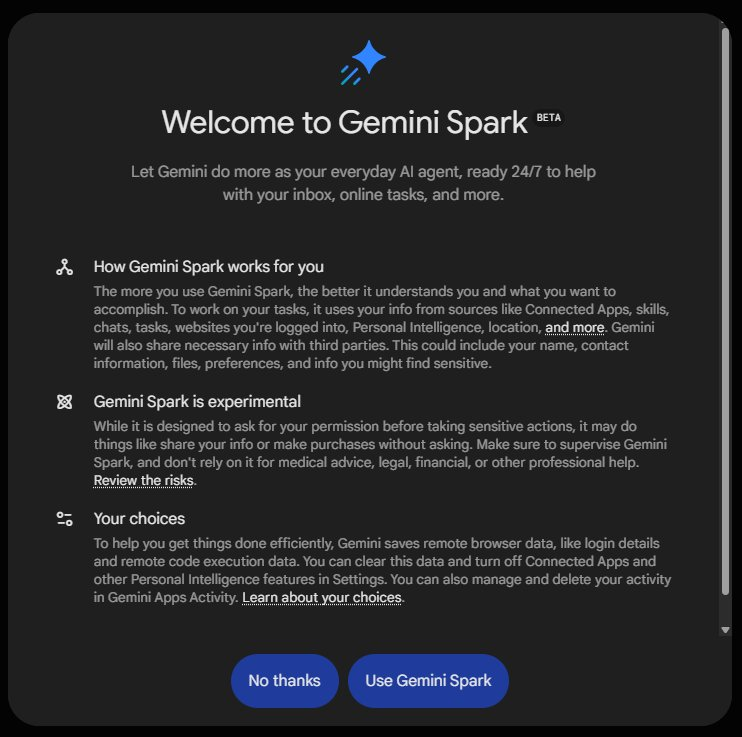
The feature introduces a dedicated Agent tab inside Gemini, separate from the existing Chat interface. From there, users can create recurring “skills” — automated task templates — and schedule workflows to run without manual oversight. Practical examples shown in leaked screenshots include clearing Gmail clutter, assembling pre-meeting briefings, and generating personalised news digests.
Spark draws from a wide data pool: connected apps, browsing sessions, chat history, scheduled tasks, location data, and something Google calls “Personal Intelligence.” The more it knows about you, the more autonomously it operates. That’s the pitch.
The Privacy Line
The onboarding screen’s fine print has attracted as much attention as the feature itself.
Spark’s disclosed terms warn that it “may do things like share your info or make purchases without asking.” Google frames this as a design feature rather than an edge case: Spark stores remote browser data and login credentials to keep background workflows running. The company says users can clear this data and manage connected services through settings, but the default posture is permissive.
This matters in context. Anthropic’s Claude Cowork explicitly blocks autonomous purchases at the policy level. OpenAI’s Operator asks for approval before significant actions — though a January 2025 incident saw it buy items without confirmation when shopping rules got ambiguous. Spark’s leaked onboarding flips that posture and tells you upfront that autonomous purchases are part of the design.
The Competitive Picture
Spark arrives at a moment when Gemini’s traffic share has tripled in twelve months, reaching 26.7% of global generative AI web traffic in April 2026, up from just 7.27% a year earlier. The gap with ChatGPT — once an abyss — is compressing fast.
The agent race is the next front. Spark is built to go directly at Claude’s Cowork and OpenAI’s Agent platform — both of which offer background task automation with varying levels of human oversight. Google’s edge is ecosystem depth: Gmail, Calendar, Drive, Chrome, and Android are already where most users live. Spark doesn’t have to convince anyone to switch platforms. It has to convince them to hand over the keys.
The “skills” framework is telling. As Gemini’s model capabilities have advanced, the strategic priority has shifted from benchmark performance to workflow integration. Spark is the consumer-facing expression of that shift — a bet that the most durable AI advantage isn’t the smartest model, but the most embedded one.
Spark is also positioned against what Google previously called “Project Mariner,” its browser-based agent. Mariner waits for a command and executes it. Spark, by contrast, is always-on — proactively monitoring accounts and deciding what to do next. That’s the meaningful architectural difference, and it’s what makes the privacy question so pointed.
The Bottom Line
Google I/O 2026 opens on 19 May. Spark is widely expected to be a centrepiece of the keynote — moving from leaked beta screens to official product. When it does, the conversation will shift from what is it to should I turn it on.
The answer isn’t simple. Spark could be genuinely useful for the right user: someone deep in the Google ecosystem, comfortable with proactive automation, and willing to supervise an agent that may occasionally act without asking. But for those still unwilling to give up their Google data for an agent to work on, it could take some more coaxing to take the agentic plunge.