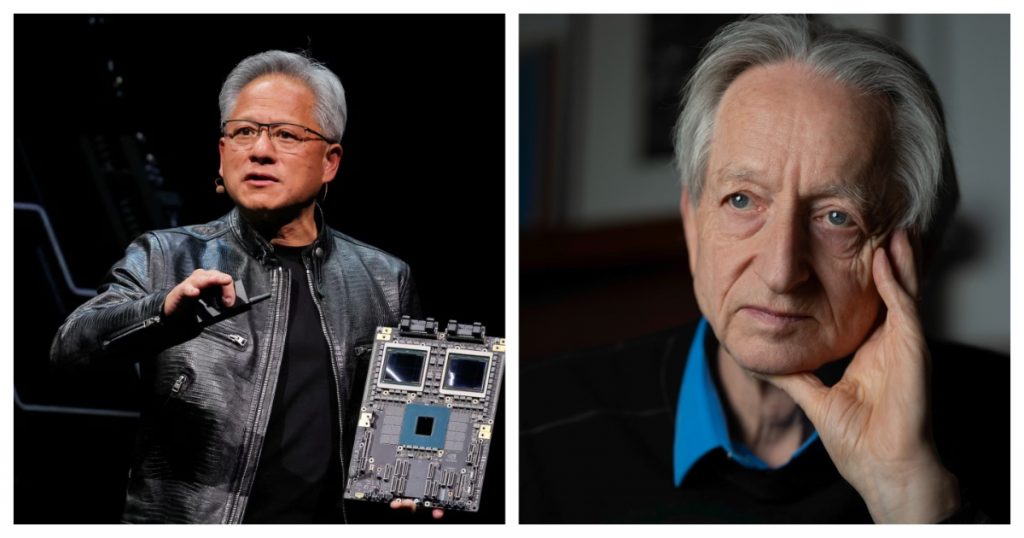
NVIDIA CEO Jensen Huang has taken aim at AI “Godfather” Geoffrey Hinton, calling his warnings about AI risk “irresponsible” and arguing that the Nobel laureate’s track record doesn’t justify them. Speaking on The Ezra Klein Show, Huang pointed to Hinton’s famous 2016 call to stop training radiologists as proof that alarming predictions can do real harm, especially to young people deciding what to study.
The exchange began when Klein asked about Hinton’s estimate that there’s a 10% chance of societal destruction from AI, a figure Hinton has said isn’t unreasonable. Huang didn’t hold back. “I would tell Geoff that it’s irresponsible to say all that,” he said. “All of his predictions have been wrong. Enough predictions. That ten percent chance is not grounded on science. It’s not grounded on research. Just because it comes from a scientist doesn’t make it scientific. Those predictions are hurtful.”
He then turned to Hinton’s radiology remark, which he treated as the test case. “Let’s take it at face value that the recommendation is exactly what he said, which is that nobody should want to be a radiologist, and the world has no radiologists today,” Huang said.
Klein followed up by playing a clip from 2016, in which Hinton said: “I think if you work as a radiologist, you’re like the coyote that’s already over the edge of the cliff but hasn’t yet looked down, so it doesn’t realize there’s no ground underneath him. People should stop training radiologists now. It’s just completely obvious that within five years, deep learning is going to do better than radiologists because it’s going to be able to get a lot more experience. It might be 10 years, but we’ve got plenty of radiologists already.”
For Huang, the clip made his broader point about the social cost of alarmism. “Is that helpful or hurtful to society? I think we can both agree it would be terribly hurtful. It didn’t happen,” he said. He went on to ask whether it’s good or bad “that we scare young people about the future of AI, so much so that they don’t even want to go to universities and don’t want to go to college anymore because they don’t think they’ll get a job.” His answer was unambiguous: “It’s hurtful. Don’t think for a second just because you’re an alarmist that you’re doing a social good.”
The radiology record
Huang’s choice of example is deliberate. Hinton’s radiology remark is one of the most cited AI predictions of the past decade, and the profession’s fortunes since have made it a favourite rebuttal for AI optimists. Radiologists now face a shortage, with average pay reaching $571,000 in 2025. Radiology staff at the Mayo Clinic grew 55% between 2016 and 2025, to more than 400 physicians, even as AI tools spread through the field.
Hinton has himself conceded the point in part. He told the New York Times in 2025 that he hadn’t made clear he was speaking purely about image analysis. The Times reported that he considered himself wrong on timing but not on direction.
Hinton’s record, meanwhile, is more mixed than “all wrong”. The bet that made his career, that neural networks trained at scale would work, was vindicated well enough to earn him a Nobel Prize, and it also happens to underpin NVIDIA’s business. The predictions Huang is most likely to be challenged on are Hinton’s forecasts about the labour market, where the evidence is still coming in. In August 2025, Hinton said he was fairly confident AI would cause massive unemployment, pointing to companies replacing junior programmers. By March 2026, he was arguing that governments would need to tax AI agents once AGI arrives, because big tech had not thought through what happens when large numbers of jobs disappear.
His existential warnings have been just as pointed. In November 2025, he likened the situation to spotting an alien invasion fleet that would arrive in about ten years, and in June 2025 he laid out how AI agents could end up competing with humans for resources. Back in October 2024, just after his Nobel win, he said AI would make human intelligence irrelevant, and in March 2025 he lamented that governments grasp bias and discrimination but not AI safety.
None of these is a precise forecast, and time will test each of them. But Huang’s strongest point may be the softer one: that confident public warnings carry consequences, and that a warning about a profession can steer students away from it.