Z.ai has finally put a name to the model that had developers guessing for the better part of a week. Ox Alpha, the anonymous “stealth” model that showed up on OpenCode and OpenRouter with no branding attached, is GLM-5.3-Flash, the first natively multimodal entry in the GLM-5 line. Z.ai says it quietly ran the model under that alias to gather real-world feedback before the official rollout, and the traffic apparently piled up fast enough to make it the most talked-about model of the week, all served on Chinese AI chips. While the model doesn’t compete with Fable 5 and GPT 5.6 Sol, it seems to be a very capable model all the same.
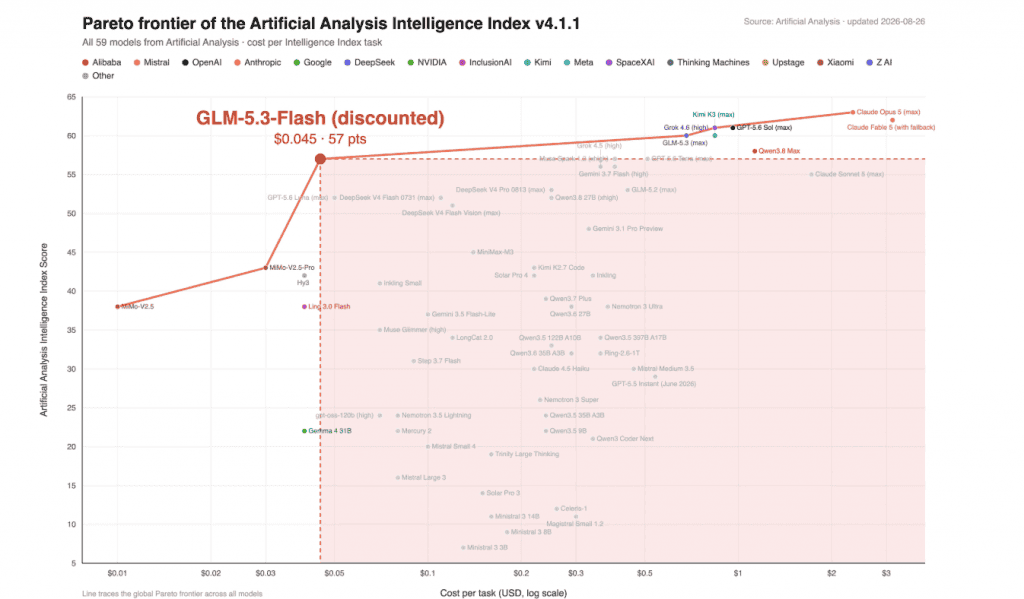
The headline claim is one that Z.ai has been chasing across its recent releases: frontier-adjacent performance at a fraction of the usual cost. GLM-5.3-Flash carries 320 billion total parameters but activates only 18 billion of them per token, and Z.ai claims it beats its own predecessor, GLM-5.2, across the board while landing at roughly a tenth of the price. On the Artificial Analysis Intelligence Index, the company says the model scores 57 at just $0.045 per task on the discounted tier, a level of capability that used to require spending around ten times as much.
GLM 5.3 Flash Benchmarks
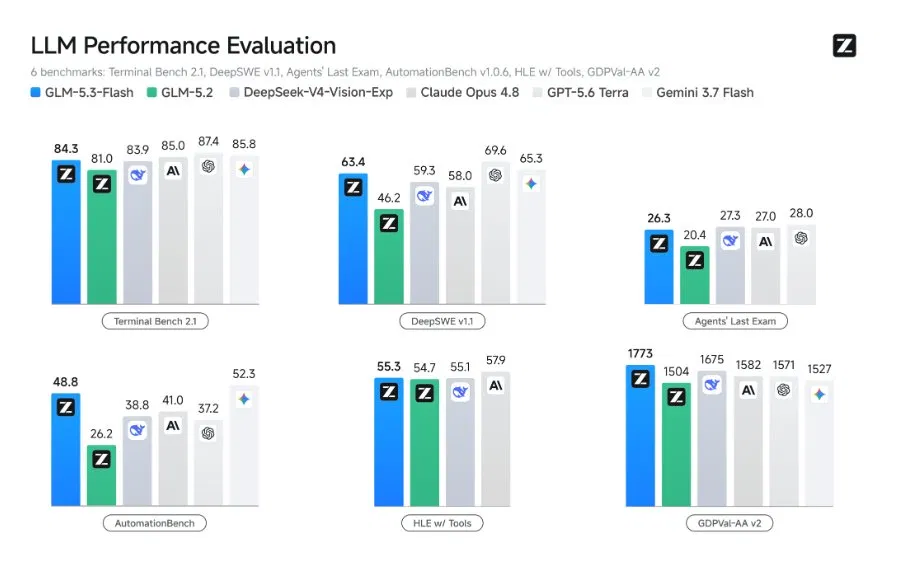
Benchmark-wise, the gains over GLM-5.2 are large rather than incremental. On DeepSWE v1.1, GLM-5.3-Flash jumps to 63.4 from 46.2. AutomationBench nearly doubles, going from 26.2 to 48.8. Terminal Bench 2.1 climbs to 84.3, putting it ahead of DeepSeek-V4-Vision-Exp and within striking distance of Claude Opus 4.8’s 85.0. GPT-5.6 Terra and Gemini 3.7 Flash still edge ahead on that particular test, at 87.4 and 85.8 respectively, but the margin has narrowed considerably from where GLM-5.2 sat.
Z.ai also ran its own internal comparison, Z.ai Code Bench v1.0, executed inside Claude Code 2.1.207. There, GLM-5.3-Flash tops out at 29.0 on max effort against Opus 4.8’s 29.5, a gap the company is happy to point to as evidence that its flash-tier model is now competing directly with a proprietary flagship rather than trailing it by a wide stretch. That comparison arrives not long after Z.ai’s own GLM-5.3 release edged out Claude Mythos 5 and GPT-5.6 Sol on CyberGym, so the company clearly sees benchmark parity with Anthropic and OpenAI’s top-end models as the story it wants told this quarter.
Architecturally, the jump from GLM-4.5 is where most of the efficiency comes from. Despite similar total parameter counts, GLM-5.3-Flash nearly halves both the activated parameter count and the number of layers. Z.ai attributes this to a hybrid attention setup that combines linear and sparse attention, letting the model handle long-context workloads without the usual blowup in serving cost, along with something the company calls Manifold-Constrained Hyper-Connections for scaling efficiency. There’s also a new technique, IndexPool, aimed specifically at trimming the latency and memory overhead of retrieval at a million-token context length by compressing indexer key vectors through weighted pooling.
Vision is the other piece Z.ai is leaning on heavily. The company frames its multimodal push not as basic image processing but as something meant to sit inside the coding loop itself, where a model can inspect its own rendered output, catch layout issues, and iterate before handing work back to a developer. On vision-specific benchmarks, GLM-5.3-Flash posts a 62.4 on OfficeQA Pro, ahead of both Opus 4.8 and DeepSeek-V4-Vision-Exp, though it falls behind Gemini 3.7 Flash on tests like BabyVision and MVbench. Z.ai is also positioning this multimodal layer for broader knowledge work beyond code, pointing to tasks involving spreadsheets, presentations, and dashboards as areas where the model can read visual context directly rather than needing everything translated into text first.
Perhaps the more unusual part of this release is the infrastructure story sitting underneath it. Z.ai says GLM-5.3-Flash has been served over the past week on a large cluster of domestically produced Chinese AI chips, using a custom inference engine built on SGLang, and reports a threefold improvement in end-to-end serving performance compared to its initial baseline on the same hardware. The company frames this as proof that Chinese chips can now support frontier-model inference at costs comparable to mainstream Nvidia GPUs, a claim that, if it holds up under outside scrutiny, matters as much for the broader chip conversation as it does for this particular model.
For now, GLM-5.3-Flash has been rolled out to all GLM Coding Plan subscribers, with the company saying it delivers three times the usable quota of the standard GLM-5.3 model at the same subscription tier. The weights are publicly available on HuggingFace under an MIT license, and the model supports SGLang, vLLM, and TokenSpeed for local deployment, with more inference frameworks expected soon. Standard API pricing lands at $0.15 per million input tokens and $0.50 per million output tokens, with cached input priced at $0.03. Given how quickly Z.ai has iterated through the GLM-5 series this year, this is unlikely to be the last word on where the flash-tier pricing war ends up.