Google might not be quite at the frontier of AI models, but it still appears to have an ace up its sleeve in the AI race — through Google Cloud.
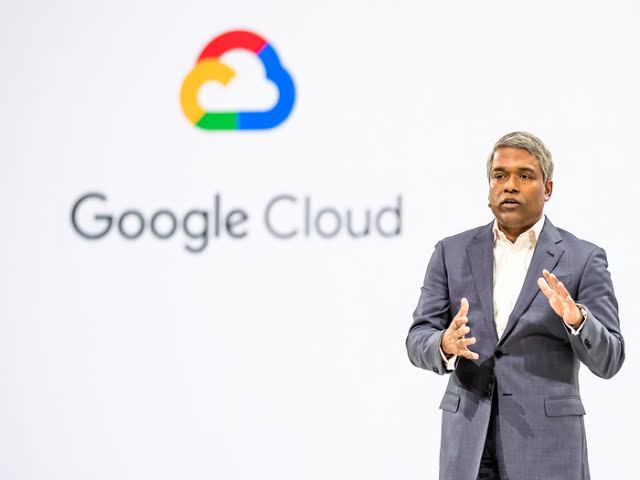
Google Cloud’s pitch at one point used to be that it was the “third place” cloud, playing catch-up to AWS and Microsoft Azure. That framing is looking increasingly outdated. Speaking at Goldman Sachs’ Communacopia + Tech Conference, Google Cloud CEO Thomas Kurian laid out a string of numbers suggesting the AI boom has turned Google Cloud from a distant challenger into one of the biggest beneficiaries of enterprise AI spending.
New Customers Coming In Twice As Fast
Kurian said Google Cloud is now signing up new customers roughly twice as fast as it was a year ago, and that the size of its biggest deals is growing even faster.
“We’ve seen more than 2x growth year-on-year in new customer acquisitions and also 2x growth quarter-on-quarter and year-over-year in deals over $100 million, so large deals,” Kurian said.
Customer acquisition doubling year-on-year points to Google Cloud winning net-new logos, not just expanding inside existing accounts. And $100 million-plus contracts — the kind signed by large enterprises building out AI infrastructure — doubling both sequentially and annually suggests the biggest checks in cloud are increasingly being written to Google.
Customers Are Blowing Past Their Own Commitments
“When a customer gives us a commitment, say, for $100, typically, they spend more than 50% more than that,” Kurian said.
In cloud contracting, committed spend is usually treated as a floor, not a ceiling — but a >50% overshoot as a pattern, rather than an exception, signals that AI workloads are scaling faster than customers themselves are forecasting.
Custom Silicon as the Moat
A recurring theme of Kurian’s remarks was that Google’s in-house chip stack — not just its software — is now a core part of its competitive pitch. He cited specific price-performance figures for Google’s custom silicon against alternatives:
“We offer 2.7x better price performance for training, 80% better price performance for inference, 30% better price performance for CPUs.”
This is consistent with the broader trajectory of Google’s TPU program, which has gone from a purely internal tool to a genuine external business line. Google’s TPUs have picked up marquee outside users — Anthropic signed a deal for 1 million TPUs worth “tens of billions of dollars”, and even OpenAI has reportedly begun using Google TPUs for parts of its own operations — while independent benchmarks from SemiAnalysis have found Google’s seventh-generation Ironwood TPU delivering up to 50% better performance per dollar than Nvidia’s Blackwell Ultra. Google has even started open-sourcing pieces of its TPU software stack, a sign it’s trying to make TPUs a credible alternative to Nvidia’s GPUs rather than a Google-only curiosity. Even Nvidia has felt compelled to publicly respond to the growing buzz around Google’s chips.
Addressing the AI Capex Question Head-On
With Alphabet’s capital expenditure ballooning to fund AI infrastructure, investors have been pressing every major cloud provider on returns. Kurian tackled the payback-period question directly, and specifically credited custom silicon for improving the economics:
“Our payback period on AI servers in aggregate is less than 2 years and on our own silicon is half that. So we have strong payback period.”
That’s a notably concrete answer in a debate that’s mostly been fought in generalities. It also lines up with earlier comments from Google’s infrastructure chief Amin Vahdat, who said the company was still early in the AI capex cycle even as its eight-year-old TPUs run at 100% utilization — suggesting demand, not depreciation, is the binding constraint on Google’s infrastructure bet.
Gemini Is Worth More Than Its Own Revenue Line
Kurian also argued that Gemini’s value to Google Cloud isn’t fully captured by looking at AI revenue in isolation — it’s pulling customers deeper into the broader cloud relationship.
“The lifetime value of a customer who uses our Gemini portfolio in the cloud over a 5-year period, we estimate to be 1.5x.”
In other words, a customer who adopts Gemini tends to become a materially more valuable cloud customer overall, likely because Gemini adoption tends to expand usage of Google Cloud’s storage, compute, and data infrastructure alongside it.
Why Cybersecurity Needs Multiple Models
On security, Kurian made the case that relying on a single AI model to find vulnerabilities is inherently risky, arguing for a multi-model approach:
“No single model finds all the issues from a cyber point of view. So if you scan with just a single model, the risk you run is think of it as you will be protected from only those vulnerabilities that, that model finds.”
It’s a pitch that plays to Google Cloud’s strength as a platform that can host and orchestrate multiple models — including its own Gemini family and third-party models — rather than locking customers into a single vendor’s AI for security-critical work.
Turning TPUs Into a Capital-Light Business
Perhaps the most structurally important comment was about how Google plans to monetize its chips beyond its own data centers. Kurian described a shift toward selling TPUs as hardware — through on-premise deals and “neocloud” partners — which changes Google’s own capital burden:
“When you buy it as hardware, we don’t need to spend capital expense for data centers because you’re putting it in your data center. And so we don’t have the responsibility for that power and space.”
This matters because it points to a version of Google’s AI hardware business that scales without requiring Google to keep building and powering data centers itself — offloading the capital intensity of AI infrastructure onto customers and partners while Google collects hardware and software revenue.
The Bigger Picture
Taken together, Kurian’s comments describe a Google Cloud that has moved from selling storage and compute as a commodity to selling a full AI stack — custom silicon, frontier models like Gemini, and multi-model security tooling — bundled into deals that are getting bigger and stickier. For a company that spent years being counted out of the cloud wars, the AI era appears to be exactly what’s rewriting Google Cloud’s position in them.