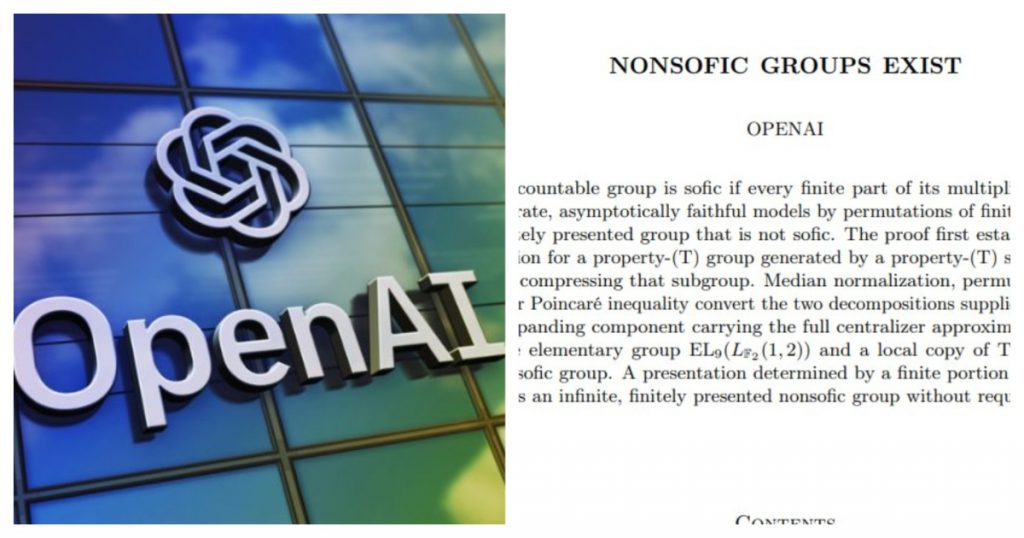
A paper attributed to OpenAI titled “Nonsofic Groups Exist” began circulating on X late on July 31, apparently leaked ahead of an official release. Within hours, mathematicians who track AI-generated proofs were calling it one of the most significant results yet produced with the help of a language model — this time closing a 27-year-old open problem in group theory rather than just a competition-style puzzle.
The paper’s abstract claims to construct an infinite, finitely presented group that is not “sofic,” settling a question raised by the mathematician Mikhail Gromov in 1999 and left open ever since. OpenAI has not yet formally confirmed the paper, but the leak was picked up and vouched for by people in a position to know.
So what’s a “sofic” group, and why does anyone care?
Group theory studies symmetry: the mathematical structures that describe how objects can be rotated, shuffled, or combined while preserving some underlying pattern. A “group” is just the abstract rulebook for one of these symmetry systems — think of all the ways you can rotate a Rubik’s cube, or all the ways you can permute a deck of cards.
Some groups are infinite, and infinite objects are notoriously hard to reason about directly. So mathematicians look for ways to approximate an infinite group using finite ones — the mathematical equivalent of studying an enormous, uncountable thing by checking whether it can be modeled arbitrarily well by something you could, in principle, write down and check on a computer.
A group is called “sofic” if this kind of approximation is always possible: no matter how complicated the group’s multiplication table is, you can find larger and larger finite systems (built from shuffling finite sets of objects around) that mimic it more and more closely, everywhere except on a vanishingly small sliver of cases. Most groups mathematicians work with every day — including all the familiar, well-behaved ones — turn out to be sofic. That’s part of why the concept is powerful: whole families of theorems that are hard to prove in general become provable once you know a group is sofic.
The open question, posed by Gromov in 1999, was whether every countable group has this property. Nobody could find a group that broke the pattern, but nobody could prove one couldn’t exist either. It became one of the more well-known unresolved questions in geometric group theory, sitting at the intersection of group theory, dynamical systems, and logic.
The leaked paper claims to answer that question: no. It reportedly constructs an explicit group that resists this kind of finite approximation no matter how hard you try — a “non-sofic” group, built and finitely presented (meaning it can be described in full by a finite list of generators and rules) rather than merely shown to exist abstractly.
How the proof reportedly works
The pages circulating online sketch a proof strategy built around a specific algebraic object called the binary Leavitt algebra — a ring construction with a kind of built-in self-similarity, where a whole copy of a structure can be found sitting inside a smaller piece of itself. From it, the authors extract a group with “property (T),” a rigidity condition that makes a group behave in a highly structured, inflexible way whenever it acts on other spaces.
The core of the argument, according to the outline, leans on a 2019 theorem about “expander graphs” (highly connected finite networks used throughout computer science and combinatorics) proved by Kun, resolving an earlier conjecture of Bowen. That theorem shows that if a hypothetical finite approximation of a property-(T) group existed, its underlying graphs would have to break apart into simpler expanding pieces after removing a small fraction of connections. The leaked paper says this forces a strong, shared symmetry constraint across the whole structure.
The construction then pairs that rigid property-(T) group with a separate, flexible group — a local copy of a well-known infinite group called Thompson’s group V — glued together with a shared central subgroup. Thompson’s group V is simple, infinite, and finitely presented, but critically it cannot be built out of finite approximations in the relevant technical sense (it isn’t what’s called “locally embeddable into finite groups,” or LEF). The proof reportedly shows that if the combined group were sofic, the rigidity forced by the property-(T) piece would have to carry over and make the Thompson’s-group piece behave like it could be finitely approximated too — which contradicts what’s already known about Thompson’s group V. That contradiction is what rules out soficity for the whole construction.
Crucially, the paper also claims to convert this into a purely finite, checkable object: a specific finite list of generators and relations (an explicit multiplication table with a stated error tolerance) that no finite permutation model can satisfy, so the non-soficity doesn’t depend on taking any kind of limit or quotient of a “nicer” group.
If it holds up, that’s the headline achievement: not just an abstract existence proof, but a concrete, finitely presented group that mathematicians can independently examine, generator by generator.
Reactions: cautious, but strikingly positive
Reaction from mathematicians who watch AI-generated proofs closely has been more confident than usual, though everyone involved is still treating it as unverified pending peer review.
Thomas Bloom, the mathematician behind Erdosproblems.com and a co-author of the earlier human-verified writeup of OpenAI’s unit distance conjecture disproof, weighed in on X. Group theory isn’t his usual area, he noted, but he said the news was big — and offered a striking comparison: he’d rank this above OpenAI’s unit distance counterexample from earlier this year in terms of significance as a piece of mathematical construction, even if a full proof of the unit distance conjecture itself (rather than a disproof) would have ranked higher still.
That comparison carries weight. The unit distance result — a disproof of a famous 1946 Erdős conjecture, later digested and verified by a group of prominent mathematicians including Noga Alon and Timothy Gowers — was widely seen as the most significant AI-assisted math result to date. Bloom placing this new construction above it, even with the caveat, is a notable vote of confidence.
Elliot Glazer, a set theorist who led development of the FrontierMath benchmark used to evaluate AI reasoning on hard math problems, went further. Responding to the leak, Glazer confirmed it was genuine and called it probably the most important math result yet produced with AI assistance. In the same thread, other commentators framed it as a major result for sofic entropy and dynamical systems theory more broadly, since so many existing techniques for analyzing dynamical systems implicitly assume the groups involved are sofic — an assumption this result shows can’t be taken for granted.
The official confirmation
OpenAI’s confirmed the non-sofic groups result as one entry in a batch of ten, alongside new bounds on sphere packing and binary codes, a disproof of Alain Connes’s rigidity conjecture on von Neumann algebras and lower bounds for computing the permanent. OpenAI says every one of these had been open for at least a decade, and in most cases far longer.
The company also addressed how it wants attribution to work going forward. It said claiming human authorship for a proof an AI system generated in full would misrepresent both the system’s contribution and the nature of real human intellectual work, and pointed to the Leiden declaration on AI and Mathematics as a reference point for the debate around it. OpenAI says it takes responsibility for the correctness of the manuscripts and Lean formalizations, while the mathematical arguments themselves came from the model.
Unlike July’s disputed Cycle Double Cover Conjecture claim, which shipped without formal verification and drew criticism over missing citations, this batch comes with Lean certificates attached from the start, which should make outside checking faster than usual even if full community review will still take time.
Where this fits
Math has had an unusually dense run of AI-linked headlines this year. OpenAI’s own unit distance disproof in May set the tone, and it didn’t stay a solo result for long: Anthropic said its Mythos model independently found a proof along a similar path within days, and Princeton’s Will Sawin later sharpened OpenAI’s exponent using cheaper, more explicit number-theoretic tools. Away from the big labs, individual researchers have started treating frontier models as genuine collaborators rather than novelty acts, as when an Anthropic researcher used Fable to help disprove the Jacobian conjecture and posted the counterexample with no fanfare at all. What’s changed since the IMO gold-medal runs last year isn’t just accuracy on known benchmarks, it’s models turning up results on problems nobody had cracked in decades, at a pace and cost that would have sounded implausible even twelve months ago. Whether that pace holds, or whether this batch of ten turns out to have the same rough edges as some earlier claims, is now down to the mathematicians actually working through the Lean files.