OpenAI is breathing right down Anthropic’s neck in the intelligence rankings with its new release.
Artificial Analysis has published its evaluation of GPT-5.6 Sol, Terra, and Luna, and the headline number is one point. GPT-5.6 Sol running at max reasoning effort scores 59 on the Artificial Analysis Intelligence Index, a single point behind Claude Fable 5 at 60. Anthropic still holds the top spot, but the margin separating the two labs has narrowed to something close to a rounding error, and OpenAI got there while charging roughly a third of what Fable 5 costs per task.
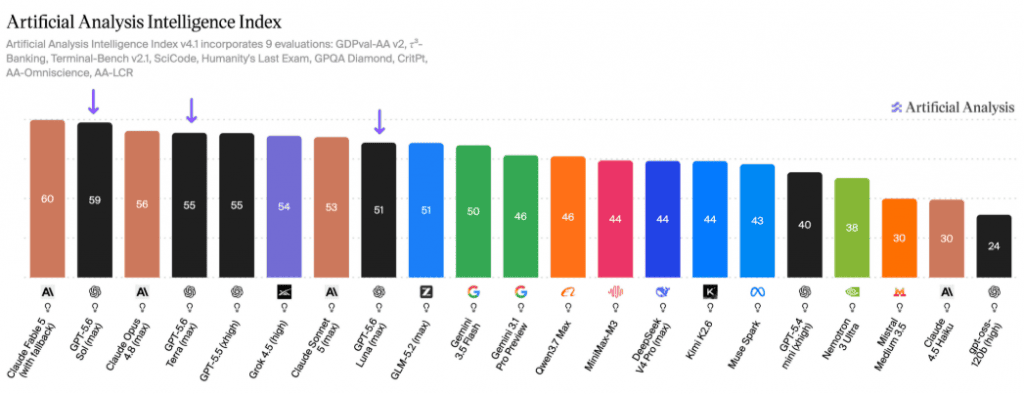
Claude Opus 4.8 sits third at 56, with GPT-5.6 Terra and GPT-5.5 tied at 55 just behind it. Terra and Luna, the two smaller members of the new GPT-5.6 family, score 55 and 51 respectively, giving OpenAI three models inside the top eight of the index. Reasoning effort turns out to matter almost as much as model choice here — Artificial Analysis notes that across every effort level, each new GPT-5.6 model pushes further along the Pareto frontier than GPT-5.5 did, and that Luna and Sol consistently beat Terra at matched cost, meaning there’s rarely a reason to pick the middle model over the other two.
The Cost Gap Is Where This Gets Interesting
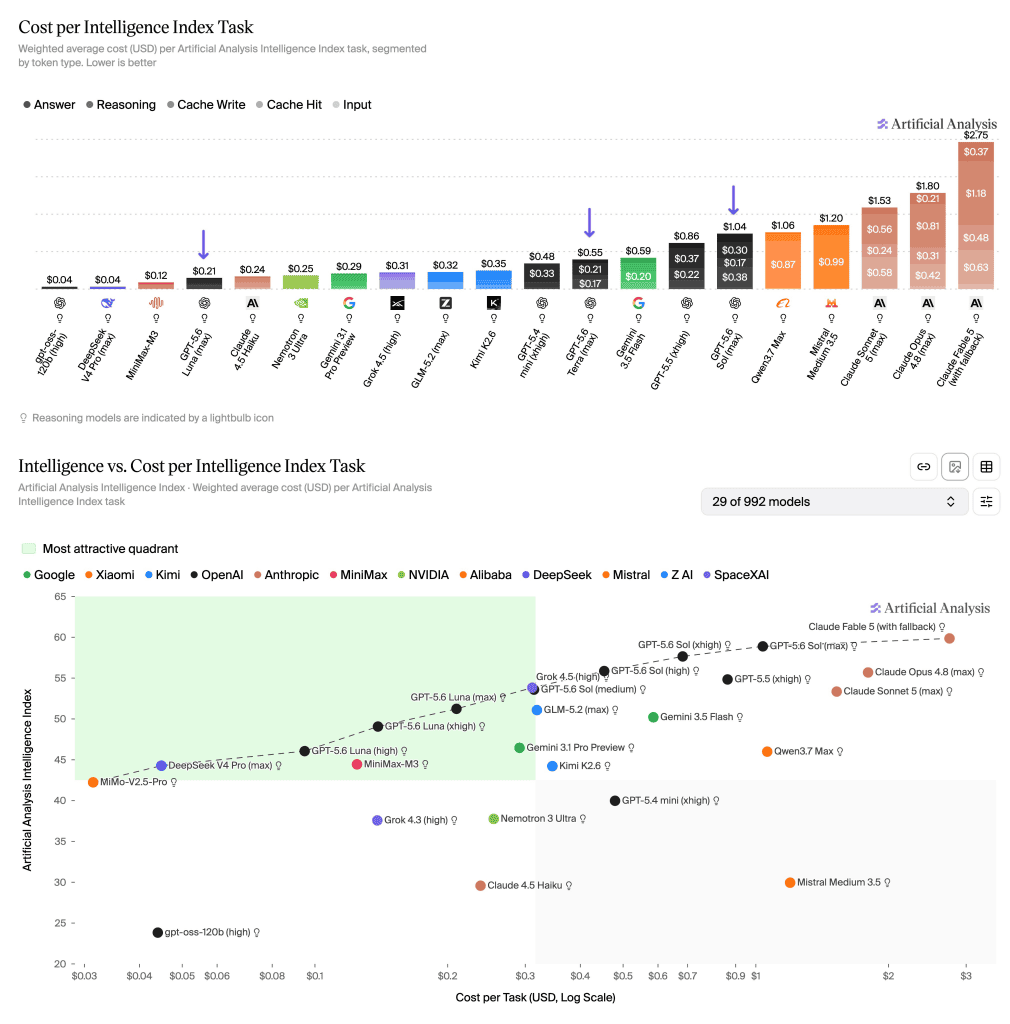
Intelligence scores this close together usually come down to price, and that’s where GPT-5.6 Sol pulls ahead decisively. Sol at max effort costs $1.04 per Intelligence Index task against Fable 5’s $2.75 — a model offering nearly identical intelligence for roughly a third of the spend. Terra costs $0.55 per task and Luna comes in at $0.21, undercutting Sol by about 50% and 80% respectively while still landing competitive scores. Artificial Analysis singles out Luna in particular, noting it matches or beats GLM-5.2 and Gemini 3.5 Flash on intelligence while costing less than either.
That pricing structure puts the entire GPT-5.6 line ahead of Fable 5 and Opus 4.8 on the Pareto frontier of intelligence versus cost. For a lab that has spent the past several months watching Chinese open-weights models chip away at the value argument for frontier pricing, that’s a meaningful shift in the conversation.
Sol Takes Coding Outright
On the Artificial Analysis Coding Agent Index, which pairs models with their native agentic harnesses and averages performance across DeepSWE, Terminal-Bench v2, and SWE-Atlas-QnA, GPT-5.6 Sol running in Codex scores 80 — the highest of any model tested, leading in all three underlying evaluations and tying Grok 4.5 on SWE-Atlas-QnA inside Grok Build. It also does this cheaper than the competition sitting just below it: Sol’s per-task cost in Codex runs about 40% below Fable 5 in Claude Code and 10% below Opus 4.8.
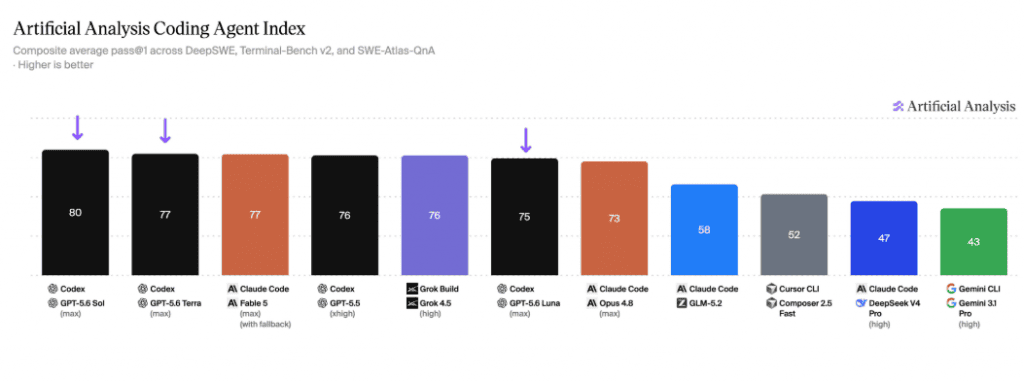
Terra and Luna land at 77 and 75 on the same index, each pulling in sharp cost reductions of roughly 60% and 80% against Sol without losing much ground on score. It’s a strong showing for a lab that had ceded coding leadership to Anthropic for much of the past year, and it arrives shortly after OpenAI’s own TerminalBench results claimed Sol had edged past Claude Mythos, Anthropic’s most restricted frontier model.
Fable Still Wins On Real Work
Where Anthropic holds firm is AA-Briefcase, Artificial Analysis’s newer benchmark built around realistic knowledge work — the kind of multi-file, multi-format deliverables that show up in actual client engagements rather than isolated coding puzzles. Fable 5 leads here largely on the strength of its Rubric Score, 56% against Sol’s 42%, and its Analytical Quality Elo comes in at 1764 versus 1592 for Sol. GPT-5.6 Sol does take second place overall on that benchmark, and Artificial Analysis credits it with the highest Presentation Elo recorded for any model so far — its slide decks and spreadsheets are, by the firm’s own account, the most visually polished output they’ve tested.
The two labs are essentially split by task type. Sol wins on raw intelligence-per-dollar and coding throughput. Fable wins on producing work that would survive a client review without heavy editing.
Pricing And Token Efficiency
GPT-5.6 also marks OpenAI’s first use of cache-write pricing, a structural change that brings it in line with how Anthropic already prices its own models. Sol, Terra, and Luna are priced at $5/$30, $2.5/$15, and $1/$6 per million input/output tokens respectively, with cache writes now costing 1.25x the standard input rate and cache reads still discounted 90%. OpenAI frames this as a more accurate reflection of what cached tokens actually cost to serve, since they occupy memory regardless of whether they get reused.
Token efficiency tells a similar story to the cost numbers. Sol at max effort uses about 15,000 tokens per Intelligence Index task, a modest improvement over GPT-5.5’s 16,000, and it does this while landing more intelligence per token than Claude Opus 4.8, GLM-5.2, and Gemini 3.5 Flash at high reasoning. Sol defines a new frontier on the intelligence-versus-output-tokens chart; Terra and Luna, running at similar token counts of 19,000, don’t quite make that same cut.
Whether a one-point gap on a nine-benchmark composite index amounts to parity or a genuine trailing position is the kind of thing reasonable people will argue about. What isn’t really up for debate is the cost line. OpenAI is now offering intelligence in the same neighborhood as Anthropic’s best model at roughly a third of the price, and that’s the number enterprise buyers are going to look at first.