OpenAI is back in the top two of the industry’s most closely watched AI leaderboard.
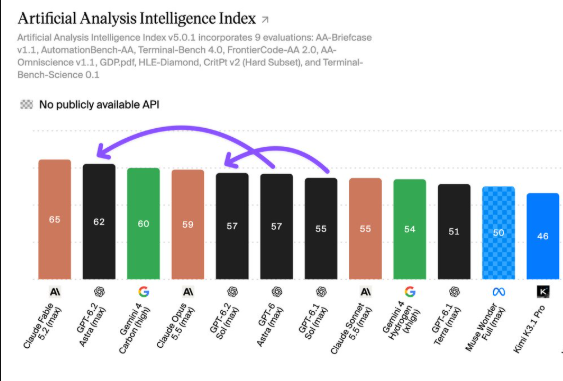
Independent benchmarking firm Artificial Analysis has published its evaluation of GPT-6.2 Astra and GPT-6.2 Sol, and the new flagship scores 62 on the Artificial Analysis Intelligence Index v5.0.1 at max reasoning effort. That puts it second overall, behind only Anthropic’s Claude Fable 5.2 at 65, and two points ahead of Google’s Gemini 4 Carbon (high), which scores 60.
It is a meaningful turnaround for OpenAI on this particular index. When GPT-6 Astra launched in September, it scored a disappointing 61 on the older version of the index, level with GPT-5.6 Sol, and it has since been overtaken by Claude Opus 5.5, Gemini 4 Carbon and Fable 5.2.
GPT-6.2 Astra Jumps 5 Points
GPT-6.2 Astra (max) improves five points on GPT-6 Astra (max), which sits at 57. That is enough to leapfrog both Gemini 4 Carbon (60) and Claude Opus 5.5 (59) at their top effort settings.
GPT-6.2 Sol (max) gains two points over GPT-6.1 Sol to reach 57, putting OpenAI’s mid-tier model level with GPT-6 Astra. Artificial Analysis says it gets there at roughly 15% of GPT-6 Astra’s cost per task.
The Intelligence Index v5.0.1 combines nine evaluations: AA-Briefcase v1.1, AutomationBench-AA, Terminal-Bench 4.0, FrontierCode-AA 2.0, AA-Omniscience v1.1, GDP.pdf, HLE-Diamond, CritPt v2 (Hard Subset) and Terminal-Bench-Science 0.1. Most of these datasets are private, a change Artificial Analysis made when it launched v5 to limit contamination.
Artificial Analysis Intelligence Index: Top 10
Further down, Meta’s Muse Wonder Full (max), which has no public API, scores 50, followed by Kimi K3.1 Pro (46), Muse Wonder (44) and Qwen4 Max (43). The best open-weight and Chinese models remain well behind the frontier labs: DeepSeek V4.1 Flash 1017 (max) scores 33, GLM-5.3 (max) 32, and Thinking Machines’ Inkling 2 Small 31.
OpenAI Dominates The Cost Frontier
The bigger story may be cost. Artificial Analysis says OpenAI models now occupy most of the Cost per Task Pareto frontier, the line of models that offer the best score for a given price. The only other labs on that frontier are Anthropic and Meta.
Read from Artificial Analysis’s chart, GPT-6.2 Astra (max) costs about $4 per Intelligence Index task. Gemini 4 Carbon (high) scores two points lower at roughly $5.50 per task, while Claude Fable 5.2 needs its xhigh setting, at around $15 per task, to land roughly level with Astra, and its max setting, at about $27 per task, to reach 65. Claude Opus 5.5 (max) costs roughly $10 per task for its 59.
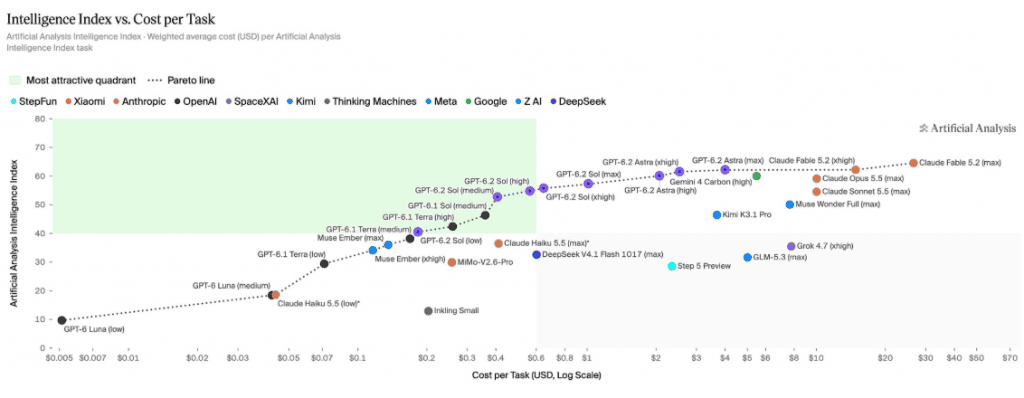
Lower effort settings look even better on price. GPT-6.2 Astra at high effort scores about 60, matching Gemini 4 Carbon’s best result at around $2 per task. GPT-6.2 Sol at high effort scores in the mid-50s for well under $1 per task.
Artificial Analysis says OpenAI dominates the Output Tokens per Task Pareto frontier as well, with Claude Fable 5.2 the only non-OpenAI model on it. That fits OpenAI’s launch pitch that the 6.2 models do more with fewer tokens.
Pricing helps too. GPT-6.2 Astra costs $8 per million input tokens and $40 per million output tokens, 20% below GPT-6 Astra, and cached input drops from $1.00 to $0.40 per million tokens. GPT-6.2 Sol keeps GPT-6.1 Sol’s $2/$10 pricing.
Strengths: Science, Knowledge, 3D and Robotics
Artificial Analysis singles out science and knowledge as OpenAI’s strongest areas:
- Terminal-Bench-Science 0.1: OpenAI leads this agentic scientific research benchmark.
- CritPt v2 (Hard Subset): OpenAI places second, behind only Claude Fable 5.2, on this research-level physics reasoning test.
- AA-Omniscience v1.1 Accuracy: GPT-6.2 Astra trails only Fable 5.2 on factual knowledge.
- HLE-Diamond: GPT-6.2 Astra again sits behind only Fable 5.2 on this reasoning and knowledge benchmark.
Outside the Intelligence Index, GPT-6.2 Astra leads AA-3D, which uses human graders to rate how well models build interactive 3D experiences. Astra scores 1,318 Elo, ahead of Claude Fable 5.2 at 1,271 and GPT-6.2 Sol at 1,259.
The OpenAI models also top AA-Robotics v0.1, a research preview that measures how well language models understand, plan and act in the real world. GPT-6.2 Astra scores 79 and GPT-6.2 Sol 78, ahead of Claude Fable 5.2 at 75. Artificial Analysis says it is adding harder tasks, since OpenAI and Anthropic models can now handle most of the basic tasks in the initial preview.
Weakness: No Gains In Coding
Coding is where the upgrade stalls. On the Artificial Analysis Coding Agent Index v2.1, which runs models through their own agent harnesses on FrontierCode-AA 2.0, Terminal-Bench 4.1 and SWE-Atlas-QnA-AA, GPT-6.2 Astra (max) in Codex scores 53, exactly level with GPT-6 Astra.
GPT-6.2 Sol actually goes backwards, slipping three points from GPT-6.1 Sol’s 52 to 49. Artificial Analysis attributes this to a 14-point drop on SWE-Atlas-QnA-AA, where the new Sol is more likely than its predecessor to leave key facts out of its answers. That is in line with OpenAI’s own launch disclosure that the 6.2 models were more likely, in some alignment tests, to omit mentioning obstacles that blocked their work.
Anthropic’s lead in agentic coding remains intact.
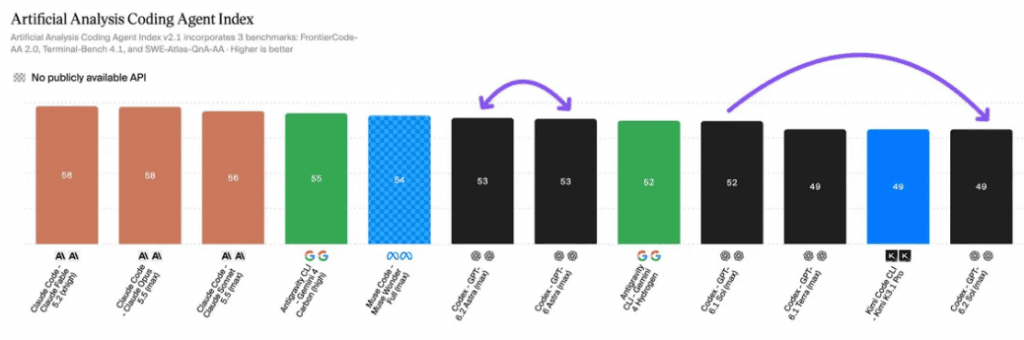
The cost picture still works in OpenAI’s favour. Going by Artificial Analysis’s chart, GPT-6.2 Astra (max) matches GPT-6 Astra’s 53 for roughly $4.80 per task, against about $7.60 for its predecessor. Several effort levels of GPT-6.2 Astra and Sol sit on the coding cost Pareto frontier. The comparison with Claude is less flattering for OpenAI, though: Claude Fable 5.2 at medium effort scores about the same as GPT-6.2 Astra (max) for under $3 per task, and Fable 5.2 at high effort reaches 58 for around $7.50.
Hallucinations Remain A Problem
Gemini 4 Carbon also still beats GPT-6.2 Astra on reliability. On the AA-Omniscience v1.1 Net Score, which rewards correct answers, penalises hallucinations and doesn’t penalise refusals, the ranking looks like this.
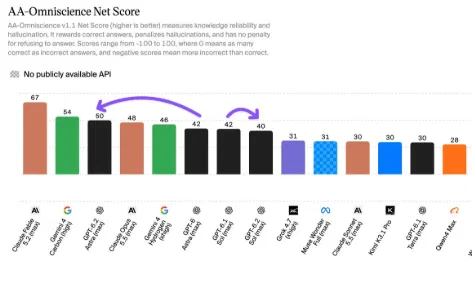
GPT-6.2 Astra gains eight points over GPT-6 Astra, but GPT-6.2 Sol slips two points below GPT-6.1 Sol. Gemini 4 Carbon, which led this benchmark when version 1.1 launched, still holds a four-point edge over Astra. Fable 5.2 has opened a big lead over the field.
So although GPT-6.2 Astra knows more facts than everything except Fable 5.2, it is more inclined to guess when it doesn’t know. Artificial Analysis measures hallucination rates of 59% for GPT-6.2 Astra and 55% for GPT-6.2 Sol at max effort. That rate is how often a model gives a wrong answer instead of declining when it doesn’t know.
What It Means
The top of the Artificial Analysis Intelligence Index has changed hands repeatedly in the past month. Gemini 4 Carbon took first place in late October, Fable 5.2 reclaimed it for Anthropic on November 9, and now GPT-6.2 Astra has pushed Carbon down to third.
OpenAI doesn’t have the top score, but it has the strongest claim on value. GPT-6.2 Astra gets within three points of Fable 5.2 at a fraction of Fable’s cost per task, and GPT-6.2 Sol delivers GPT-6 Astra-level intelligence for a few cents to a dollar per task depending on effort. For enterprises that choose models on price-performance rather than leaderboard position, that may matter more than second place.
The gaps are in coding, where Anthropic still leads clearly and the new Sol regressed, and in hallucinations, where both Fable 5.2 and Gemini 4 Carbon remain more reliable.