There had been some concerns about an AI over-buildout, but at the moment it seems that people can’t get their hands on the GPUs they want.
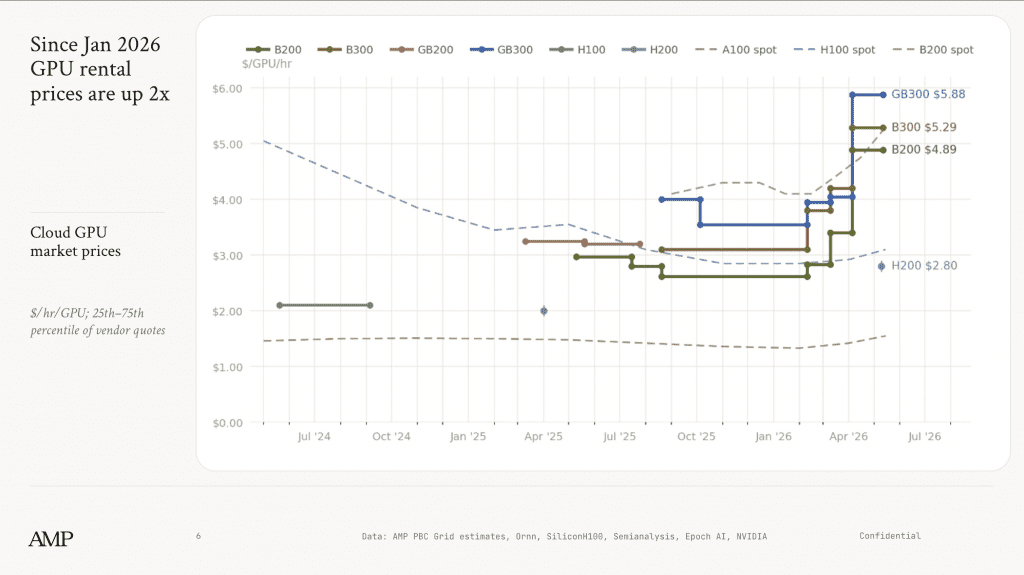
Anjney Midha, founder of AMP and formerly a partner at a16z, posted a striking chart this week that cuts through the noise: since January 2026, GPU rental prices have more than doubled. His summary was blunt — “we are living through the covid of compute, and all the toilet paper is gone.”
The data, drawn from AMP PBC Grid estimates, Ornn, SiliconH100, Semianalysis, Epoch AI, and NVIDIA, tracks cloud GPU market prices at the 25th–75th percentile of vendor quotes across a range of chips.
What The Chart Shows
The newest and most capable chips are commanding eye-watering rates. GB300s — NVIDIA’s latest Blackwell-generation hardware — are now renting at $5.88/GPU/hr. B300s are at $5.29/hr, and B200s at $4.89/hr. Even the H200, positioned as a more accessible alternative, sits at $2.80/hr.
To put this in context: the H100, the workhorse of the last AI training cycle, had spot prices hovering near $2.00/hr for much of late 2024. Rental prices for both A100s and H100s surged sharply at the start of 2026 — a structural pickup, not a blip.
The Blackwell chips barely existed on the open market a year ago. They’re now priced nearly 3x the H100’s peak spot rate, and they’re still hard to get.
Demand Is Not Theoretical
The overbuilding narrative — popularized after DeepSeek’s efficiency claims earlier in 2025 — looks increasingly shaky. The price signal here is unambiguous: demand is outpacing supply at every tier of the market.
What’s driving it? Partly training runs for next-generation frontier models, but increasingly it’s inference. AI model usage is growing at a pace that translates directly into GPU-hours consumed daily. Google Gemini’s web traffic grew 643% year-over-year in February 2026. ChatGPT, Grok, and Claude all posted triple-digit growth over the same period. Every one of those queries requires compute cycles to answer.
This is operational demand — businesses running AI in production, not just experimenting. The chips to serve it are, apparently, not sufficient.
The Infrastructure Race Isn’t Slowing
The backdrop to all this is a staggering level of capital expenditure by the hyperscalers. Big Tech is projected to collectively spend around $655 billion on AI infrastructure in 2026. Amazon alone has committed $200 billion. Google is near-doubling its spend to $180 billion. And yet, prices are still going up.
That’s the paradox: even as hundreds of billions pour into new data centers and chip procurement, the market is tightening. The build-out takes time. Data center construction has surpassed office construction in the US for the first time on record, but shovels in the ground today don’t translate to available GPU capacity tomorrow.
What This Means
For AI startups and researchers, the cost of compute has quietly become one of the defining constraints of 2026. The companies that locked in capacity early — through reserved instances or direct chip purchases — are sitting on a significant advantage. Those coming to the market now are paying a steep premium, if they can find availability at all.
For investors, the pricing data is a direct rebuke of the overbuilding thesis. Markets don’t double prices when supply is abundant.
Midha’s “toilet paper” analogy could be apt. In March 2020, people weren’t hoarding toilet paper because they needed more of it — they were hoarding it because everyone else was. The same dynamic could be playing out in compute. The fear of being caught without access is itself a driver of scarcity. Whether that resolves cleanly or badly is the open question — but for now, the GPUs are gone, and the price is whatever the market will bear.