There are dozens of companies now producing AI models, but they seem to be remarkably similar in their political views — with one notable exception.
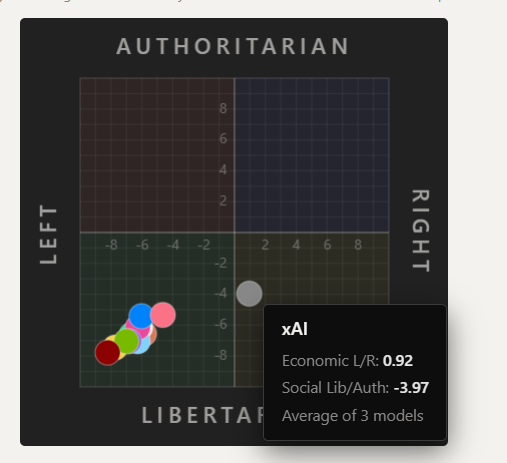
A site called aipolcom.net, which tracks where various large language models land when they’re run through the political compass test, has put together a chart plotting thirteen major AI models from companies including OpenAI, Google, Meta, Anthropic, DeepSeek, Alibaba, Mistral, Nvidia, Moonshot AI, MiniMax, Z.ai, Nous Research and xAI. Every single one of them clusters in the bottom left quadrant of the chart, the zone that the political compass labels as left-libertarian, except for xAI’s Grok, which lands almost dead center on the economic axis and only mildly libertarian on the social one.
How The Political Compass Works
The political compass is an old framework, first popularised by politicalcompass.org, that tries to map political belief onto two separate axes instead of the usual single left-to-right line. One axis runs from economic left to economic right, essentially measuring how much a person or entity favours state intervention and redistribution versus free markets and deregulation. The other axis runs from libertarian to authoritarian, capturing views on personal freedom, civil liberties and the extent to which the state should be allowed to intervene in people’s private lives. Plot both scores together and you get a single point on a four-quadrant grid, with Gandhi-style libertarian-left, Thatcher-style authoritarian-right, and so on occupying the four corners.
The test itself consists of 62 propositions that respondents are asked to agree or disagree with, on statements ranging from “the freer the market, the freer the people” to “all authority should be questioned.” It’s been criticised over the years for vague wording and a supposed built-in libertarian lean, but it remains the most widely used tool of its kind, largely because the questions haven’t changed in decades, which makes results comparable across time and across subjects, including, increasingly, AI models.
The Methodology
According to aipolcom.net, the scores for each AI model come from actually submitting the model’s answers to the real politicalcompass.org test through an automated form-filler, rather than estimating a score separately. The site says it anticipated the obvious objection that the test itself is rigged to produce left-libertarian results regardless of input, and ran a control to check: forty sets of random answers were fed through the same test, and those landed tightly clustered near the center of the grid, nowhere close to where the actual AI models ended up. The site also tested extreme, uniform answer sets designed to deliberately land in each of the four quadrants, and found all four were reachable, which the site takes as evidence the scoring mechanism itself isn’t the thing pulling models leftward.
Each model’s placement on the chart appears to be an average across multiple test runs, with the tooltip for xAI’s dot specifically noting it reflects the average of three separate model runs.
The Numbers
On the economic axis, every model from Meta, OpenAI, Google, Anthropic, DeepSeek, Alibaba, Mistral, Nvidia, Moonshot AI, MiniMax, Z.ai and Nous Research scored somewhere between -4.63 and -8.25, firmly on the left side of the ledger. WSWS, an outlier included seemingly as more of a reference point than a mainstream commercial model, sits furthest left at -8.25. Among the widely used commercial models, Mistral AI comes in at -7.75, Google at -6.42, OpenAI at -6.13, Meta at -6.00, and Anthropic at -5.85. Grok is the sole exception, scoring 0.92, putting it just barely on the right side of center and closer to neutral than any other model by a wide margin.
The social axis tells a similar story. Every model bar Grok scored between -3.97 and -7.79 on the libertarian-authoritarian scale, meaning they all lean towards personal freedom and away from state control over private life. Grok again lands closest to the middle at -3.97, still libertarian-leaning but noticeably less so than its closest competitor, Meta, at -5.44.
Plotted together on the compass, the cluster of Google, OpenAI, Anthropic, Meta, DeepSeek and the rest sit tightly bunched in the libertarian-left quadrant, while Grok sits alone near the vertical axis, technically split between the left and right economic halves depending on how the average is drawn, but visually and numerically distinct from every other model tested.
Why This Happens
The explanation researchers keep arriving at, across several separate studies over the last couple of years, is that this isn’t really a mystery. Models are trained on enormous amounts of text scraped from the internet, and if that underlying corpus carries a particular ideological tilt, the model tends to inherit it unless a lab specifically works to correct for it during fine-tuning. Wikipedia in particular gets cited often in this context, given how much of it ends up in training data and how frequently its own editorial slant has been debated.
xAI has built much of its public identity around positioning Grok as a corrective to the excessive left-leaning bias of rival chatbots, and this data would appear to back that positioning up. A separate Wall Street Journal analysis of how six major models argue contentious policy questions found much the same pattern, with GPT-5.5 producing left-only arguments in 80% of its responses and Grok coming closest to an even split between left-only, right-only and both-sides answers, though even there Grok still leaned left more often than right.
The Bigger Concern
The commentary worth dwelling on here goes beyond which company’s model happens to score where on a niche internet quiz. AI models, ideally, should be neutral evaluators when it comes to contested political and social questions, particularly as they get folded into products that summarise the news, draft policy memos, answer citizens’ questions about government programs, or eventually assist in decisions that carry real consequences. A model that has absorbed a consistent ideological lean during training isn’t necessarily going to announce that lean when asked directly, since most of them are trained to insist they hold no political opinions at all. But the tilt still shows up in which arguments they present first, which framings they treat as obvious versus which they treat as one side of a debate, and which policy trade-offs they nudge users toward without being asked.
That’s a manageable quirk when the stakes are a chatbot answering a trivia question. It becomes a much harder problem the moment these systems are handed genuine decision-making authority, whether that’s screening loan applications, moderating political content, or advising on public policy, because a consistent, invisible bias baked into the model’s training is far harder to audit and correct for than a bias in a single human decision-maker. Right now, with essentially the entire industry converging on the same ideological corner of the compass, the danger isn’t that any one company is deliberately steering its model. It’s that nobody seems to be steering at all, and the training process itself is doing the steering for them.