AI isn’t only helping highly-paid white-collar employees improve their productivity — it’s helping those out in lower-paying roles too.
A new study by Anthropic, based on survey responses from 81,000 Claude users, finds that productivity gains from AI aren’t evenly distributed across the workforce — they follow a U-shaped curve, with both the highest- and lowest-paid workers reporting the largest benefits.
The Numbers
Anthropic used Claude itself to rate respondents’ self-reported productivity gains on a 1–7 scale, where 2 represents no change and 7 represents transformational improvement. The mean score came in at 5.1 — “substantially more productive.” Only 3% reported negative or neutral impacts.
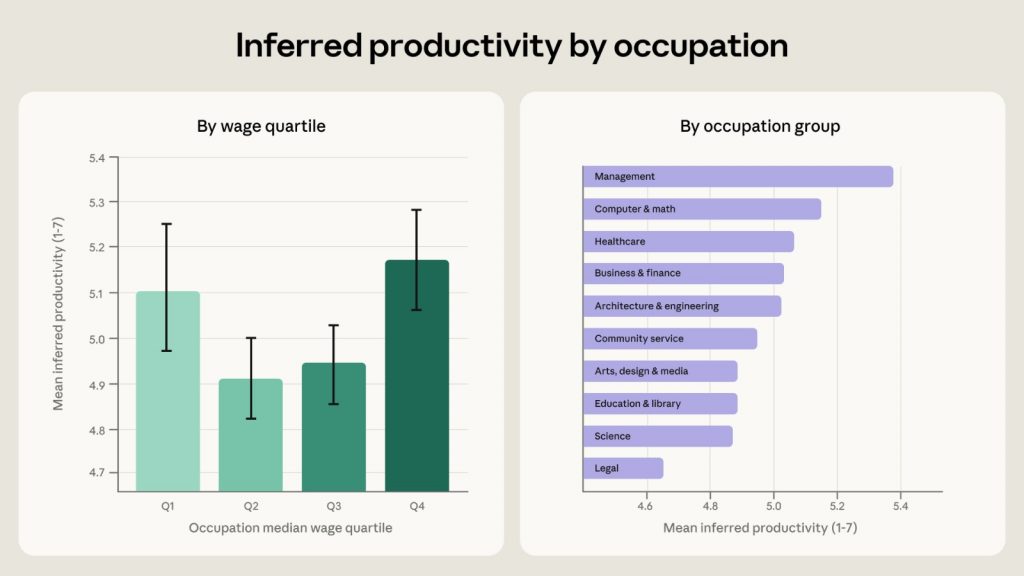
By occupation group, management workers scored highest (≈5.35), followed by computer & math (≈5.3) and healthcare (≈5.2). Legal workers scored the lowest among the groups surveyed, at around 4.65.
The wage-quartile breakdown is where the story gets interesting. Workers in the top quartile (Q4) reported the highest mean productivity gain — roughly 5.17 — but Q1 (the lowest-paid) came in at 5.10, ahead of both Q2 (4.91) and Q3 (4.94). AI disrupting white-collar jobs first was the prevailing assumption, but the data complicates that narrative.
Why High-Wage Workers Benefit Most — But Not Only
The result for top earners is consistent with earlier Anthropic findings: in tasks requiring higher education levels, Claude tends to reduce completion time by a greater percentage. A software developer compressing months of web development into days scores a 7; a manager automating report synthesis scores a 5.
But the productivity gains at the bottom of the income ladder are harder to explain away as a simple coding-adjacent effect. Anthropic notes that the Q1 result holds even when computer and math occupations are excluded.
Blue-Collar Workers Using AI for More Than Their Day Jobs
Some of the most striking anecdotes in the study involve lower-wage workers using AI not to improve their current role — but to build a second one. A delivery driver used Claude to launch an e-commerce business. A landscaper was building a music application.
This points to something the productivity discourse often misses: AI is creating new opportunities and roles, not just making existing ones faster. For workers whose primary jobs offer little room for technological leverage, AI is functioning as an equalizer for side projects and entrepreneurial ventures.
Even within their core roles, lower-wage workers are finding applications. One customer service representative described using AI to dramatically speed up drafting responses — a repetitive, high-volume task where AI compounds over thousands of interactions.
The Caveat
The study’s sample — active Claude users willing to complete a survey — skews toward people already extracting value from AI. Anthropic acknowledges this. The 42% who gave no clear indication on productivity, and the 3% who reported neutral or negative impact, are a reminder that adoption and benefit aren’t universal.
Still, the study is one of the largest real-world productivity datasets on AI to date, and the U-shaped pattern across wage quartiles is notable. JP Morgan CEO Jamie Dimon has predicted a four-hour workday driven by AI — that vision is considerably more plausible if the productivity gains are as broad-based as Anthropic’s data suggests.
Whether AI ultimately compresses the wage gap or widens it remains an open question. But the early evidence suggests its benefits are less confined to the corner office than the conventional wisdom assumed.