On May 13, 2026, New York-based short seller Culper Research published a 40-page report titled “NVIDIA (NVDA): The China Problem.” Nvidia’s stock rose about 3% that day, and the market largely shrugged. Six months later, the report reads very differently.
On November 8, Nvidia’s board launched an independent investigation into reports that CEO Jensen Huang had been targeted by a Chinese intelligence operation, and Huang admitted to employees in a memo that he had been unfaithful to his wife. The woman at the centre of the reporting is Alice Huang (also known as Huang Le), a senior executive at Megaspeed, a Singapore-based Nvidia customer that Culper had put at the heart of its short thesis.
Culper’s report did not allege an affair, and it did not allege espionage. But it did single out Huang’s relationship with Alice Huang as “uncomfortably close,” and it built a much larger argument around the company she was linked to. Here’s what the report said, how it was structured, and how much of it has since been borne out, disputed or left unproven.
The short seller’s pitch
Culper opened with a disclaimer that it was not betting against AI. Its one stated reason for shorting Nvidia was that the company has “a significant China problem.”
The core claim: after the U.S. tightened export restrictions in April 2025, Nvidia told investors its China data-centre business had gone to zero. Culper argued that more than 20% of Nvidia’s FY2026 compute revenue was still being driven by Chinese demand, routed through Southeast Asian intermediaries and illegal diversion. It also argued that this exposure was now collapsing as Beijing itself blocks Nvidia, leaving a hole in analysts’ forward estimates.
As a short seller, Culper disclosed that it stood to profit if Nvidia’s stock fell, and its report leaned heavily on anonymous sources, including former Nvidia and Supermicro employees and a current Megaspeed employee. Keep that in mind throughout.
The Jensen Huang and Alice Huang section
This was a smaller part of the report, but it’s the part that now draws the most attention. Culper began with two sightings. In June 2024, Huang was photographed partying with Alice Huang in Taipei around Computex, and Culper noted that New York Times reporting at the time described her saying she could get Huang to show up, after which he arrived. That was the same month, Culper said, that a Megaspeed subsidiary pledged its assets to an Alibaba-owned entity. In May 2025, weeks after the U.S. trade restrictions, Huang was filmed dining in Taiwan with Alice Huang and a Hong Kong business executive. Culper pointed to a moment in the footage where she seemed to hang back from reporters, which it read as reluctance to be seen with him once export controls tightened. That was an interpretation of a video, not evidence of anything.
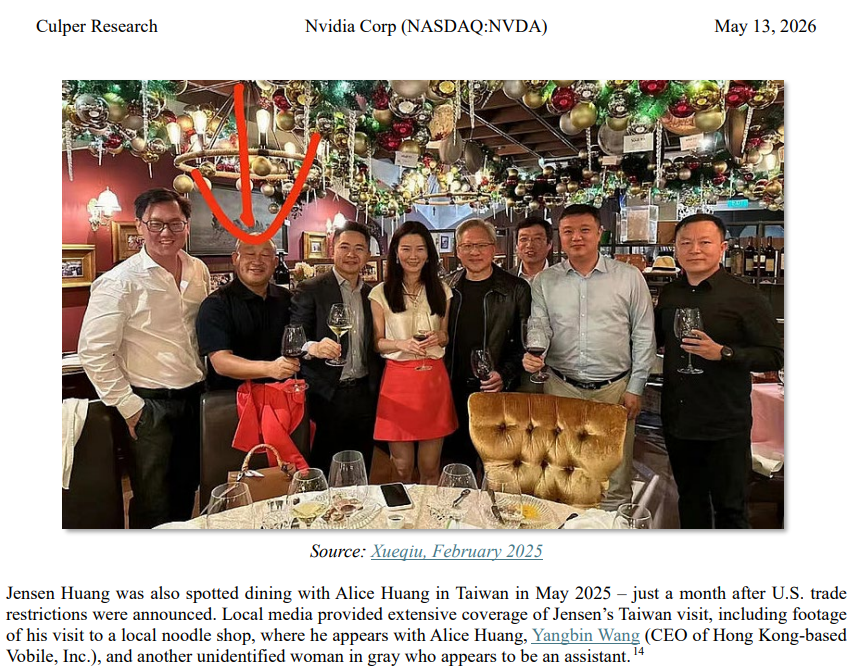

Culper then leaned on its anonymous sources. A current Megaspeed employee told it that Alice Huang, whom Bloomberg and the New York Times had reported as having left the company, was still effectively “our boss” and one of the top three people there. The same employee claimed Huang visits Megaspeed-linked data centres every few months and that Alibaba representatives show up around each visit. A former Nvidia employee said colleagues wondered whether Megaspeed had a special relationship with Huang. Culper’s conclusion was blunt: it didn’t believe Huang could plausibly claim ignorance of what was happening in Nvidia’s channel, and its heading asked whether he was “an idiot” or “in on it.”
The full bear case
Culper’s argument starts from a gap between what Nvidia says and what the data show. Huang said in October 2025 that Nvidia was “100% out of China,” yet a former Nvidia director told Culper that 20% to 40% of its data-centre business stayed functionally Chinese. Culper also pointed to third-party figures: the Financial Times put total Chinese AI chip supply from domestic makers at roughly $12 billion to $13 billion in 2025, against a market Nvidia’s own leadership has described as worth $50 billion, and IDC data suggested Nvidia shipped about 2.2 million cards in China, far more than Nvidia’s disclosed H20 sales would support. Because Nvidia reports revenue by the headquarters of its customers, who are OEMs and channel partners rather than end users, a California server maker shipping to a Malaysian buyer would show up as a U.S. sale. Culper also flagged that Nvidia changed its geographic reporting in late 2025, which removed what had been reported as Singapore revenue, a figure that had grown from 8.5% to about 20% of sales and was drawing scrutiny as a possible diversion hub. Nvidia has said over 99% of that revenue was tied to U.S. customers and that the new method better reflects its geography.
The centrepiece is Megaspeed, described as Nvidia’s largest Southeast Asian chip buyer and a 2023 spin-out of Chinese gaming firm 7Road. Its Singapore balance sheet grew from about $33 million at the end of 2023 to about $3.0 billion a year later, driven by $2.9 billion in “refundable deposits” from an unnamed source that was passed down to subsidiaries such as Malaysia’s Speedmatrix. On June 18, 2024, two months before Speedmatrix says it began operations, it pledged its assets to Apex Enterprise Solutions (Singapore), whose ultimate parent Singapore filings show to be Alibaba Group. As of March 2025, Apex reported about $4.15 billion in prepayments and about $4.2 billion in loans from related companies, both up more than tenfold. Culper suggested that Alibaba money may have flowed through Apex to Megaspeed and then to Speedmatrix to buy Nvidia-powered servers, which is inference from filings, not a documented transfer. It also noted that Nvidia’s assurance that Megaspeed has no Chinese shareholders speaks to equity, not financing. Speedmatrix then imported $4.6 billion of product from December 2024 to January 2026, $4.0 billion of it from Nvidia Elite partner Aivres, which is about one-third owned by the Chinese state through Inspur, the firm whose U.S. entity-list listing led to the rebrand. Gigabyte’s Giga Computing shipped another $511 million, mostly to Speedmatrix and to Novagate Cloud, a company Culper said looks like a Megaspeed offshoot, with a near-identical website, a director sharing Megaspeed’s address and a Malaysian entity formed two days after the April 2025 restrictions. Culper tied the same network to OBON, the firm that Bloomberg identified as “Company-1” in the March 2026 indictment of Supermicro co-founder Wally Liaw and two others over about $2.5 billion in alleged smuggling, and quoted a former Nvidia employee calling Megaspeed “the tip of the iceberg.” It also relayed a source’s claim that Bain’s Bridge Data Centres dropped Megaspeed in April 2026 after finding “dummy servers,” although Bloomberg said the company gave no reason.
Finally, Culper argued that Nvidia could have seen all this, because former employees described pre-sale red flags such as new customers placing huge orders, and post-sale signals such as software-update IP addresses and servers going dark. It also argued that China is a downside risk and not the upside many analysts assume. Beijing has since late 2025 pursued an antitrust case against Nvidia, customs crackdowns, a ban on foreign AI chips in state-funded data centres and reported blocks on H200 shipments, and mainland operators told Culper there were “very few orders.” Culper’s conclusion was that revenue that never really went to zero is now actually going to zero, leaving a “massive air gap” in forward estimates.
What Culper did not claim
It’s worth being clear about the limits of the report. It did not say Huang had a romantic relationship with Alice Huang, and it did not say she was a spy or had any link to Chinese intelligence. It also did not prove that Alibaba financed Megaspeed or that Nvidia knowingly sold to Chinese end users, because those were inferences from filings and anonymous sources. Nvidia has said Megaspeed was investigated and no diversion was found, and Megaspeed has not been charged with anything.
What has happened since
- The stock. According to a Protos analysis in August, apart from one day right after the report, Nvidia’s stock never closed higher than its May 13 close. The week before the report, the stock had rallied 13%.
- July 2026. Taiwanese prosecutors searched the home and workplace of an Nvidia employee suspected of smuggling restricted chips to China, according to Bloomberg and other outlets.
- October 29. The New York Times reported that U.S. intelligence agencies believed Alice Huang was passing information to Beijing and that Jensen Huang was a potential target. It said a Megaspeed-linked company in Malaysia had bought at least $4.8 billion of Nvidia equipment between June 2024 and February 2026. Nvidia said Huang’s dealings with Megaspeed were normal and that it had checked there was no diversion.
- November 5 to 7. Three House Republican committee chairs asked Huang for a closed-door briefing on November 18. The Financial Times reported that a U.S. intelligence-based memo said Huang had been romantically involved with Alice Huang and that she had been tasked with pushing him to advocate looser export curbs, a position he has publicly argued for.
- November 8. Nvidia’s board said it had no reason to believe national security or company secrets were compromised and that it has confidence in Huang. It said independent directors with outside counsel will run the investigation. Huang’s memo apologised for being unfaithful to his wife. Elon Musk has since backed Huang as irreplaceable for American AI leadership.
The New York Times reporting did not establish that Jensen Huang knew of any alleged intelligence activity. Beijing has denied it was running Alice Huang as an asset, and Megaspeed has hired outside counsel for its own internal investigation.
So was Culper right?
On the specific question of Huang and Alice Huang, Culper noticed a relationship that Nvidia had been describing as ordinary, flagged the timing, and said it was closer than it looked. That has now been confirmed by Huang’s own memo, though the espionage dimension remains an allegation from U.S. officials, not a finding.
On the broader thesis, the picture is mixed. Megaspeed is under scrutiny from U.S. and Singapore authorities, the Supermicro case showed that diversion at scale was real, and the congressional and board investigations have put Nvidia’s channel controls in the spotlight. But the central financial claims, that Alibaba funded Megaspeed through shell companies and that more than 20% of Nvidia’s FY2026 compute revenue was Chinese-driven, remain unproven and unconfirmed by any regulator. Nvidia’s board investigation, and the November 18 briefing Congress has requested, are the next things to watch.