While OpenAI’s latest math proofs aren’t immediately comprehensible to the vast majority of humans, they could soon end up being used to train AI models.
Hugging Face has converted a batch of OpenAI’s formal math problems into open-source reinforcement learning environments, giving anyone who wants to train their own AI models a ready-made, executable math benchmark to work with.
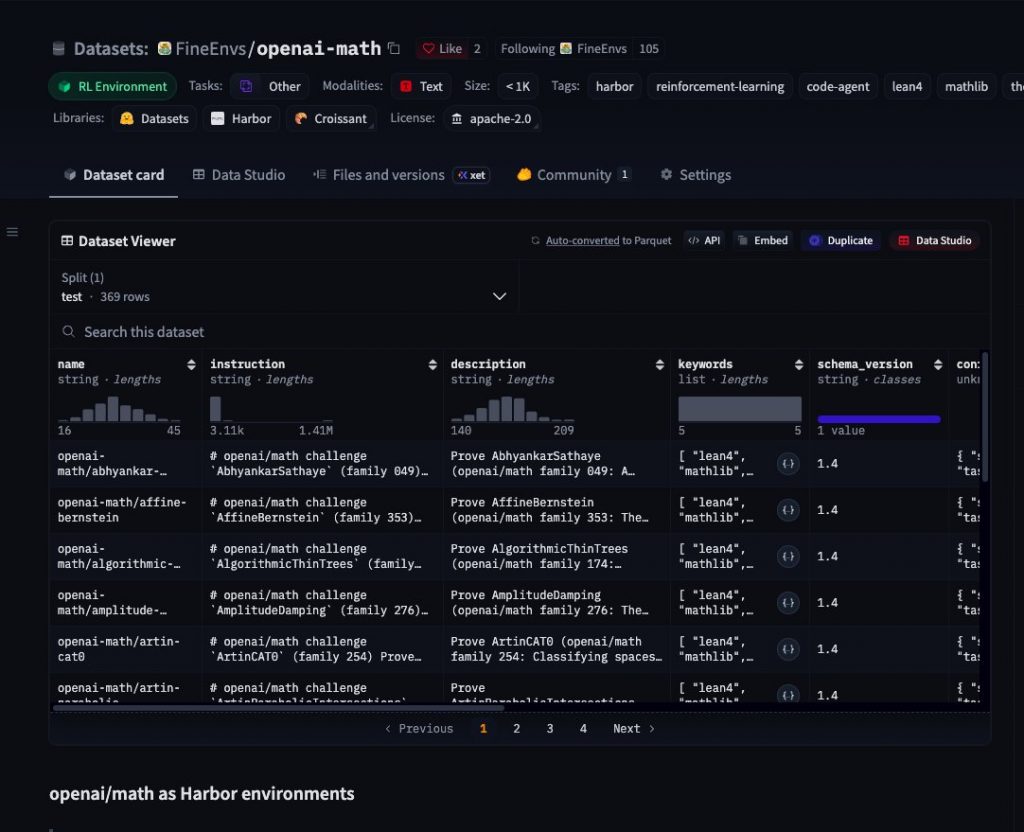
The new dataset, openai-math, was released under Hugging Face’s FineEnvs initiative and contains 369 test-split entries drawn from OpenAI’s Lean 4 formalizations, each one packaged as a runnable RL environment rather than a static question-answer pair. Every entry comes with an instruction, a description of the underlying proof challenge, and metadata such as keywords and a schema version, structured so that a model’s attempt at a proof can be automatically graded instead of judged by a human.
Hugging Face co-founder and CEO Clem Delangue announced the release on X, framing it as a step toward turning closed research drops into shared training infrastructure. In his words, the project takes a research release and makes it “executable training infrastructure for everyone,” and he called the broader approach of converting open research into open, buildable environments an important direction for training better open models. He also flagged a significant limitation upfront: the automated verifier only accepts the exact original formalization of a proof, so a mathematically valid but differently structured proof can still score zero. Delangue described the release as “early and rough” rather than a finished benchmark.
The dataset sits in Hugging Face’s RL Environment category and lists tags including harbor, reinforcement-learning, code-agent, lean4, and mathlib, pointing to the toolchain it’s built on. Lean 4 is a formal proof assistant, and mathlib is its large community-maintained library of formalized mathematics, the same ecosystem that has become a popular testbed for checking whether an AI-generated proof is actually correct rather than just plausible-sounding. Problems in the set carry names like AbhyankarSathaye, AffineBernstein, and ArtinCAT0, reflecting the kind of advanced, research-level mathematics OpenAI had originally formalized.
Packaging the problems as Harbor-compatible RL environments matters because it changes what a developer can do with them. A static dataset of problems and solutions is useful for evaluation, but it doesn’t train a model on its own. An RL environment, on the other hand, can be plugged directly into a training loop: a model proposes a proof, the Lean verifier checks it, and the pass or fail signal is fed back as a reward. That loop is the same basic mechanism behind the reasoning gains labs have reported from reinforcement learning on verifiable tasks like math and code, and Hugging Face’s release effectively open-sources the scaffolding for doing that specific kind of training on OpenAI’s math set, rather than just the problems themselves.
The move fits a pattern of AI labs and researchers increasingly treating formal mathematics as a high-value proving ground, in part because machine-checkable proofs give a clean, unambiguous reward signal that’s hard to game. It also lands at a moment when the mathematics community itself is actively debating what role AI should play in the field. Fields medalist Terence Tao recently argued that mathematics is approaching a “Math 2.0” moment in which the discipline will need to move beyond pure problem-solving as AI tools get better at exactly that task, a tension that releases like this one, which directly reward AI systems for solving formal proofs, sit right in the middle of.
For now, the openai-math environments remain a rough first cut, with the strict verifier issue being the most obvious gap for the community to fix. But as an early example of a frontier lab’s internal math tooling being rebuilt as something any developer can clone, inspect, and train against, it is a notable test case for whether “open research” can translate into genuinely open, reusable training pipelines rather than one-off benchmark papers.